Cerulean Warbler

Cerulean Warbler

Setophaga cerulea

Silhouette: Dylan GE Gomes · PhyloPic

LCNTNear ThreatenedVUENCR
Daily sighting probability <5% · Rare
at Bogota

In 3 days <5%

30 Verified sightings at Bogota
1,934 In all 22 parks From 2019 to 2026
September Best month
☀️ Diurnal When it's spotted

About the Cerulean Warbler

The cerulean warbler (Setophaga cerulea) is a small songbird in the family Parulidae. It is a long-distance migrant, breeding in eastern North American hardwood forests and wintering on the Eastern slope of the Andes in South America during non-breeding season, preferring subtropical forests.

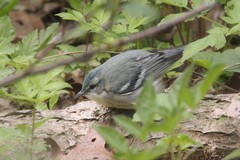
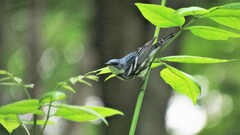
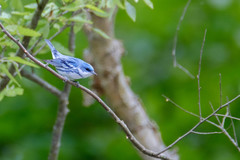
It displays strong sexual dichromatism: Adult males have cerulean blue and white upperparts, with a black necklace across the breast and black streaks on the back and flanks. Females and immature birds have bluish-green upperparts, a pale stripe over the eye, no streaking, and are yellow below. All have two white wing bars and a thin, pointed bill.

The cerulean warbler is insectivorous and predominantly feeds on insect larvae, though it also comsumes winged insects. It forages for prey and nests high in forest canopies. Individuals are strongly territorial; males will defend areas of forests. Males arrive on breeding grounds about one to two weeks earlier than females. Breeding and incubation take place from late May to early June.

The species is rated as near threatened on the International Union for Conservation of Nature (IUCN)'s Red List of endangered species, indicating it is under risk of becoming vulnerable in the near future. The population of the cerulean warbler has been under rapid decline, though in recent years this decline has slowed. Deforestation in its non-breeding range continues to reduce its available habitat. Wikipedia →

Sounds

Song1:09

United States · 2025

© Bobby Wilcox · XC1038381 · CC BY-NC-SA 4.0

Alarm call0:15

United States · 2024

© Oscar Gordo · XC924428 · CC BY-NC-SA 4.0

Call0:15

United States · 2016

© Matt Wistrand · XC420726 · CC BY-NC-SA 4.0

Global Distribution

Parks Where Found

# Park Country Daily sighting probability
1 Shenandoah National Park 🇺🇸 United States
~10%
2 Point Pelee National Park 🇨🇦 Canada
<5%
3 Henri Pittier National Park 🇻🇪 Venezuela
<5%
4 Great Smoky Mountains National Park 🇺🇸 United States
<5%
5 Chagres National Park 🇵🇦 Panama
<5%
6 Sierra de la Macarena National Park 🇨🇴 Colombia
<5%
7 Chingaza National Natural Park 🇨🇴 Colombia
<5%
8 Soberanía National Park 🇵🇦 Panama
<5%
9 Farallones de Cali National Natural Park 🇨🇴 Colombia
<5%
10 Bastimentos Island National Marine Park 🇵🇦 Panama
<5%
11 Cahuita National Park 🇨🇷 Costa Rica
<5%
12 La Amistad International Park (Panama) 🇵🇦 Panama
<5%
13 Gandoca-Manzanillo Wildlife Refuge 🇨🇷 Costa Rica
<5%
14 Arenal Volcano National Park 🇨🇷 Costa Rica
<5%
15 Los Nevados National Natural Park 🇨🇴 Colombia
<5%
16 Poás Volcano National Park 🇨🇷 Costa Rica
<5%
17 Monteverde Cloud Forest Reserve 🇨🇷 Costa Rica
<5%
18 Tenorio Volcano National Park 🇨🇷 Costa Rica
<5%
19 Parque Natural Metropolitano 🇵🇦 Panama
<5%
20 Braulio Carrillo National Park 🇨🇷 Costa Rica
<5%
21 Merritt Island National Wildlife Refuge 🇺🇸 United States
<5%
22 Tapantí-Macizo de la Muerte National Park 🇨🇷 Costa Rica
<5%

Cities Where Found

# City Country Daily sighting probability
1 Toronto 🇨🇦 Canada
<5%
2 Houston 🇺🇸 United States
<5%
3 Bogota 🇨🇴 Colombia
<5%
4 Chicago 🇺🇸 United States
<5%
5 Havana 🇨🇺 Cuba
<5%
6 Medellín 🇨🇴 Colombia
<5%
7 New York City 🇺🇸 United States
<5%
8 Austin 🇺🇸 United States
<5%
9 San José 🇨🇷 Costa Rica
<5%
10 Miami 🇺🇸 United States
<5%

Before you go

What are the chances of seeing a Cerulean Warbler in Bogota?

Rare

Under 5% of wildlife watchers report a Cerulean Warbler sighting in Bogota on a given day, based on 30 verified sightings from GBIF citizen-science data. It is the 157th most-seen of the 231 birds we can rate there. Over three days the chance rises to under 5%, if each day is a fresh chance.

When is the best time to see a Cerulean Warbler in Bogota?

Any time of year

In every month with enough records, under 5% of wildlife watchers report a Cerulean Warbler in Bogota on a given day, so our monthly data shows no clear season.

What time of day is best to see a Cerulean Warbler?

Between 8 and 11 am

Across all the parks we cover, that three-hour window holds the most Cerulean Warbler sightings with a recorded time, and about 9 in 10 of them come between 6 am and 6 pm: it is a daytime animal.

Is Bogota the best place to see a Cerulean Warbler?

Among the best

Of the 14 cities where we can rate Cerulean Warbler sightings, Bogota ranks 3rd at under 5%, level with the leaders once rounded. The best odds are in Toronto (Canada, under 5%) and Houston (United States, under 5%).

Which relatives of the Cerulean Warbler live in Bogota?

Same genus: Setophaga

The closest relatives of the Cerulean Warbler that you can see in Bogota (genus Setophaga, Setophaga Warblers) are Blackburnian Warbler (about 20%), Yellow Warbler (about 10%) and Northern Yellow Warbler (about 10%), with each one's daily chance of a sighting.

Where does the Cerulean Warbler sighting chance come from?

GBIF citizen-science records

It is estimated from how often the Cerulean Warbler is recorded against all the birds logged in Bogota (30 verified sightings), calibrated against known sighting rates. Figures are rounded to the nearest 10% because citizen-science data supports honest approximations, not decimals, and months with records from fewer than five people show "—". How it works.

← Back to Bogota