Palmnut Vulture

Palmnut Vulture

Gypohierax angolensis

Silhouette: Kai Caspar · PhyloPic

LCLeast ConcernNTVUENCR
Daily sighting probability ~10% · With luck
at Freetown

In 3 days ~30% in a week ~50%

10 Verified sightings at Freetown
3,375 In all 29 parks From 2019 to 2026
January Best month
☀️ Diurnal When it's spotted

About the Palmnut Vulture

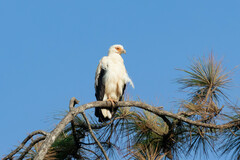
The palm-nut vulture (Gypohierax angolensis) or vulturine fish eagle, is a large bird of prey in the family Accipitridae (which also includes many other diurnal raptors such as kites, buzzards and harriers, vultures, and eagles). It is the only member of the genus Gypohierax.

This bird is an Old World vulture (only distantly related to the New World vultures, which are in a separate family, the Cathartidae). It breeds in forest and savannah across sub-Saharan Africa, usually near water, its range coinciding with that of the oil and Raffia palms. It is quite approachable, like many African vultures, and can be seen near habitation, even on large hotel lawns in the tourist areas of countries such as the Gambia.

The palm-nut vulture was formally described in 1788 by the German naturalist Johann Friedrich Gmelin in his revised and expanded edition of Carl Linnaeus's Systema Naturae. He placed it with the eagles, hawks and falcons in the genus Falco and coined the binomial name Falco angolensis. Gmelin based his description on the "Angola vulture" that had been described in 1781 by the English ornithologist John Latham in his multi-volume work A General Synopsis of Birds.... Wikipedia →

Sounds

Call0:27

Uganda · 2023

© Brendan Sloan · XC825931 · CC BY-NC-ND 4.0

Song0:56

Tanzania · 2021

© Louis A. Hansen · XC633973 · CC BY-NC-SA 4.0

Global Distribution

Parks Where Found

# Park Country Daily sighting probability
1 Semuliki National Park 🇺🇬 Uganda
~70%
2 Odzala-Kokoua National Park 🇨🇬 Republic of the Congo
~60%
3 Queen Elizabeth National Park 🇺🇬 Uganda
~50%
4 Murchison Falls National Park 🇺🇬 Uganda
~40%
5 Niokolo-Koba National Park 🇸🇳 Senegal
~40%
6 Liwonde National Park 🇲🇼 Malawi
~30%
7 Taï National Park 🇨🇮 Ivory Coast
~30%
8 Meru National Park 🇰🇪 Kenya
~20%
9 Akagera National Park 🇷🇼 Rwanda
~20%
10 Mikumi National Park 🇹🇿 Tanzania
~20%
11 Virunga National Park 🇨🇩 Democratic Republic of the Congo
~20%
12 Lake Manyara National Park 🇹🇿 Tanzania
~20%
13 Kibale National Park 🇺🇬 Uganda
~10%
14 Lake Mburo National Park 🇺🇬 Uganda
~10%
15 Arusha National Park 🇹🇿 Tanzania
~10%
16 Mkomazi National Park 🇹🇿 Tanzania
~10%
17 Gorongosa National Park 🇲🇿 Mozambique
~10%
18 Tsavo West National Park 🇰🇪 Kenya
<5%
19 Ruaha National Park 🇹🇿 Tanzania
<5%
20 iSimangaliso Wetland Park 🇿🇦 South Africa
<5%
21 Samburu National Reserve 🇰🇪 Kenya
<5%
22 Bwindi Impenetrable National Park 🇺🇬 Uganda
<5%
23 Tarangire National Park 🇹🇿 Tanzania
<5%
24 Tsavo East National Park 🇰🇪 Kenya
<5%
25 Nairobi National Park 🇰🇪 Kenya
<5%
26 Serengeti National Park 🇹🇿 Tanzania
<5%
27 Ngorongoro Conservation Area 🇹🇿 Tanzania
<5%
28 Amboseli National Park 🇰🇪 Kenya
<5%
29 Masai Mara National Reserve 🇰🇪 Kenya
<5%

Cities Where Found

# City Country Daily sighting probability
1 Kampala 🇺🇬 Uganda
~40%
2 Kigali 🇷🇼 Rwanda
~30%
3 Mombasa 🇰🇪 Kenya
~30%
4 Dar es-Salaam 🇹🇿 Tanzania
~20%
5 Bujumbura 🇧🇮 Burundi
~10%
6 Serrekunda 🇬🇲 Gambia
~10%
7 Lagos 🇳🇬 Nigeria
~10%
8 Freetown 🇸🇱 Sierra Leone
~10%
9 Monrovia 🇱🇷 Liberia
~10%
10 Durban 🇿🇦 South Africa
~10%

Zoos & Centres Where Found

# Zoo / Centre Country
1 Pairi Daiza 🇧🇪 Belgium In captivity
2 ZooParc de Beauval 🇫🇷 France In captivity
3 Le Pal 🇫🇷 France In captivity
4 Réserve africaine de Sigean 🇫🇷 France In captivity
5 Walsrode World Bird Park 🇩🇪 Germany In captivity
6 San Diego Zoo Safari Park 🇺🇸 United States In captivity
7 Bronx Zoo 🇺🇸 United States In captivity
8 Phoenix Zoo 🇺🇸 United States In captivity
9 São Paulo Zoo 🇧🇷 Brazil In captivity
10 Berlin Zoological Garden 🇩🇪 Germany In captivity
11 Catoctin Wildlife Preserve and Zoo 🇺🇸 United States In captivity
12 Fort Worth Zoo 🇺🇸 United States In captivity
13 Zoo Aquarium de Madrid 🇪🇸 Spain In captivity
14 Valencia Bioparc 🇪🇸 Spain In captivity
15 Ménagerie du Jardin des Plantes 🇫🇷 France In captivity
16 Zoo d'Upie 🇫🇷 France In captivity
17 The Zoo Wild Life Park 🇦🇪 United Arab Emirates In captivity
18 World of Birds Wildlife Sanctuary and Monkey Park 🇿🇦 South Africa In captivity
19 Cim d'Àligues 🇪🇸 Spain In captivity
20 Aquarium Berlin 🇩🇪 Germany In captivity
21 Volerie des aigles 🇫🇷 France In captivity
22 Donjon des aigles 🇫🇷 France In captivity
23 Fauconnerie du Puy du Fou 🇫🇷 France In captivity
24 Parco Gallorose 🇮🇹 Italy In captivity

Before you go

What are the chances of seeing a Palmnut Vulture in Freetown?

With luck

About 10% of wildlife watchers report a Palmnut Vulture sighting in Freetown on a given day, based on 10 verified sightings from GBIF citizen-science data. It is the 35th most-seen of the 79 birds we can rate there. Over three days the chance rises to about 30%, and over a week to about 50%, if each day is a fresh chance.

When is the best time to see a Palmnut Vulture in Freetown?

Any time of year

In every month with enough records, about 10% of wildlife watchers report a Palmnut Vulture in Freetown on a given day, so our monthly data shows no clear season. March–April, July–August and October–November have too few records to rate.

What time of day is best to see a Palmnut Vulture?

Between 7 and 10 am

Across all the parks we cover, that three-hour window holds the most Palmnut Vulture sightings with a recorded time, and about 9 in 10 of them come between 6 am and 6 pm: it is a daytime animal.

Is Freetown the best place to see a Palmnut Vulture?

8th of 11

Of the 11 cities where we can rate Palmnut Vulture sightings, Freetown ranks 8th at about 10%. The best odds are in Kampala (Uganda, about 40%), Kigali (Rwanda, about 30%) and Mombasa (Kenya, about 30%).

Which relatives of the Palmnut Vulture live in Freetown?

Same family: Accipitridae

The closest relatives of the Palmnut Vulture that you can see in Freetown (family Accipitridae, Hawks, Eagles, and Kites) are Black Kite (about 40%), Hooded Vulture (about 40%) and African Harrier-Hawk (about 10%), with each one's daily chance of a sighting.

Where does the Palmnut Vulture sighting chance come from?

GBIF citizen-science records

It is estimated from how often the Palmnut Vulture is recorded against all the birds logged in Freetown (10 verified sightings), calibrated against known sighting rates. Figures are rounded to the nearest 10% because citizen-science data supports honest approximations, not decimals, and months with records from fewer than five people show "—". How it works.

← Back to Freetown