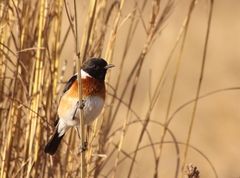
African Stonechat

African Stonechat

Saxicola torquatus

Silhouette: PhyloPic

LCLeast ConcernNTVUENCR
Daily sighting probability ~10% · With luck
at Harare

In 3 days ~30% in a week ~50%

61 Verified sightings at Harare
5,032 In all 32 parks From 2019 to 2026
July Best month
☀️ Diurnal When it's spotted

About the African Stonechat

The African stonechat or common stonechat (Saxicola torquatus) is a species of the Old World flycatcher family (Muscicapidae), inhabiting sub-Saharan Africa and adjacent regions. Like the other chats, it was long assigned to the thrush family (Turdidae), to which the chats are convergent. Its scientific name refer to its appearance and habitat and means "collared rock-dweller": Saxicola from Latin saxum ("rock") + incola ("one who dwells in a place"), torquatus, Latin for "collared".

In the past S. torquatus usually referred to the entire "common stonechat" superspecies and some sources still keep it that way, but all available evidence strongly supports full species status for the European (S. rubicola) and the Siberian stonechat (S. maurus) of temperate Eurasia, in addition to the island-endemics Fuerteventura chat (S. dacotiae) and Réunion stonechat (S. tectes) which were never unequivocally accepted into S. torquatus. The Madagascar stonechat (S. t. sibilla) has sometimes been considered distinct. In addition, the well-marked populations of the Horn of Africa uplands may well qualify for an additional species.

In 1760, the French zoologist Mathurin... Wikipedia →

Sounds

Song0:23

Kenya · 2026

© Ding Li Yong · XC1179249 · CC BY-NC-ND 4.0

Call0:08

Burundi · 2025

© Bram Piot · XC1021963 · CC BY-NC-SA 4.0

Alarm call0:18

South Africa · 2007

© Nature sounds by Simply Birding · XC652170 · CC BY-NC-ND 4.0

Global Distribution

Parks Where Found

# Park Country Daily sighting probability
1 Golden Gate Highlands National Park 🇿🇦 South Africa
~70%
2 Mantadia National Park 🇲🇬 Madagascar
~50%
3 Arusha National Park 🇹🇿 Tanzania
~50%
4 Nyungwe National Park 🇷🇼 Rwanda
~50%
5 Volcanoes National Park 🇷🇼 Rwanda
~50%
6 Bale Mountains National Park 🇪🇹 Ethiopia
~40%
7 Aberdare National Park 🇰🇪 Kenya
~30%
8 Hluhluwe-Imfolozi Park 🇿🇦 South Africa
~20%
9 Moremi Game Reserve 🇧🇼 Botswana
~20%
10 De Hoop Nature Reserve 🇿🇦 South Africa
~20%
11 West Coast National Park 🇿🇦 South Africa
~20%
12 Ngorongoro Conservation Area 🇹🇿 Tanzania
~20%
13 Virunga National Park 🇨🇩 Democratic Republic of the Congo
~20%
14 Mkomazi National Park 🇹🇿 Tanzania
~20%
15 Chobe National Park 🇧🇼 Botswana
~10%
16 iSimangaliso Wetland Park 🇿🇦 South Africa
~10%
17 Kafue National Park 🇿🇲 Zambia
~10%
18 Ranomafana National Park 🇲🇬 Madagascar
~10%
19 uMkhuze Game Reserve 🇿🇦 South Africa
~10%
20 Gorongosa National Park 🇲🇿 Mozambique
~10%
21 Pilanesberg National Park 🇿🇦 South Africa
~10%
22 Bwindi Impenetrable National Park 🇺🇬 Uganda
~10%
23 Addo Elephant National Park 🇿🇦 South Africa
~10%
24 Kruger National Park 🇿🇦 South Africa
~10%
25 Garden Route National Park 🇿🇦 South Africa
<5%
26 Lake Nakuru National Park 🇰🇪 Kenya
<5%
27 Mikumi National Park 🇹🇿 Tanzania
<5%
28 Akagera National Park 🇷🇼 Rwanda
<5%
29 Serengeti National Park 🇹🇿 Tanzania
<5%
30 Kibale National Park 🇺🇬 Uganda
<5%
31 Lake Mburo National Park 🇺🇬 Uganda
<5%
32 Nairobi National Park 🇰🇪 Kenya
<5%

Cities Where Found

# City Country Daily sighting probability
1 Antananarivo 🇲🇬 Madagascar
~30%
2 Kigali 🇷🇼 Rwanda
~30%
3 Harare 🇿🇼 Zimbabwe
~10%
4 Johannesburg 🇿🇦 South Africa
~10%
5 Pretoria 🇿🇦 South Africa
<5%
6 Nairobi 🇰🇪 Kenya
<5%
7 Cape Town 🇿🇦 South Africa
<5%

Before you go

What are the chances of seeing an African Stonechat in Harare?

With luck

About 10% of wildlife watchers report an African Stonechat sighting in Harare on a given day, based on 61 verified sightings from GBIF citizen-science data. It is the 82nd most-seen of the 213 birds we can rate there. Over three days the chance rises to about 30%, and over a week to about 50%, if each day is a fresh chance.

When is the best time to see an African Stonechat in Harare?

July

In that month about 20% of wildlife watchers report an African Stonechat in Harare on a given day, against under 5% in February and September, the lowest months. That is one of Harare's driest months, with about 20 mm of rain against 200 mm in December.

What time of day is best to see an African Stonechat?

Between 11 am and 2 pm

Across all the parks we cover, that three-hour window holds the most African Stonechat sightings with a recorded time, and about 9 in 10 of them come between 6 am and 6 pm: it is a daytime animal.

Is Harare the best place to see an African Stonechat?

3rd of 7

Of the 7 cities where we can rate African Stonechat sightings, Harare ranks 3rd at about 10%. The best odds are in Antananarivo (Madagascar, about 30%) and Kigali (Rwanda, about 30%).

Which relatives of the African Stonechat live in Harare?

Same family: Muscicapidae

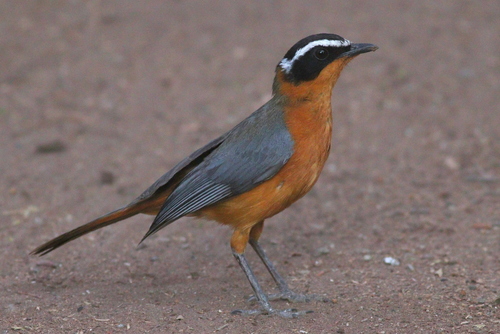
The closest relatives of the African Stonechat that you can see in Harare (family Muscicapidae, Old World Flycatchers, Robins, and Chats) are White-browed Robin-Chat (about 60%) and Southern Black Flycatcher (about 30%), with each one's daily chance of a sighting.

Where does the African Stonechat sighting chance come from?

GBIF citizen-science records

It is estimated from how often the African Stonechat is recorded against all the birds logged in Harare (61 verified sightings), calibrated against known sighting rates. Figures are rounded to the nearest 10% because citizen-science data supports honest approximations, not decimals, and months with records from fewer than five people show "—". How it works.

← Back to Harare