




Completed


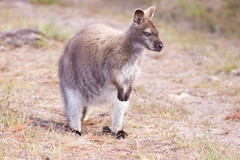

Red-necked Wallaby
Notamacropus rufogriseus
Silhouette: Kawinwit Kittipalawattanapol · PhyloPic
- KingdomAnimalia (Animals)
- PhylumChordata (Chordates)
- ClassMammalia (Mammals)
- OrderDiprotodontia (Kangaroos, Possums, Wombats, and Allies)
- FamilyMacropodidae (Kangaroos, Wallabies and Allies)
- GenusNotamacropus (Typical Wallabies)
- SpeciesNotamacropus rufogriseus (Red-necked Wallaby)
In 3 days ~70% in a week ~90%
78 Verified sightings at Hobart
1,244 In all 10 parks From 2019 to 2026
January Best month
☀️ Diurnal When it's spotted
About the Red-necked Wallaby
The red-necked wallaby or Bennett's wallaby (Notamacropus rufogriseus) is a medium-sized macropod marsupial (wallaby), common in the more temperate and fertile parts of eastern Australia, including Tasmania. Red-necked wallabies have been introduced to several other countries, including New Zealand, the United Kingdom (in England and Scotland), Ireland, the Isle of Man, France and Germany.
Red-necked wallabies are distinguished by their black nose and paws, white stripe on the upper lip, and grizzled medium grey coat with a reddish wash across the shoulders. They can weigh 13.8 to 18.6 kilograms (30 to 41 lb) and attain a head-body length of 90 centimetres (35 in), although males are generally bigger than females. Red-necked wallabies are very similar in appearance to the black-striped wallaby (Notamacropus dorsalis), the only difference being that red-necked wallabies are larger, lack a black stripe down the back, and have softer fur. Red-necked wallabies may live up to nine years.
Red-necked wallabies are found in coastal scrub and sclerophyll forest throughout coastal and highland eastern Australia, from Bundaberg, Queensland, to the... Wikipedia →
Recent sightings of Red-necked Wallaby in Hobart
LIVEiNaturalistGlobal Distribution
Parks Where Found
| # | Park | Country | Daily sighting probability |
|---|---|---|---|
| 1 | Cradle Mountain-Lake St Clair National Park | 🇦🇺 Australia | |
| 2 | Freycinet National Park | 🇦🇺 Australia | |
| 3 | Maria Island National Park | 🇦🇺 Australia | |
| 4 | Kosciuszko National Park | 🇦🇺 Australia | |
| 5 | Grampians National Park | 🇦🇺 Australia | |
| 6 | Lamington National Park | 🇦🇺 Australia | |
| 7 | Booderee National Park | 🇦🇺 Australia | |
| 8 | Springbrook National Park | 🇦🇺 Australia | |
| 9 | Great Otway National Park | 🇦🇺 Australia | |
| 10 | Blue Mountains National Park | 🇦🇺 Australia |
Zoos & Centres Where Found
| # | Zoo / Centre | Country | |
|---|---|---|---|
| 1 | Disney's Animal Kingdom | 🇺🇸 United States | |
| 2 | Busch Gardens Tampa | 🇺🇸 United States | |
| 3 | Moscow Zoo | 🇷🇺 Russia | |
| 4 | Pairi Daiza | 🇧🇪 Belgium | |
| 5 | Prague Zoo | 🇨🇿 Czechia | |
| 6 | National Zoological Park | 🇺🇸 United States | |
| 7 | ZooParc de Beauval | 🇫🇷 France | |
| 8 | Denver Zoo | 🇺🇸 United States | |
| 9 | Copenhagen Zoo | 🇩🇰 Denmark | |
| 10 | Natura Artis Magistra | 🇳🇱 Netherlands | |
| 11 | Cleveland Metroparks Zoo | 🇺🇸 United States | |
| 12 | Cincinnati Zoo and Botanical Garden | 🇺🇸 United States | |
| 13 | Zürich Zoo | 🇨🇭 Switzerland | |
| 14 | Barcelona Zoo | 🇪🇸 Spain | |
| 15 | Le Pal | 🇫🇷 France | |
| 16 | Australia Zoo | 🇦🇺 Australia | |
| 17 | Zlín-Lešná Zoo | 🇨🇿 Czechia | |
| 18 | Korkeasaari Zoo | 🇫🇮 Finland | |
| 19 | Parc Phœnix | 🇫🇷 France | |
| 20 | Fota Wildlife Park | 🇮🇪 Ireland | |
| 21 | Réserve africaine de Sigean | 🇫🇷 France | |
| 22 | Parc des oiseaux | 🇫🇷 France | |
| 23 | Zoo Hluboka | 🇨🇿 Czechia | |
| 24 | Zoo de Maubeuge | 🇫🇷 France | |
| 25 | Kaliningrad Zoo | 🇷🇺 Russia | |
| 26 | Zoopark Vyškov | 🇨🇿 Czechia | |
| 27 | Zoobotánico Jerez | 🇪🇸 Spain | |
| 28 | La Tanière | 🇫🇷 France | |
| 29 | Zoo d'Amiens | 🇫🇷 France | |
| 30 | Karagandy Zoo | 🇰🇿 Kazakhstan | |
| 31 | San Diego Zoo Safari Park | 🇺🇸 United States | |
| 32 | Whipsnade Zoo | 🇬🇧 United Kingdom | |
| 33 | Binder Park Zoo | 🇺🇸 United States | |
| 34 | Toronto Zoo | 🇨🇦 Canada | |
| 35 | Minnesota Zoo | 🇺🇸 United States | |
| 36 | Living Desert Zoo and Gardens | 🇺🇸 United States | |
| 37 | Serengeti Park | 🇩🇪 Germany | |
| 38 | Tierpark Sababurg | 🇩🇪 Germany | |
| 39 | Woburn Safari Park | 🇬🇧 United Kingdom | |
| 40 | Port Lympne Wild Animal Park | 🇬🇧 United Kingdom | |
| 41 | Grant's Farm | 🇺🇸 United States | |
| 42 | Bronx Zoo | 🇺🇸 United States | |
| 43 | Longleat Safari and Adventure Park | 🇬🇧 United Kingdom | |
| 44 | Kansas City Zoo | 🇺🇸 United States | |
| 45 | Badoca Safari Park | 🇵🇹 Portugal | |
| 46 | Ramat Gan Safari | 🇮🇱 Israel | |
| 47 | Tallinn Zoo | 🇪🇪 Estonia | |
| 48 | Planète Sauvage | 🇫🇷 France | |
| 49 | Brookfield Zoo | 🇺🇸 United States | |
| 50 | Auto Safari Chapin | 🇬🇹 Guatemala |
Closest Relatives at Hobart


Before you go
What are the chances of seeing a Red-necked Wallaby in Hobart?
Possible
About 30% of wildlife watchers report a Red-necked Wallaby sighting in Hobart on a given day, based on 78 verified sightings from GBIF citizen-science data. It is the 3rd most-seen of the 9 mammals we can rate there. Over three days the chance rises to about 70%, and over a week to about 90%, if each day is a fresh chance.
When is the best time to see a Red-necked Wallaby in Hobart?
January
In that month about 50% of wildlife watchers report a Red-necked Wallaby in Hobart on a given day, against about 20% in April and August–September, the lowest months.
What time of day is best to see a Red-necked Wallaby?
Between 2 and 5 pm
Across all the parks we cover, that three-hour window holds the most Red-necked Wallaby sightings with a recorded time, and about 9 in 10 of them come between 6 am and 6 pm: it is a daytime animal.
Is Hobart the best place to see a Red-necked Wallaby?
Yes
Of the 2 cities where we can rate Red-necked Wallaby sightings, Hobart has the highest daily chance: about 30%. Next come Brisbane (Australia, about 10%).
Where does the Red-necked Wallaby sighting chance come from?
GBIF citizen-science records
It is estimated from how often the Red-necked Wallaby is recorded against all the mammals logged in Hobart (78 verified sightings), calibrated against known sighting rates. Figures are rounded to the nearest 10% because citizen-science data supports honest approximations, not decimals, and months with records from fewer than five people show "—". How it works.
