Superb Fairywren

Superb Fairywren

Malurus cyaneus

Silhouette: Michael Scroggie · PhyloPic

LCLeast ConcernNTVUENCR Endemic
Daily sighting probability ~20% · Possible
at Hobart

In 3 days ~50% in a week ~80%

297 Verified sightings at Hobart
12,721 In all 14 parks From 2019 to 2026
August Best month
☀️ Diurnal When it's spotted

About the Superb Fairywren

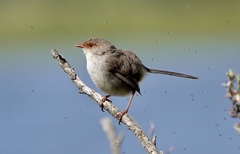
The superb fairywren (Malurus cyaneus) is a passerine bird in the Australasian wren family, Maluridae, and is common and familiar across south-eastern Australia. It is a sedentary and territorial species, also exhibiting a high degree of sexual dimorphism; the male in breeding plumage has a striking bright blue forehead, ear coverts, mantle, and tail, with a black mask and black or dark blue throat. Non-breeding males, females and juveniles are predominantly grey-brown in colour; this gave the early impression that males were polygamous, as all dull-coloured birds were taken for females. Six subspecies groups are recognized: three larger and darker forms from Tasmania, Flinders and King Island respectively, and three smaller and paler forms from mainland Australia and Kangaroo Island.

Like other fairywrens, the superb fairywren is notable for several peculiar behavioural characteristics; the birds are socially monogamous and sexually promiscuous, meaning that although they form pairs between one male and one female, each partner will mate with other individuals and even assist in raising the young from such pairings. Male wrens pluck yellow petals and display them to females as part of a courtship display.

The superb fairywren can be found in almost any area that has at least a little dense undergrowth for shelter, including grasslands with scattered shrubs, moderately thick forest, woodland, heaths, and domestic gardens. It has adapted well to the urban environment and is common in suburban Sydney, Canberra, Melbourne and Brisbane. The superb fairywren eats mostly insects and supplements its diet with seeds.

The superb fairywren was named 'Australian Bird of the Year' for 2021, after a survey conducted by Birdlife Australia saw the species narrowly defeat the tawny frogmouth with a margin of 666 votes (over 400,000 votes were cast in total). Wikipedia →

Sounds

Song0:30

Australia · 2026

© Khristos Nizamis · XC1181678 · CC BY-NC-ND 4.0

Call0:49

Australia · 2024

© Romuald Mikusek · XC1173655 · CC BY-NC-SA 4.0

Song and call0:47

Australia · 2023

© Peter Boesman · XC859930 · CC BY-NC-ND 4.0

Global Distribution

Parks Where Found

# Park Country Daily sighting probability
1 Great Otway National Park 🇦🇺 Australia
~90%
2 Flinders Chase 🇦🇺 Australia
~90%
3 Grampians National Park 🇦🇺 Australia
~80%
4 Wilsons Promontory National Park 🇦🇺 Australia
~80%
5 Freycinet National Park 🇦🇺 Australia
~70%
6 Kosciuszko National Park 🇦🇺 Australia
~70%
7 Cradle Mountain-Lake St Clair National Park 🇦🇺 Australia
~60%
8 Lamington National Park 🇦🇺 Australia
~50%
9 Royal National Park 🇦🇺 Australia
~50%
10 Booderee National Park 🇦🇺 Australia
~40%
11 Blue Mountains National Park 🇦🇺 Australia
~30%
12 Maria Island National Park 🇦🇺 Australia
~10%
13 Springbrook National Park 🇦🇺 Australia
~10%
14 Hattah-Kulkyne National Park 🇦🇺 Australia
<5%

Cities Where Found

# City Country Daily sighting probability
1 Melbourne 🇦🇺 Australia
~50%
2 Sydney 🇦🇺 Australia
~40%
3 Brisbane 🇦🇺 Australia
~40%
4 Hobart 🇦🇺 Australia
~20%

Zoos & Centres Where Found

# Zoo / Centre Country
1 Adelaide Zoo 🇦🇺 Australia In captivity
2 Featherdale Sydney Wildlife Park 🇦🇺 Australia In captivity

Before you go

What are the chances of seeing a Superb Fairywren in Hobart?

Possible

About 20% of wildlife watchers report a Superb Fairywren sighting in Hobart on a given day, based on 297 verified sightings from GBIF citizen-science data. It is the 25th most-seen of the 79 birds we can rate there. Over three days the chance rises to about 50%, and over a week to about 80%, if each day is a fresh chance.

When is the best time to see a Superb Fairywren in Hobart?

August

In that month about 40% of wildlife watchers report a Superb Fairywren in Hobart on a given day, against about 10% in January, May and November, the lowest months.

What time of day is best to see a Superb Fairywren?

Between 11 am and 2 pm

Across all the parks we cover, that three-hour window holds the most Superb Fairywren sightings with a recorded time, and nearly all of them come between 6 am and 6 pm: it is a daytime animal.

Is Hobart the best place to see a Superb Fairywren?

4th of 4

Of the 4 cities where we can rate Superb Fairywren sightings, Hobart ranks 4th at about 20%. The best odds are in Melbourne (Australia, about 50%), Sydney (Australia, about 40%) and Brisbane (Australia, about 40%).

Which relatives of the Superb Fairywren live in Hobart?

Same order: Passeriformes

The closest relatives of the Superb Fairywren that you can see in Hobart (order Passeriformes, Perching Birds) are Eurasian Blackbird (about 90%), Forest Raven (about 80%) and Silvereye (about 70%), with each one's daily chance of a sighting.

Where does the Superb Fairywren sighting chance come from?

GBIF citizen-science records

It is estimated from how often the Superb Fairywren is recorded against all the birds logged in Hobart (297 verified sightings), calibrated against known sighting rates. Figures are rounded to the nearest 10% because citizen-science data supports honest approximations, not decimals, and months with records from fewer than five people show "—". How it works.

← Back to Hobart