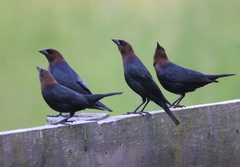
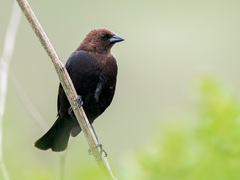
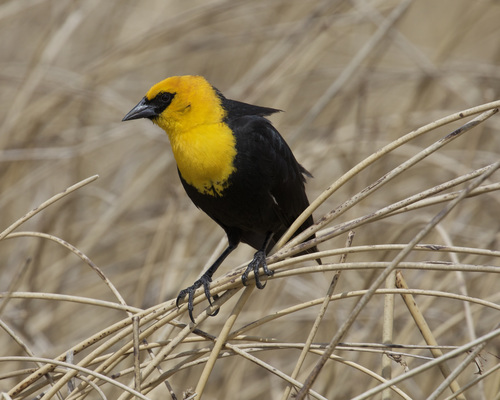
Brown-headed Cowbird

Brown-headed Cowbird

Molothrus ater

Silhouette: Andy Wilson · PhyloPic

LCLeast ConcernNTVUENCR
Daily sighting probability ~10% · With luck
at Los Angeles

In 3 days ~20% in a week ~40%

7,316 Verified sightings at Los Angeles
25,198 In all 37 parks From 2019 to 2026
May Best month
☀️ Diurnal When it's spotted

About the Brown-headed Cowbird

The brown-headed cowbird (Molothrus ater) is a small, obligate brood parasitic icterid native to temperate and subtropical North America. It is a permanent resident in the southern parts of its range; northern birds migrate to the southern United States and Mexico in winter, returning to their summer habitat around March or April.

The brown-headed cowbird was described by the French polymath Georges-Louis Leclerc, Comte de Buffon in 1775 in his Histoire Naturelle des Oiseaux from a specimen collected in the Carolinas. The bird was also illustrated in a hand-colored plate engraved by François-Nicolas Martinet in the Planches Enluminées D'Histoire Naturelle, which was produced under the supervision of Edme-Louis Daubenton to accompany Buffon's text. Neither the plate caption nor Buffon's description included a scientific name, but in 1783, Dutch naturalist Pieter Boddaert coined the binomial name Oriolus ater in his catalogue of the Planches Enluminées. The brown-headed cowbird is now placed in the genus Molothrus that was introduced by English naturalist William Swainson in 1832 with the brown-headed cowbird as the type species. The genus name combines the Ancient Greek... Wikipedia →

Sounds

Song0:24

Mexico · 2025

© Manuel Grosselet · XC997863 · CC BY-NC-SA 4.0

Call1:28

United States · 2023

© Richard E. Webster · XC938836 · CC BY-NC-SA 4.0

Uncertain1:24

United States · 2021

© William Whitehead · XC643230 · CC BY-NC-ND 4.0

Global Distribution

Parks Where Found

# Park Country Daily sighting probability
1 Point Pelee National Park 🇨🇦 Canada
~60%
2 Badlands National Park 🇺🇸 United States
~40%
3 Elk Island National Park 🇨🇦 Canada
~30%
4 Yellowstone National Park 🇺🇸 United States
~30%
5 Death Valley National Park 🇺🇸 United States
~20%
6 Grand Teton National Park 🇺🇸 United States
~20%
7 Yosemite National Park 🇺🇸 United States
~20%
8 Banff National Park 🇨🇦 Canada
~20%
9 Shenandoah National Park 🇺🇸 United States
~20%
10 Big Bend National Park 🇺🇸 United States
~20%
11 Riding Mountain National Park 🇨🇦 Canada
~20%
12 Everglades National Park 🇺🇸 United States
~20%
13 Jasper National Park 🇨🇦 Canada
~10%
14 Glacier National Park 🇺🇸 United States
~10%
15 Sequoia and Kings Canyon National Parks 🇺🇸 United States
~10%
16 Pacific Rim National Park Reserve 🇨🇦 Canada
~10%
17 Congaree National Park 🇺🇸 United States
~10%
18 Rocky Mountain National Park 🇺🇸 United States
~10%
19 Saguaro National Park 🇺🇸 United States
~10%
20 Grand Canyon National Park 🇺🇸 United States
~10%
21 Great Bear Rainforest 🇨🇦 Canada
~10%
22 Guadalupe Mountains National Park 🇺🇸 United States
~10%
23 Great Smoky Mountains National Park 🇺🇸 United States
~10%
24 Zion National Park 🇺🇸 United States
~10%
25 El Vizcaíno Biosphere Reserve 🇲🇽 Mexico
~10%
26 Redwood National Park 🇺🇸 United States
~10%
27 Channel Islands National Park 🇺🇸 United States
~10%
28 Joshua Tree National Park 🇺🇸 United States
~10%
29 Cabo Pulmo National Park 🇲🇽 Mexico
~10%
30 Olympic National Park 🇺🇸 United States
~10%
31 Bahía de Loreto National Park 🇲🇽 Mexico
<5%
32 Padre Island National Seashore 🇺🇸 United States
<5%
33 Big Cypress National Preserve 🇺🇸 United States
<5%
34 Merritt Island National Wildlife Refuge 🇺🇸 United States
<5%
35 Acadia National Park 🇺🇸 United States
<5%
36 Cumbres de Monterrey National Park 🇲🇽 Mexico
<5%
37 Celestún Biosphere Reserve 🇲🇽 Mexico
<5%

Cities Where Found

# City Country Daily sighting probability
1 León 🇲🇽 México
~30%
2 Detroit 🇺🇸 United States
~30%
3 Chicago 🇺🇸 United States
~30%
4 Baltimore 🇺🇸 United States
~30%
5 Washington 🇺🇸 United States
~20%
6 Mesa 🇺🇸 United States
~20%
7 Philadelphia 🇺🇸 United States
~20%
8 Toronto 🇨🇦 Canada
~20%
9 Minneapolis [Saint Paul] 🇺🇸 United States
~20%
10 Dallas 🇺🇸 United States
~20%

Zoos & Centres Where Found

# Zoo / Centre Country
1 Columbus Zoo and Aquarium 🇺🇸 United States In captivity
2 Omaha’s Henry Doorly Zoo and Aquarium 🇺🇸 United States In captivity
3 Ralph Perkins II Wildlife Center and Woods Garden 🇺🇸 United States In captivity

Before you go

What are the chances of seeing a Brown-headed Cowbird in Los Angeles?

With luck

About 10% of wildlife watchers report a Brown-headed Cowbird sighting in Los Angeles on a given day, based on 7,316 verified sightings from GBIF citizen-science data. It is the 108th most-seen of the 426 birds we can rate there. Over three days the chance rises to about 20%, and over a week to about 40%, if each day is a fresh chance.

When is the best time to see a Brown-headed Cowbird in Los Angeles?

May and June

In those months about 20% of wildlife watchers report a Brown-headed Cowbird in Los Angeles on a given day, against under 5% in October to March, the lowest months. Those are among Los Angeles's driest months, with about 5 mm of rain a month against 75 mm in February.

What time of day is best to see a Brown-headed Cowbird?

Between 8 and 11 am

Across all the parks we cover, that three-hour window holds the most Brown-headed Cowbird sightings with a recorded time, and about 8 in 10 of them come between 6 am and 6 pm: it is a daytime animal.

Is Los Angeles the best place to see a Brown-headed Cowbird?

26th of 36

Of the 36 cities where we can rate Brown-headed Cowbird sightings, Los Angeles ranks 26th at about 10%. The best odds are in León (México, about 30%), Detroit (United States, about 30%) and Chicago (United States, about 30%).

Which relatives of the Brown-headed Cowbird live in Los Angeles?

Same family: Icteridae

The closest relatives of the Brown-headed Cowbird that you can see in Los Angeles (family Icteridae, New World Blackbirds and Orioles) are Hooded Oriole (about 20%), Red-winged Blackbird (about 20%) and Great-tailed Grackle (about 10%), with each one's daily chance of a sighting.

Where does the Brown-headed Cowbird sighting chance come from?

GBIF citizen-science records

It is estimated from how often the Brown-headed Cowbird is recorded against all the birds logged in Los Angeles (7,316 verified sightings), calibrated against known sighting rates. Figures are rounded to the nearest 10% because citizen-science data supports honest approximations, not decimals, and months with records from fewer than five people show "—". How it works.

← Back to Los Angeles