Yellow-fronted Canary

Yellow-fronted Canary

Crithagra mozambica

Silhouette: Sheatherius · PhyloPic

LCLeast ConcernNTVUENCR
Daily sighting probability ~10% · With luck
at Lubango

In 3 days ~10% in a week ~30%

5 Verified sightings at Lubango
9,135 In all 36 parks From 2019 to 2026
February Best month
🌅 Crepuscular When it's spotted

About the Yellow-fronted Canary

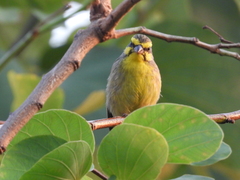
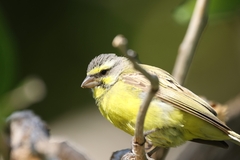
The yellow-fronted canary (Crithagra mozambica) is a small passerine bird in the finch family. It is sometimes known in aviculture as the green singing finch or the green singer. This bird is a resident breeder in Africa south of the Sahara Desert. Its habitat is open woodland and cultivation. It nests in trees, laying three or four eggs in a compact cup nest. It has been introduced to Mauritius, Rodrigues, Réunion, Assumption Island, Mafia Island, Puerto Rico, and the Hawaiian Islands, where it is found on western Hawaii, southeastern Oahu and Molokai.

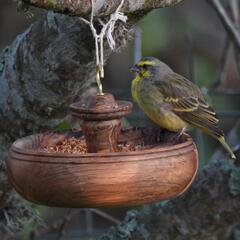
The yellow-fronted canary is a common, gregarious seedeater. It is 11–13 cm in length. The adult male has a green back and brown wings and tail. The underparts and rump are yellow, and the head is yellow with a grey crown and nape and a black malar stripe. The female is similar, but with a weaker head pattern and duller underparts. Juveniles are greyer than the female, especially on the head.

Its song is a warbled zee-zeree-chereeo. The yellow-fronted canary was formerly placed in the genus Serinus, but phylogenetic analysis using mitochondrial and nuclear DNA sequences found the genus to be polyphyletic. The genus was... Wikipedia →

Sounds

Song0:16

South Africa · 2026

© Marna Buys · XC1140446 · CC BY-NC-SA 4.0

Call0:37

Ethiopia · 2014

© Andrew Spencer · XC268716 · CC BY-NC-ND 4.0

Song0:45

Malawi · 2024

© Magnus Wadstein · XC938981 · CC BY-NC-SA 4.0

Global Distribution

Parks Where Found

# Park Country Daily sighting probability
1 uMkhuze Game Reserve 🇿🇦 South Africa
~70%
2 Hluhluwe-Imfolozi Park 🇿🇦 South Africa
~50%
3 Akagera National Park 🇷🇼 Rwanda
~40%
4 Gonarezhou National Park 🇿🇼 Zimbabwe
~40%
5 Liwonde National Park 🇲🇼 Malawi
~40%
6 Pilanesberg National Park 🇿🇦 South Africa
~40%
7 Masai Mara National Reserve 🇰🇪 Kenya
~40%
8 Kruger National Park 🇿🇦 South Africa
~30%
9 iSimangaliso Wetland Park 🇿🇦 South Africa
~30%
10 Mikumi National Park 🇹🇿 Tanzania
~30%
11 Volcanoes National Park 🇷🇼 Rwanda
~30%
12 Lake Mburo National Park 🇺🇬 Uganda
~20%
13 Kidepo Valley National Park 🇺🇬 Uganda
~20%
14 Queen Elizabeth National Park 🇺🇬 Uganda
~20%
15 South Luangwa National Park 🇿🇲 Zambia
~20%
16 Kibale National Park 🇺🇬 Uganda
~20%
17 Hwange National Park 🇿🇼 Zimbabwe
~20%
18 Gorongosa National Park 🇲🇿 Mozambique
~20%
19 Nyungwe National Park 🇷🇼 Rwanda
~10%
20 Serengeti National Park 🇹🇿 Tanzania
~10%
21 Niokolo-Koba National Park 🇸🇳 Senegal
~10%
22 Virunga National Park 🇨🇩 Democratic Republic of the Congo
~10%
23 Kafue National Park 🇿🇲 Zambia
~10%
24 Addo Elephant National Park 🇿🇦 South Africa
~10%
25 Mana Pools National Park 🇿🇼 Zimbabwe
~10%
26 Arusha National Park 🇹🇿 Tanzania
~10%
27 Murchison Falls National Park 🇺🇬 Uganda
~10%
28 Lower Zambezi National Park 🇿🇲 Zambia
~10%
29 Ngorongoro Conservation Area 🇹🇿 Tanzania
<5%
30 Bwindi Impenetrable National Park 🇺🇬 Uganda
<5%
31 Chobe National Park 🇧🇼 Botswana
<5%
32 Ruaha National Park 🇹🇿 Tanzania
<5%
33 Semuliki National Park 🇺🇬 Uganda
<5%
34 Lake Manyara National Park 🇹🇿 Tanzania
<5%
35 Moremi Game Reserve 🇧🇼 Botswana
<5%
36 Tarangire National Park 🇹🇿 Tanzania
<5%

Cities Where Found

# City Country Daily sighting probability
1 Yaoundé 🇨🇲 Cameroon
~80%
2 Kigali 🇷🇼 Rwanda
~50%
3 Lusaka 🇿🇲 Zambia
~40%
4 Zanzibar City 🇹🇿 Tanzania
~30%
5 Abuja 🇳🇬 Nigeria
~30%
6 Durban 🇿🇦 South Africa
~20%
7 Mombasa 🇰🇪 Kenya
~20%
8 Lilongwe 🇲🇼 Malawi
~20%
9 Dar es-Salaam 🇹🇿 Tanzania
~20%
10 Freetown 🇸🇱 Sierra Leone
~20%

Zoos & Centres Where Found

# Zoo / Centre Country
1 National Aviary 🇺🇸 United States In captivity
2 Bloedel Conservatory 🇨🇦 Canada In captivity

Before you go

What are the chances of seeing a Yellow-fronted Canary in Lubango?

With luck

About 10% of wildlife watchers report a Yellow-fronted Canary sighting in Lubango on a given day, based on 5 verified sightings from GBIF citizen-science data. It is the 30th most-seen of the 35 birds we can rate there. Over three days the chance rises to about 10%, and over a week to about 30%, if each day is a fresh chance.

When is the best time to see a Yellow-fronted Canary in Lubango?

February and October

In those months about 10% of wildlife watchers report a Yellow-fronted Canary in Lubango on a given day, against under 5% in January, March and July–September, the lowest months. April–June and November–December have too few records to rate.

What time of day is best to see a Yellow-fronted Canary?

Between 9 am and noon

Across all the parks we cover, that three-hour window holds the most Yellow-fronted Canary sightings with a recorded time, and about 6 in 10 of them come between 6 am and 6 pm: it is most active around dawn and dusk.

Is Lubango the best place to see a Yellow-fronted Canary?

18th of 21

Of the 21 cities where we can rate Yellow-fronted Canary sightings, Lubango ranks 18th at about 10%. The best odds are in Yaoundé (Cameroon, about 80%), Kigali (Rwanda, about 50%) and Lusaka (Zambia, about 40%).

Which relatives of the Yellow-fronted Canary live in Lubango?

Same order: Passeriformes

The closest relatives of the Yellow-fronted Canary that you can see in Lubango (order Passeriformes, Perching Birds) are Pied Crow (about 40%), Common Bulbul (about 30%) and Blue-breasted Cordonbleu (about 20%), with each one's daily chance of a sighting.

Where does the Yellow-fronted Canary sighting chance come from?

GBIF citizen-science records

It is estimated from how often the Yellow-fronted Canary is recorded against all the birds logged in Lubango (5 verified sightings), calibrated against known sighting rates. Figures are rounded to the nearest 10% because citizen-science data supports honest approximations, not decimals, and months with records from fewer than five people show "—". How it works.

← Back to Lubango