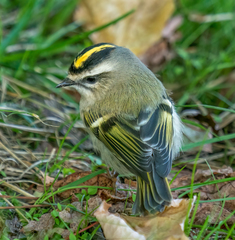
Golden-crowned Kinglet

Golden-crowned Kinglet

Regulus satrapa

Silhouette: Ferran Sayol · PhyloPic

LCLeast ConcernNTVUENCR
Daily sighting probability <5% · Rare
at Minneapolis [Saint Paul]

In 3 days ~10% in a week ~30%

1,073 Verified sightings at Minneapolis [Saint Paul]
27,003 In all 33 parks From 2019 to 2026
October Best month
☀️ Diurnal When it's spotted

About the Golden-crowned Kinglet

The golden-crowned kinglet (Regulus satrapa) is a very small songbird in the family Regulidae that lives throughout much of North America. Adults are olive-gray on the upperparts with white underparts, thin bills and short tails. They have white wing bars, a black stripe through the eyes and a yellow crown surrounded by black. The adult male has an orange patch in the middle of the yellow crown. The juvenile is similar to the adult, but with a browner back and without the yellow crown. This is one of the smallest passerines in North America. Its length, at 8 to 11 cm (3.1 to 4.3 in), is probably the shortest of any American passerine. Its weight, averaging 6.1 g (0.22 oz) for females and 6.3 g (0.22 oz) for males and ranging from 4.5 to 7.8 g (0.16 to 0.28 oz), is similar to the American bushtit and black-tailed gnatcatcher. The golden-crowned kinglet has a wingspan of 5.5–7.1 in (14–18 cm).

The golden-crowned kinglet is insectivorous, foraging in trees or shrubs, where it eats insects (especially caterpillars), insect eggs and spiders. It produces a series of high-pitched calls on a single note, and tends not to fear human approach. Its nest is a well... Wikipedia →

Sounds

Call0:21

United States · 2026

© Greg Irving · XC1100995 · CC BY-NC-SA 4.0

Song0:22

Canada · 2022

© Sunny Tseng · XC752955 · CC BY-NC-SA 4.0

Uncertain0:17

United States · 2021

© Brian Hendrix · XC653057 · CC BY-NC-SA 4.0

Global Distribution

Parks Where Found

# Park Country Daily sighting probability
1 Pacific Rim National Park Reserve 🇨🇦 Canada
~50%
2 Glacier National Park 🇺🇸 United States
~50%
3 Reserva de la Biosfera Mariposa Monarca 🇲🇽 Mexico
~50%
4 Olympic National Park 🇺🇸 United States
~40%
5 Isle Royale National Park 🇺🇸 United States
~40%
6 Sequoia and Kings Canyon National Parks 🇺🇸 United States
~40%
7 Acadia National Park 🇺🇸 United States
~40%
8 Jasper National Park 🇨🇦 Canada
~40%
9 Banff National Park 🇨🇦 Canada
~40%
10 Redwood National Park 🇺🇸 United States
~40%
11 Great Bear Rainforest 🇨🇦 Canada
~40%
12 Cape Breton Highlands National Park 🇨🇦 Canada
~30%
13 Congaree National Park 🇺🇸 United States
~30%
14 Yosemite National Park 🇺🇸 United States
~30%
15 Great Smoky Mountains National Park 🇺🇸 United States
~20%
16 Point Pelee National Park 🇨🇦 Canada
~20%
17 Gros Morne National Park 🇨🇦 Canada
~10%
18 Grand Teton National Park 🇺🇸 United States
~10%
19 Voyageurs National Park 🇺🇸 United States
~10%
20 Shenandoah National Park 🇺🇸 United States
~10%
21 Riding Mountain National Park 🇨🇦 Canada
~10%
22 Rocky Mountain National Park 🇺🇸 United States
~10%
23 Katmai National Park 🇺🇸 United States
~10%
24 Kenai Fjords National Park 🇺🇸 United States
~10%
25 Wrangell-St. Elias National Park 🇺🇸 United States
<5%
26 Zion National Park 🇺🇸 United States
<5%
27 Yellowstone National Park 🇺🇸 United States
<5%
28 Elk Island National Park 🇨🇦 Canada
<5%
29 Kluane National Park 🇨🇦 Canada
<5%
30 Grand Canyon National Park 🇺🇸 United States
<5%
31 Big Bend National Park 🇺🇸 United States
<5%
32 Channel Islands National Park 🇺🇸 United States
<5%
33 Merritt Island National Wildlife Refuge 🇺🇸 United States
<5%

Cities Where Found

# City Country Daily sighting probability
1 Seattle 🇺🇸 United States
~40%
2 Vancouver 🇨🇦 Canada
~30%
3 Portland 🇺🇸 United States
~20%
4 Toronto 🇨🇦 Canada
~20%
5 Chicago 🇺🇸 United States
~10%
6 New York City 🇺🇸 United States
~10%
7 Boston 🇺🇸 United States
~10%
8 Montreal 🇨🇦 Canada
~10%
9 Detroit 🇺🇸 United States
~10%
10 Philadelphia 🇺🇸 United States
~10%

Zoos & Centres Where Found

# Zoo / Centre Country
1 Ralph Perkins II Wildlife Center and Woods Garden 🇺🇸 United States In captivity

Before you go

What are the chances of seeing a Golden-crowned Kinglet in Minneapolis [Saint Paul]?

Rare

Under 5% of wildlife watchers report a Golden-crowned Kinglet sighting in Minneapolis [Saint Paul] on a given day, based on 1,073 verified sightings from GBIF citizen-science data. It is the 92nd most-seen of the 232 birds we can rate there. Over three days the chance rises to about 10%, and over a week to about 30%, if each day is a fresh chance.

When is the best time to see a Golden-crowned Kinglet in Minneapolis [Saint Paul]?

October

In that month about 30% of wildlife watchers report a Golden-crowned Kinglet in Minneapolis [Saint Paul] on a given day, against under 5% in May–September and December–March, the lowest months.

What time of day is best to see a Golden-crowned Kinglet?

Between 10 am and 1 pm

Across all the parks we cover, that three-hour window holds the most Golden-crowned Kinglet sightings with a recorded time, and about 9 in 10 of them come between 6 am and 6 pm: it is a daytime animal.

Is Minneapolis [Saint Paul] the best place to see a Golden-crowned Kinglet?

15th of 27

Of the 27 cities where we can rate Golden-crowned Kinglet sightings, Minneapolis [Saint Paul] ranks 15th at under 5%. The best odds are in Seattle (United States, about 40%), Vancouver (Canada, about 30%) and Portland (United States, about 20%).

Where does the Golden-crowned Kinglet sighting chance come from?

GBIF citizen-science records

It is estimated from how often the Golden-crowned Kinglet is recorded against all the birds logged in Minneapolis [Saint Paul] (1,073 verified sightings), calibrated against known sighting rates. Figures are rounded to the nearest 10% because citizen-science data supports honest approximations, not decimals, and months with records from fewer than five people show "—". How it works.

← Back to Minneapolis [Saint Paul]