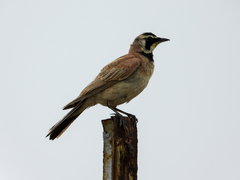
Horned Lark

Horned Lark

Eremophila alpestris

Silhouette: Andy Wilson · PhyloPic

LCLeast ConcernNTVUENCR
Daily sighting probability <5% · Rare
at Minneapolis [Saint Paul]

In 3 days <5%

34 Verified sightings at Minneapolis [Saint Paul]
5,577 In all 27 parks From 2019 to 2026
October Best month
☀️ Diurnal When it's spotted

About the Horned Lark

The horned lark or shore lark (Eremophila alpestris) is a species of lark in the family Alaudidae found across the northern hemisphere. It is known as "horned lark" in North America for distinctive feathers on the heads of the male birds in summer, and as "shore lark" in Europe because it can be found on shorelines in the winter.

The horned lark was formally described in 1758 by the Swedish naturalist Carl Linnaeus in the tenth edition of his Systema Naturae under the binomial name Alauda alpestris. Linnaeus based his account on the description and illustration by the English naturalist Mark Catesby in his book The Natural History of Carolina, Florida and the Bahama Islands that was published between 1729 and 1732. Linnaeus specified the type locality as North America but this has been restricted to the coastal areas of South Carolina. The horned lark is now placed together with Temminck's lark in the genus Eremophila that was introduced in 1828 by the German naturalist Friedrich Boie. The specific epithet alpestris is Latin meaning "of the high mountains", from Alpes, the Alps. A molecular genetic study of the Alaudidae published in 2023 found that Temminck's lark (Eremophila... Wikipedia →

Sounds

Song0:21

China · 2026

© Bo Shunqi 薄顺奇 · XC1174887 · CC BY-NC-SA 4.0

Call0:15

Mongolia · 2022

© Stanislas Wroza · XC765940 · CC BY-NC-SA 4.0

Alarm call0:14

Poland · 2017

© Jarek Matusiak · XC351273 · CC BY-NC-SA 4.0

Global Distribution

Parks Where Found

# Park Country Daily sighting probability
1 Gobi Gurvansaikhan National Park 🇲🇳 Mongolia
~70%
2 Badlands National Park 🇺🇸 United States
~50%
3 Hemis National Park 🇮🇳 India
~20%
4 El Vizcaíno Biosphere Reserve 🇲🇽 Mexico
~20%
5 Death Valley National Park 🇺🇸 United States
~10%
6 Rocky Mountain National Park 🇺🇸 United States
~10%
7 Joshua Tree National Park 🇺🇸 United States
~10%
8 Wadden Sea National Park 🇩🇪 Germany
~10%
9 Channel Islands National Park 🇺🇸 United States
~10%
10 Point Pelee National Park 🇨🇦 Canada
~10%
11 Jasper National Park 🇨🇦 Canada
<5%
12 Gros Morne National Park 🇨🇦 Canada
<5%
13 Denali National Park 🇺🇸 United States
<5%
14 Kluane National Park 🇨🇦 Canada
<5%
15 Yellowstone National Park 🇺🇸 United States
<5%
16 Olympic National Park 🇺🇸 United States
<5%
17 Grand Teton National Park 🇺🇸 United States
<5%
18 Redwood National Park 🇺🇸 United States
<5%
19 Banff National Park 🇨🇦 Canada
<5%
20 Yosemite National Park 🇺🇸 United States
<5%
21 Grand Canyon National Park 🇺🇸 United States
<5%
22 Acadia National Park 🇺🇸 United States
<5%
23 Padre Island National Seashore 🇺🇸 United States
<5%
24 Sequoia and Kings Canyon National Parks 🇺🇸 United States
<5%
25 Glacier National Park 🇺🇸 United States
<5%
26 Zion National Park 🇺🇸 United States
<5%
27 Shenandoah National Park 🇺🇸 United States
<5%

Cities Where Found

# City Country Daily sighting probability
1 San Diego 🇺🇸 United States
~10%
2 Novosibirsk 🇷🇺 Russia
~10%
3 Mexico City 🇲🇽 México
<5%
4 Los Angeles 🇺🇸 United States
<5%
5 Bogota 🇨🇴 Colombia
<5%
6 Denver 🇺🇸 United States
<5%
7 Chicago 🇺🇸 United States
<5%
8 Toronto 🇨🇦 Canada
<5%
9 Detroit 🇺🇸 United States
<5%
10 Philadelphia 🇺🇸 United States
<5%

Zoos & Centres Where Found

# Zoo / Centre Country
1 Zoo Pilsen 🇨🇿 Czechia In captivity
2 Beijing Zoo 🇨🇳 China In captivity

Before you go

What are the chances of seeing a Horned Lark in Minneapolis [Saint Paul]?

Rare

Under 5% of wildlife watchers report a Horned Lark sighting in Minneapolis [Saint Paul] on a given day, based on 34 verified sightings from GBIF citizen-science data. It is the 197th most-seen of the 232 birds we can rate there. Over three days the chance rises to under 5%, if each day is a fresh chance.

When is the best time to see a Horned Lark in Minneapolis [Saint Paul]?

Any time of year

In every month with enough records, under 5% of wildlife watchers report a Horned Lark in Minneapolis [Saint Paul] on a given day, so our monthly data shows no clear season.

What time of day is best to see a Horned Lark?

Between 10 am and 1 pm

Across all the parks we cover, that three-hour window holds the most Horned Lark sightings with a recorded time, and about 9 in 10 of them come between 6 am and 6 pm: it is a daytime animal.

Is Minneapolis [Saint Paul] the best place to see a Horned Lark?

17th of 26

Of the 26 cities where we can rate Horned Lark sightings, Minneapolis [Saint Paul] ranks 17th at under 5%. The best odds are in San Diego (United States, about 10%), Novosibirsk (Russia, about 10%) and Mexico City (México, under 5%).

Which relatives of the Horned Lark live in Minneapolis [Saint Paul]?

Same order: Passeriformes

The closest relatives of the Horned Lark that you can see in Minneapolis [Saint Paul] (order Passeriformes, Perching Birds) are American Robin (about 80%), Northern Cardinal (about 80%) and Black-capped Chickadee (about 70%), with each one's daily chance of a sighting.

Where does the Horned Lark sighting chance come from?

GBIF citizen-science records

It is estimated from how often the Horned Lark is recorded against all the birds logged in Minneapolis [Saint Paul] (34 verified sightings), calibrated against known sighting rates. Figures are rounded to the nearest 10% because citizen-science data supports honest approximations, not decimals, and months with records from fewer than five people show "—". How it works.

← Back to Minneapolis [Saint Paul]