Indian Robin

Indian Robin

Saxicoloides fulicatus

Silhouette: Martin Bulla, based on François Desbordes' illustration · PhyloPic

Daily sighting probability ~10% · With luck
at Mumbai

In 3 days ~30% in a week ~60%

896 Verified sightings at Mumbai
8,977 In all 19 parks From 2019 to 2026
April Best month
☀️ Diurnal When it's spotted

About the Indian Robin

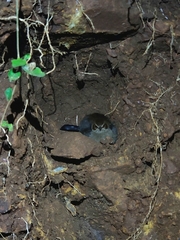
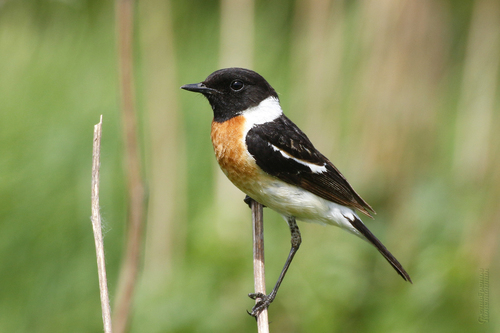
The Indian robin (Copsychus fulicatus) is a species of passerine bird in the family Muscicapidae. It is widespread in the Indian subcontinent and ranges across Bangladesh, Bhutan, India, Nepal, Pakistan and Sri Lanka. The males of the northern subspecies have brown backs whose extent gradually reduces southwards, with the males of the southern subspecies having all-black backs. They are commonly found in open scrub areas and often seen running along the ground or perching on low thorny shrubs and rocks. The long tail is usually held up and the chestnut undertail coverts and dark body make them easily distinguishable from pied bushchats and Oriental magpie-robins.

In 1760, the French zoologist Mathurin Jacques Brisson included a description of the Indian robin in his Ornithologie based on a specimen that he mistakenly believed had been collected in the Philippines. He used the French name Le grand traquet des Philippines and the Latin Rubetra Philippensis Major. Although Brisson coined Latin names, these do not conform to the binomial system and are not recognised by the International Commission on Zoological Nomenclature. When the Swedish naturalist Carl Linnaeus updated... Wikipedia →

Sounds

Recording0:16

India · 2024

© Mayukh Hajra · iNaturalist · CC BY-NC 4.0

Recording0:09

India · 2020

© Dr Adil A · iNaturalist · CC BY-NC 4.0

Recording0:11

India · 2026

© Mamatha Achanta · iNaturalist · CC BY-NC 4.0

Global Distribution

Parks Where Found

# Park Country Daily sighting probability
1 Yala National Park 🇱🇰 Sri Lanka
~80%
2 Udawalawe National Park 🇱🇰 Sri Lanka
~70%
3 Gir National Park 🇮🇳 India
~70%
4 Wilpattu National Park 🇱🇰 Sri Lanka
~60%
5 Keoladeo National Park 🇮🇳 India
~60%
6 Ranthambore National Park 🇮🇳 India
~60%
7 Minneriya National Park 🇱🇰 Sri Lanka
~50%
8 Bandhavgarh National Park 🇮🇳 India
~50%
9 Satpura National Park 🇮🇳 India
~40%
10 Mudumalai National Park 🇮🇳 India
~30%
11 Jim Corbett National Park 🇮🇳 India
~30%
12 Bandipur National Park 🇮🇳 India
~20%
13 Kanha National Park 🇮🇳 India
~20%
14 Royal Bardia National Park 🇳🇵 Nepal
~10%
15 Nagarhole National Park 🇮🇳 India
~10%
16 Horton Plains National Park 🇱🇰 Sri Lanka
<5%
17 Sinharaja Forest Reserve 🇱🇰 Sri Lanka
<5%
18 Chitwan National Park 🇳🇵 Nepal
<5%
19 Periyar National Park 🇮🇳 India
<5%

Cities Where Found

# City Country Daily sighting probability
1 Solapur 🇮🇳 India
~80%
2 Nashik 🇮🇳 India
~70%
3 Raipur 🇮🇳 India
~70%
4 Durg 🇮🇳 India
~60%
5 Indore 🇮🇳 India
~60%
6 Jodhpur 🇮🇳 India
~60%
7 Madurai 🇮🇳 India
~60%
8 Bhopal 🇮🇳 India
~50%
9 Jaipur 🇮🇳 India
~50%
10 Rajkot 🇮🇳 India
~50%

Before you go

What are the chances of seeing an Indian Robin in Mumbai?

With luck

About 10% of wildlife watchers report an Indian Robin sighting in Mumbai on a given day, based on 896 verified sightings from GBIF citizen-science data. It is the 60th most-seen of the 283 birds we can rate there. Over three days the chance rises to about 30%, and over a week to about 60%, if each day is a fresh chance.

When is the best time to see an Indian Robin in Mumbai?

April and May

In those months about 20% of wildlife watchers report an Indian Robin in Mumbai on a given day, against under 5% in July to September, the lowest months. Those are among Mumbai's driest months, with about 15 mm of rain a month against 830 mm in July.

What time of day is best to see an Indian Robin?

Between 7 and 10 am

Across all the parks we cover, that three-hour window holds the most Indian Robin sightings with a recorded time, and about 9 in 10 of them come between 6 am and 6 pm: it is a daytime animal.

Is Mumbai the best place to see an Indian Robin?

40th of 56

Of the 56 cities where we can rate Indian Robin sightings, Mumbai ranks 40th at about 10%. The best odds are in Solapur (India, about 80%), Nashik (India, about 70%) and Raipur (India, about 70%).

Where does the Indian Robin sighting chance come from?

GBIF citizen-science records

It is estimated from how often the Indian Robin is recorded against all the birds logged in Mumbai (896 verified sightings), calibrated against known sighting rates. Figures are rounded to the nearest 10% because citizen-science data supports honest approximations, not decimals, and months with records from fewer than five people show "—". How it works.

← Back to Mumbai