Red Knot

Red Knot

Calidris canutus

Silhouette: Richard Rich · PhyloPic

LCNTNear ThreatenedVUENCR
Daily sighting probability <5% · Rare
at Panama City

In 3 days ~10% in a week ~30%

265 Verified sightings at Panama City
2,547 In all 24 parks From 2019 to 2026
May Best month
☀️ Diurnal When it's spotted

About the Red Knot

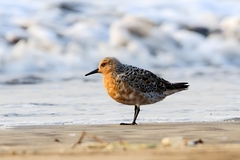
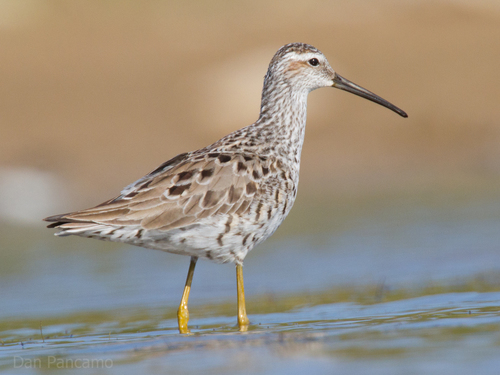
The red knot or just knot (Calidris canutus) is a medium-sized shorebird which breeds in tundra and the Arctic Cordillera in the far north of Canada, Europe, and Russia. It is the type species of the genus Calidris. Six subspecies are recognised.

Their diet varies according to season; arthropods and larvae are the preferred food items at the breeding grounds, while various hard-shelled molluscs are consumed at other feeding sites at other times. North American breeders migrate to coastal areas in Europe and South America, while the Eurasian populations winter in Africa, Papua New Guinea, Australia, and New Zealand. This species forms enormous flocks when not breeding.

The red knot was first described by Carl Linnaeus in his landmark 1758 10th edition of Systema Naturae as Tringa canutus. The red knot and the great knot were originally the only two species placed in the genus Calidris, but many other species of sandpiper were subsequently added. A 2004 study found that the genus was polyphyletic and that the closest relative of the two knot species is the surfbird (Calidris virgata).

There are six subspecies, in order of size: Wikipedia →

Sounds

Recording0:05

Denmark · 2025

© Lars Mogensen · XC1030302 · CC BY-NC-SA 4.0

Flight call0:11

Estonia · 2025

© Uku Paal · XC1024540 · CC BY-NC-SA 4.0

Nocturnal flight call0:26

United Kingdom · 2025

© Will Scott · XC1006207 · CC BY-NC-SA 4.0

Global Distribution

Parks Where Found

# Park Country Daily sighting probability
1 Wadden Sea National Park 🇩🇪 Germany
~20%
2 Padre Island National Seashore 🇺🇸 United States
~10%
3 West Coast National Park 🇿🇦 South Africa
~10%
4 El Vizcaíno Biosphere Reserve 🇲🇽 Mexico
~10%
5 Ciénaga de Zapata 🇨🇺 Cuba
~10%
6 Snowdonia National Park 🇬🇧 United Kingdom
<5%
7 Doñana National Park 🇪🇸 Spain
<5%
8 Merritt Island National Wildlife Refuge 🇺🇸 United States
<5%
9 Ría Lagartos Biosphere Reserve 🇲🇽 Mexico
<5%
10 Pacific Rim National Park Reserve 🇨🇦 Canada
<5%
11 Cabo Blanco Absolute Nature Reserve 🇨🇷 Costa Rica
<5%
12 Camargue 🇫🇷 France
<5%
13 Rottnest Island 🇦🇺 Australia
<5%
14 Wilsons Promontory National Park 🇦🇺 Australia
<5%
15 Svalbard 🇳🇴 Norway
<5%
16 Gros Morne National Park 🇨🇦 Canada
<5%
17 Everglades National Park 🇺🇸 United States
<5%
18 iSimangaliso Wetland Park 🇿🇦 South Africa
<5%
19 Channel Islands National Park 🇺🇸 United States
<5%
20 Great Bear Rainforest 🇨🇦 Canada
<5%
21 Bastimentos Island National Marine Park 🇵🇦 Panama
<5%
22 Point Pelee National Park 🇨🇦 Canada
<5%
23 Olympic National Park 🇺🇸 United States
<5%
24 La Amistad International Park (Panama) 🇵🇦 Panama
<5%

Cities Where Found

# City Country Daily sighting probability
1 Liverpool 🇬🇧 United Kingdom
~40%
2 Auckland 🇳🇿 New Zealand
~10%
3 Dublin 🇮🇪 Ireland
~10%
4 Panama City 🇵🇦 Panama
<5%
5 Maputo 🇲🇿 Mozambique
<5%
6 Seattle 🇺🇸 United States
<5%
7 San Diego 🇺🇸 United States
<5%
8 Havana 🇨🇺 Cuba
<5%
9 Manila 🇵🇭 Philippines
<5%
10 Porto 🇵🇹 Portugal
<5%

Zoos & Centres Where Found

# Zoo / Centre Country
1 National Zoological Park 🇺🇸 United States In captivity
2 Monterey Bay Aquarium 🇺🇸 United States In captivity

Before you go

What are the chances of seeing a Red Knot in Panama City?

Rare

Under 5% of wildlife watchers report a Red Knot sighting in Panama City on a given day, based on 265 verified sightings from GBIF citizen-science data. It is the 116th most-seen of the 363 birds we can rate there. Over three days the chance rises to about 10%, and over a week to about 30%, if each day is a fresh chance.

When is the best time to see a Red Knot in Panama City?

April–May and December

In those months about 10% of wildlife watchers report a Red Knot in Panama City on a given day, against under 5% in January–March and June–November, the lowest months.

What time of day is best to see a Red Knot?

Between 11 am and 2 pm

Across all the parks we cover, that three-hour window holds the most Red Knot sightings with a recorded time, and about 9 in 10 of them come between 6 am and 6 pm: it is a daytime animal.

Is Panama City the best place to see a Red Knot?

4th of 31

Of the 31 cities where we can rate Red Knot sightings, Panama City ranks 4th at under 5%. The best odds are in Liverpool (United Kingdom, about 40%), Auckland (New Zealand, about 10%) and Dublin (Ireland, about 10%).

Which relatives of the Red Knot live in Panama City?

Same genus: Calidris

The closest relatives of the Red Knot that you can see in Panama City (genus Calidris, Calidris Sandpipers) are Western Sandpiper (about 20%), Semipalmated Sandpiper (about 10%) and Least Sandpiper (about 10%), with each one's daily chance of a sighting.

Where does the Red Knot sighting chance come from?

GBIF citizen-science records

It is estimated from how often the Red Knot is recorded against all the birds logged in Panama City (265 verified sightings), calibrated against known sighting rates. Figures are rounded to the nearest 10% because citizen-science data supports honest approximations, not decimals, and months with records from fewer than five people show "—". How it works.

← Back to Panama City