Savanna Hawk

Savanna Hawk

Buteogallus meridionalis

Silhouette: Sheatherius · PhyloPic

LCLeast ConcernNTVUENCR
Daily sighting probability <5% · Rare
at Panama City

In 3 days ~10% in a week ~30%

294 Verified sightings at Panama City
1,929 In all 19 parks From 2019 to 2026
September Best month
☀️ Diurnal When it's spotted

About the Savanna Hawk

The savanna hawk (Buteogallus meridionalis) is a large raptor found in open savanna and swamp edges. It was formerly placed in the genus Heterospizias. It breeds from Panama and Trinidad south to Bolivia, Uruguay and central Argentina. There are also reports of it in California, from 1973 in Alameda County and from 1974 in San Diego County.

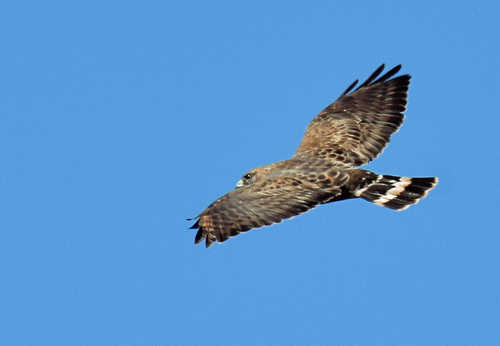
The savanna hawk is 46–61 cm (18–24 in) in length and weighs 845 g (29.8 oz). The adult has a rufous body with grey mottling above and fine black barring below. The flight feathers of the long broad wings are black, and the tail is banded black and white. The legs are yellow. The call is a loud scream keeeeru.

Immature birds are similar to the adults but have darker, duller upperparts, paler underparts with coarser barring, and a whitish supercilium. This species perches very vertically, and its legs are strikingly long. The savanna hawk feeds on small mammals, small birds, lizards, snakes, toads, frogs, eels, other fish, crabs, roots, spiders, and large insects (such as grasshoppers). It usually sits on an open high perch from which it swoops on its prey, but will also hunt on foot, and several birds may... Wikipedia →

Sounds

Flight call0:23

Brazil · 2026

© JAYRSON ARAUJO DE OLIVEIRA · XC1135387 · CC BY-NC-SA 4.0

Begging call0:53

Brazil · 2023

© Robson Silva e Silva · XC1018282 · CC BY-NC-SA 4.0

Call0:31

Bolivia · 2021

© Richard E. Webster · XC704727 · CC BY-NC-SA 4.0

Global Distribution

Parks Where Found

# Park Country Daily sighting probability
1 Emas National Park 🇧🇷 Brazil
~60%
2 Parque Estadual Encontro das Águas 🇧🇷 Brazil
~60%
3 San Lorenzo Protected Forest 🇵🇦 Panama
~20%
4 Iberá National Park 🇦🇷 Argentina
~20%
5 Serra da Canastra National Park 🇧🇷 Brazil
~10%
6 El Impenetrable National Park 🇦🇷 Argentina
~10%
7 Sierra de la Macarena National Park 🇨🇴 Colombia
<5%
8 Caroni Swamp 🇹🇹 Trinidad and Tobago
<5%
9 Serra dos Órgãos National Park 🇧🇷 Brazil
<5%
10 El Palmar National Park 🇦🇷 Argentina
<5%
11 Machalilla National Park 🇪🇨 Ecuador
<5%
12 Itatiaia National Park 🇧🇷 Brazil
<5%
13 Anavilhanas National Park 🇧🇷 Brazil
<5%
14 Amboró National Park 🇧🇴 Bolivia
<5%
15 Chapada Diamantina National Park 🇧🇷 Brazil
<5%
16 Tayrona National Natural Park 🇨🇴 Colombia
<5%
17 Chapada dos Guimarães National Park 🇧🇷 Brazil
<5%
18 Parque Natural Metropolitano 🇵🇦 Panama
<5%
19 Piedras Blancas National Park 🇨🇷 Costa Rica
<5%

Cities Where Found

# City Country Daily sighting probability
1 Guayaquil 🇪🇨 Ecuador
~10%
2 Panama City 🇵🇦 Panama
<5%
3 Barranquilla 🇨🇴 Colombia
<5%
4 Santa Cruz de la Sierra 🇧🇴 Bolivia
<5%
5 Curitiba 🇧🇷 Brazil
<5%
6 Goiânia 🇧🇷 Brazil
<5%
7 Porto Alegre 🇧🇷 Brazil
<5%
8 Campo Grande 🇧🇷 Brazil
<5%
9 Belo Horizonte 🇧🇷 Brazil
<5%
10 Rio de Janeiro 🇧🇷 Brazil
<5%

Zoos & Centres Where Found

# Zoo / Centre Country
1 São Paulo Zoo 🇧🇷 Brazil In captivity
2 Parque de las Leyendas 🇵🇪 Peru In captivity
3 Aviario Nacional de Colombia 🇨🇴 Colombia In captivity
4 Bioparque Los Ocarros 🇨🇴 Colombia In captivity
5 Bioparque Wakatá 🇨🇴 Colombia In captivity
6 Mangal das Garças 🇧🇷 Brazil In captivity
7 El Nispero Zoo 🇵🇦 Panama In captivity
8 Parque dos Falcões 🇧🇷 Brazil In captivity
9 Zoológico de Canindé 🇧🇷 Brazil In captivity
10 GüiráOga 🇦🇷 Argentina In captivity

Before you go

What are the chances of seeing a Savanna Hawk in Panama City?

Rare

Under 5% of wildlife watchers report a Savanna Hawk sighting in Panama City on a given day, based on 294 verified sightings from GBIF citizen-science data. It is the 119th most-seen of the 363 birds we can rate there. Over three days the chance rises to about 10%, and over a week to about 30%, if each day is a fresh chance.

When is the best time to see a Savanna Hawk in Panama City?

February, September and November–December

In those months about 10% of wildlife watchers report a Savanna Hawk in Panama City on a given day, against under 5% in January, March–August and October, the lowest months.

What time of day is best to see a Savanna Hawk?

Between 3 and 6 pm

Across all the parks we cover, that three-hour window holds the most Savanna Hawk sightings with a recorded time, and about 9 in 10 of them come between 6 am and 6 pm: it is a daytime animal.

Is Panama City the best place to see a Savanna Hawk?

2nd of 12

Of the 12 cities where we can rate Savanna Hawk sightings, Panama City ranks 2nd at under 5%. The best odds are in Guayaquil (Ecuador, about 10%).

Where does the Savanna Hawk sighting chance come from?

GBIF citizen-science records

It is estimated from how often the Savanna Hawk is recorded against all the birds logged in Panama City (294 verified sightings), calibrated against known sighting rates. Figures are rounded to the nearest 10% because citizen-science data supports honest approximations, not decimals, and months with records from fewer than five people show "—". How it works.

← Back to Panama City