Crested Lark

Crested Lark

Galerida cristata

Silhouette: Gossipguy and T. Michael Keesey · PhyloPic

LCLeast ConcernNTVUENCR
Daily sighting probability ~10% · With luck
at Ramallah

In 3 days ~40% in a week ~70%

86 Verified sightings at Ramallah
5,234 In all 13 parks From 2019 to 2026
May Best month
☀️ Diurnal When it's spotted

About the Crested Lark

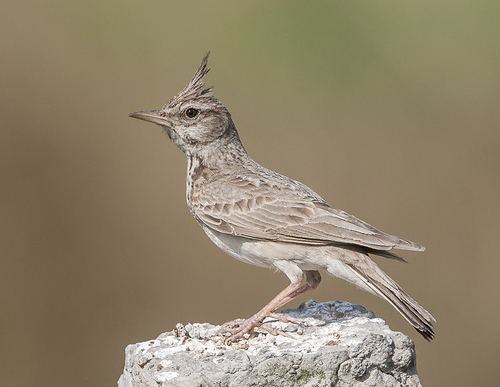
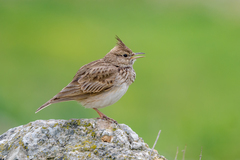
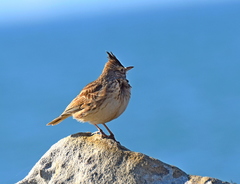
The crested lark (Galerida cristata) is a species of lark widespread across Eurasia and northern Africa. It is a non-migratory bird, but can occasionally be found as a vagrant in Great Britain. The crested lark was one of the many species originally described by Carl Linnaeus in his landmark 1758 10th edition of Systema Naturae. It was classified in the genus Alauda until German naturalist Friedrich Boie placed it in the new genus Galerida in 1821. Colin Harrison recommended lumping members of Galerida and Lullula back into Alauda in 1865 due to a lack of defining characteristics. The current scientific name is derived from Latin. Galerida was the name for a lark with a crest, from galerum, "cap", and cristata means "crested". Alban Guillaumet and colleagues noted the distinctiveness of populations from the Maghreb—birds in the dryer parts of Morocco and Tunisia had longer bills while those in more coastal northern parts had shorter bills typical of the European subspecies. The authors sampled the mitochondrial DNA and found they were distinct genetically. Wikipedia →

Sounds

Song1:09

Senegal · 2026

© Peter Boesman · XC1081202 · CC BY-NC-ND 4.0

Call1:03

Italy · 2025

© Francesco Sottile · XC995971 · CC BY-NC-SA 4.0

Flight call0:07

Italy · 2015

© Marco Dragonetti · XC314948 · CC BY-NC-ND 4.0

Global Distribution

Parks Where Found

# Park Country Daily sighting probability
1 Doñana National Park 🇪🇸 Spain
~40%
2 Monfragüe National Park 🇪🇸 Spain
~30%
3 Camargue 🇫🇷 France
~30%
4 Hortobágy National Park 🇭🇺 Hungary
~30%
5 Kiskunság National Park 🇭🇺 Hungary
~20%
6 Sierra Nevada National Park 🇪🇸 Spain
~10%
7 Gobi Gurvansaikhan National Park 🇲🇳 Mongolia
~10%
8 Sierra de Guadarrama National Park 🇪🇸 Spain
~10%
9 Fertő-Hanság National Park 🇭🇺 Hungary
~10%
10 Ranthambore National Park 🇮🇳 India
<5%
11 Keoladeo National Park 🇮🇳 India
<5%
12 Pyrénées National Park 🇫🇷 France
<5%
13 Chitwan National Park 🇳🇵 Nepal
<5%

Cities Where Found

# City Country Daily sighting probability
1 Antalya 🇹🇷 Turkey
~50%
2 Manama 🇧🇭 Bahrain
~50%
3 Karaj 🇮🇷 Iran
~40%
4 Sincan 🇹🇷 Turkey
~40%
5 Doha 🇶🇦 Qatar
~30%
6 Dakar 🇸🇳 Senegal
~30%
7 Tunis 🇹🇳 Tunisia
~20%
8 Riyadh 🇸🇦 Saudi Arabia
~20%
9 Tel Aviv 🇮🇱 Israel
~20%
10 Izmir 🇹🇷 Turkey
~20%

Before you go

What are the chances of seeing a Crested Lark in Ramallah?

With luck

About 10% of wildlife watchers report a Crested Lark sighting in Ramallah on a given day, based on 86 verified sightings from GBIF citizen-science data. It is the 42nd most-seen of the 118 birds we can rate there. Over three days the chance rises to about 40%, and over a week to about 70%, if each day is a fresh chance.

When is the best time to see a Crested Lark in Ramallah?

May–August and December

In those months about 20% of wildlife watchers report a Crested Lark in Ramallah on a given day, against about 10% in January–April and September–November, the lowest months. Those are among Ramallah's driest months, with about 20 mm of rain a month against 90 mm in January.

What time of day is best to see a Crested Lark?

Between 8 and 11 am

Across all the parks we cover, that three-hour window holds the most Crested Lark sightings with a recorded time, and about 8 in 10 of them come between 6 am and 6 pm: it is a daytime animal.

Is Ramallah the best place to see a Crested Lark?

12th of 42

Of the 42 cities where we can rate Crested Lark sightings, Ramallah ranks 12th at about 10%. The best odds are in Antalya (Turkey, about 50%), Manama (Bahrain, about 50%) and Karaj (Iran, about 40%).

Where does the Crested Lark sighting chance come from?

GBIF citizen-science records

It is estimated from how often the Crested Lark is recorded against all the birds logged in Ramallah (86 verified sightings), calibrated against known sighting rates. Figures are rounded to the nearest 10% because citizen-science data supports honest approximations, not decimals, and months with records from fewer than five people show "—". How it works.

← Back to Ramallah