





Completed

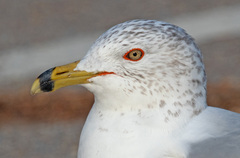



Ring-billed Gull
Larus delawarensis
Silhouette: Jason Dilworth · PhyloPic
- KingdomAnimalia (Animals)
- PhylumChordata (Chordates)
- ClassAves (Birds)
- OrderCharadriiformes (Shorebirds and Allies)
- FamilyLaridae (Gulls, Terns, and Skimmers)
- GenusLarus (Large White-headed Gulls)
- SpeciesLarus delawarensis (Ring-billed Gull)
In 3 days ~30% in a week ~60%
1,765 Verified sightings at Sacramento
26,706 In all 34 parks From 2019 to 2026
December Best month
☀️ Diurnal When it's spotted
About the Ring-billed Gull
The ring-billed gull (Larus delawarensis) is a medium-sized gull native to North America, breeding in Canada and the northern Contiguous United States, and wintering mainly in the United States and northern Mexico. The genus name is from Latin Larus which appears to have referred to a gull or other large seabird. The specific delawarensis refers to the Delaware River.
The ring-billed gull is a medium-sized gull, having an average length of 43 to 54 centimetres (16.9 to 21.3 in) and a wingspan that ranges from 105 to 117 centimetres (41.3 to 46.1 in). Adults weigh from 300 to 700 grams (10.6 to 24.7 oz).
The head, neck and underparts are white; the relatively short bill is yellow with a black ring; the back and wings are silver grey with black wingtips with white 'mirrors'; and the legs are yellow. The eyes are yellow with red rims. This gull takes three years to reach its breeding plumage starting with the largely brown juvenile plumage, its appearance changing with each fall moult.
The average lifespan of an individual that reaches adulthood is 10.9 years. The oldest ring-billed gull on record was observed in Cleveland in 2021, still alive at the age of 28 years... Wikipedia →
Recent sightings of Ring-billed Gull in Sacramento
LIVEiNaturalistGlobal Distribution
Parks Where Found
Cities Where Found
| # | City | Country | Daily sighting probability |
|---|---|---|---|
| 1 | Toronto | 🇨🇦 Canada | |
| 2 | Montreal | 🇨🇦 Canada | |
| 3 | Chicago | 🇺🇸 United States | |
| 4 | Edmonton | 🇨🇦 Canada | |
| 5 | Calgary | 🇨🇦 Canada | |
| 6 | New York City | 🇺🇸 United States | |
| 7 | Denver | 🇺🇸 United States | |
| 8 | Baltimore | 🇺🇸 United States | |
| 9 | Detroit | 🇺🇸 United States | |
| 10 | Boston | 🇺🇸 United States |
Zoos & Centres Where Found
| # | Zoo / Centre | Country | |
|---|---|---|---|
| 1 | Cameron Park Zoo | 🇺🇸 United States | |
| 2 | Animal Forest | 🇺🇸 United States | |
| 3 | South Carolina Aquarium | 🇺🇸 United States |
Closest Relatives at Sacramento




Before you go
What are the chances of seeing a Ring-billed Gull in Sacramento?
With luck
About 10% of wildlife watchers report a Ring-billed Gull sighting in Sacramento on a given day, based on 1,765 verified sightings from GBIF citizen-science data. It is the 65th most-seen of the 235 birds we can rate there. Over three days the chance rises to about 30%, and over a week to about 60%, if each day is a fresh chance.
When is the best time to see a Ring-billed Gull in Sacramento?
December
In that month about 30% of wildlife watchers report a Ring-billed Gull in Sacramento on a given day, against under 5% in April to September, the lowest months. That is one of Sacramento's wettest months, with about 120 mm of rain against almost none in July.
What time of day is best to see a Ring-billed Gull?
Between noon and 3 pm
Across all the parks we cover, that three-hour window holds the most Ring-billed Gull sightings with a recorded time, and about 9 in 10 of them come between 6 am and 6 pm: it is a daytime animal.
Is Sacramento the best place to see a Ring-billed Gull?
22nd of 42
Of the 42 cities where we can rate Ring-billed Gull sightings, Sacramento ranks 22nd at about 10%. The best odds are in Toronto (Canada, about 70%), Montreal (Canada, about 70%) and Chicago (United States, about 60%).
Which relatives of the Ring-billed Gull live in Sacramento?
Same genus: Larus
The closest relatives of the Ring-billed Gull that you can see in Sacramento (genus Larus, Large White-headed Gulls) are California Gull (about 20%) and American Herring Gull (about 10%), with each one's daily chance of a sighting.
Where does the Ring-billed Gull sighting chance come from?
GBIF citizen-science records
It is estimated from how often the Ring-billed Gull is recorded against all the birds logged in Sacramento (1,765 verified sightings), calibrated against known sighting rates. Figures are rounded to the nearest 10% because citizen-science data supports honest approximations, not decimals, and months with records from fewer than five people show "—". How it works.
