

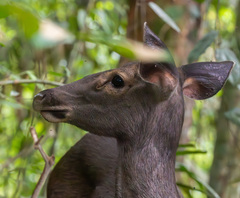

Completed

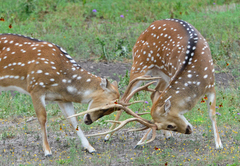
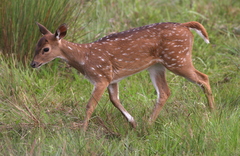


Axis Deer
Axis axis
Silhouette: Steven Traver · PhyloPic
- KingdomAnimalia (Animals)
- PhylumChordata (Chordates)
- ClassMammalia (Mammals)
- OrderArtiodactyla (Even-toed Ungulates and Cetaceans)
- FamilyCervidae (Deer)
- GenusAxis (Axis Deer)
- SpeciesAxis axis (Axis Deer)
In 3 days ~10% in a week ~20%
13 Verified sightings at San Antonio
2,176 In all 18 parks From 2019 to 2026
November Best month
☀️ Diurnal When it's spotted
About the Axis Deer
The chital (Axis axis; ), also called spotted deer and axis deer, is a deer species native to the Indian subcontinent. It was first described by Johann Christian Polycarp Erxleben in 1777. A moderate-sized deer, male chital reach 90 cm (35 in) and females 70 cm (28 in) at the shoulder. While males weigh 70–90 kg (150–200 lb), females weigh around 40–60 kg (88–132 lb). It is sexually dimorphic; males are larger than females, and antlers are present only on males. The upper parts are golden to rufous, completely covered in white spots. The abdomen, rump, throat, insides of legs, ears, and tail are all white. The antlers, three-pronged, are nearly 1 m (3 ft 3 in) long.
The vernacular name "chital" (pronounced ) comes from cītal (Hindi: चीतल), derived from the Sanskrit word citrala (चित्रल), meaning "variegated" or "spotted". The name of the cheetah has a similar origin. Variations of "chital" include "cheetal" and "cheetul". Other common names for the chital are Indian spotted deer (or simply the spotted deer) and axis deer.
The chital was first described by Johann Christian Polycarp Erxleben in 1777 as Cervus axis. In 1827, Charles Hamilton... Wikipedia →
Recent sightings of Axis Deer in San Antonio
LIVEiNaturalistGlobal Distribution
Parks Where Found
| # | Park | Country | Daily sighting probability |
|---|---|---|---|
| 1 | Wilpattu National Park | 🇱🇰 Sri Lanka | |
| 2 | Yala National Park | 🇱🇰 Sri Lanka | |
| 3 | Ranthambore National Park | 🇮🇳 India | |
| 4 | Nagarhole National Park | 🇮🇳 India | |
| 5 | Mudumalai National Park | 🇮🇳 India | |
| 6 | Chitwan National Park | 🇳🇵 Nepal | |
| 7 | Bandipur National Park | 🇮🇳 India | |
| 8 | Bandhavgarh National Park | 🇮🇳 India | |
| 9 | Kanha National Park | 🇮🇳 India | |
| 10 | Udawalawe National Park | 🇱🇰 Sri Lanka | |
| 11 | Keoladeo National Park | 🇮🇳 India | |
| 12 | Gir National Park | 🇮🇳 India | |
| 13 | Sundarbans National Park | 🇮🇳 India | |
| 14 | Jim Corbett National Park | 🇮🇳 India | |
| 15 | Royal Bardia National Park | 🇳🇵 Nepal | |
| 16 | El Palmar National Park | 🇦🇷 Argentina | |
| 17 | Satpura National Park | 🇮🇳 India | |
| 18 | Minneriya National Park | 🇱🇰 Sri Lanka |
Zoos & Centres Where Found
Closest Relatives at San Antonio




Before you go
What are the chances of seeing an Axis Deer in San Antonio?
Rare
Under 5% of wildlife watchers report an Axis Deer sighting in San Antonio on a given day, based on 13 verified sightings from GBIF citizen-science data. It is the 15th most-seen of the 17 mammals we can rate there. Over three days the chance rises to about 10%, and over a week to about 20%, if each day is a fresh chance.
When is the best time to see an Axis Deer in San Antonio?
November and December
In those months about 10% of wildlife watchers report an Axis Deer in San Antonio on a given day, against under 5% in January to October, the lowest months.
What time of day is best to see an Axis Deer?
Between 3 and 6 pm
Across all the parks we cover, that three-hour window holds the most Axis Deer sightings with a recorded time, and about 8 in 10 of them come between 6 am and 6 pm: it is a daytime animal.
Is San Antonio the best place to see an Axis Deer?
7th of 7
Of the 7 cities where we can rate Axis Deer sightings, San Antonio ranks 7th at under 5%. The best odds are in Bhopal (India, about 40%), Chennai (India, about 30%) and Jaipur (India, about 20%).
Where does the Axis Deer sighting chance come from?
GBIF citizen-science records
It is estimated from how often the Axis Deer is recorded against all the mammals logged in San Antonio (13 verified sightings), calibrated against known sighting rates. Figures are rounded to the nearest 10% because citizen-science data supports honest approximations, not decimals, and months with records from fewer than five people show "—". How it works.
