American Oystercatcher

American Oystercatcher

Haematopus palliatus

Silhouette: Andy Wilson · PhyloPic

LCLeast ConcernNTVUENCR
Daily sighting probability <5% · Rare
at Santos

In 3 days ~10%

38 Verified sightings at Santos
5,145 In all 20 parks From 2019 to 2026
November Best month
☀️ Diurnal When it's spotted

About the American Oystercatcher

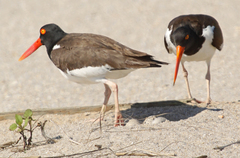
The American oystercatcher (Haematopus palliatus), occasionally called the American pied oystercatcher, is a member of family Haematopodidae. Originally called the "sea pie", it was renamed in 1731 when naturalist Mark Catesby claimed that he had observed the bird eating oysters. The current population of American oystercatchers is estimated to be 50,000 – 99,999 mature individuals. There are estimated to be 1,500 breeding pairs along the Atlantic and Gulf Coasts of the US. The bird is marked by its black and white body and a long, thick orange beak.

The American oystercatcher has distinctive black and white plumage and a long, bright orange beak. The head and breast are black and the back, wings and tail greyish-black. The underparts are white, as are feathers on the inner part of the wing which become visible during flight. The irises are yellow and the eyes have orange orbital rings. The legs are pink. Adults are between 42–52 cm (17–20 in) in length.

The American oystercatcher is found on the Atlantic coast of North America from coastal Massachusetts to northern Florida, where it is also found on the Gulf coast, the Caribbean, and south to Brazil... Wikipedia →

Sounds

Duet0:18

Ecuador · 2023

© Jonas Nilsson · XC1008553 · CC BY-NC-SA 4.0

Call0:23

Mexico · 2020

© Manuel Grosselet · XC573992 · CC BY-NC-SA 4.0

Alarm call0:43

Mexico · 2020

© Isain Contreras Rodríguez · XC572455 · CC BY-NC-SA 4.0

Global Distribution

Parks Where Found

# Park Country Daily sighting probability
1 Península Valdés 🇦🇷 Argentina
~80%
2 Coiba National Park 🇵🇦 Panama
~30%
3 Galápagos Islands 🇪🇨 Ecuador
~30%
4 Ría Lagartos Biosphere Reserve 🇲🇽 Mexico
~20%
5 El Vizcaíno Biosphere Reserve 🇲🇽 Mexico
~10%
6 Las Baulas Marine National Park 🇨🇷 Costa Rica
~10%
7 Cabo Blanco Absolute Nature Reserve 🇨🇷 Costa Rica
~10%
8 Ostional Wildlife Refuge 🇨🇷 Costa Rica
~10%
9 Marino Ballena National Park 🇨🇷 Costa Rica
~10%
10 Bahía de Loreto National Park 🇲🇽 Mexico
~10%
11 Corcovado National Park 🇨🇷 Costa Rica
~10%
12 Santa Rosa National Park 🇨🇷 Costa Rica
<5%
13 Big Cypress National Preserve 🇺🇸 United States
<5%
14 Channel Islands National Park 🇺🇸 United States
<5%
15 Celestún Biosphere Reserve 🇲🇽 Mexico
<5%
16 Padre Island National Seashore 🇺🇸 United States
<5%
17 Everglades National Park 🇺🇸 United States
<5%
18 Carara National Park 🇨🇷 Costa Rica
<5%
19 Acadia National Park 🇺🇸 United States
<5%
20 Merritt Island National Wildlife Refuge 🇺🇸 United States
<5%

Cities Where Found

# City Country Daily sighting probability
1 Lima 🇵🇪 Peru
~30%
2 Vitória 🇧🇷 Brazil
~20%
3 Montevideo 🇺🇾 Uruguay
~10%
4 Boston 🇺🇸 United States
~10%
5 New York City 🇺🇸 United States
<5%
6 Santos 🇧🇷 Brazil
<5%
7 Rio de Janeiro 🇧🇷 Brazil
<5%
8 Miami 🇺🇸 United States
<5%
9 San Diego 🇺🇸 United States
<5%
10 Panama City 🇵🇦 Panama
<5%

Zoos & Centres Where Found

# Zoo / Centre Country
1 National Zoological Park 🇺🇸 United States In captivity
2 Jacksonville Zoo and Gardens 🇺🇸 United States In captivity
3 Aviario Nacional de Colombia 🇨🇴 Colombia In captivity
4 Mangal das Garças 🇧🇷 Brazil In captivity
5 Mote Marine Laboratory 🇺🇸 United States In captivity
6 Seaside Seabird Sanctuary 🇺🇸 United States In captivity

Before you go

What are the chances of seeing an American Oystercatcher in Santos?

Rare

Under 5% of wildlife watchers report an American Oystercatcher sighting in Santos on a given day, based on 38 verified sightings from GBIF citizen-science data. It is the 105th most-seen of the 203 birds we can rate there. Over three days the chance rises to about 10%, if each day is a fresh chance.

When is the best time to see an American Oystercatcher in Santos?

September and November

In those months about 10% of wildlife watchers report an American Oystercatcher in Santos on a given day, against under 5% in October and December–August, the lowest months.

What time of day is best to see an American Oystercatcher?

Between 8 and 11 am

Across all the parks we cover, that three-hour window holds the most American Oystercatcher sightings with a recorded time, and about 9 in 10 of them come between 6 am and 6 pm: it is a daytime animal.

Is Santos the best place to see an American Oystercatcher?

6th of 10

Of the 10 cities where we can rate American Oystercatcher sightings, Santos ranks 6th at under 5%. The best odds are in Lima (Peru, about 30%), Vitória (Brazil, about 20%) and Montevideo (Uruguay, about 10%).

Which relatives of the American Oystercatcher live in Santos?

Same order: Charadriiformes

The closest relatives of the American Oystercatcher that you can see in Santos (order Charadriiformes, Shorebirds and Allies) are Southern Lapwing (about 40%), Dominican Gull (about 20%) and Cabot's Tern (about 10%), with each one's daily chance of a sighting.

Where does the American Oystercatcher sighting chance come from?

GBIF citizen-science records

It is estimated from how often the American Oystercatcher is recorded against all the birds logged in Santos (38 verified sightings), calibrated against known sighting rates. Figures are rounded to the nearest 10% because citizen-science data supports honest approximations, not decimals, and months with records from fewer than five people show "—". How it works.

← Back to Santos