Hawfinch

Hawfinch

Coccothraustes coccothraustes

Silhouette: Sheatherius · PhyloPic

LCLeast ConcernNTVUENCR
Daily sighting probability ~40% · Likely
at Sendai

In 3 days ~80% in a week >90%

211 Verified sightings at Sendai
3,066 In all 21 parks From 2019 to 2026
March Best month
☀️ Diurnal When it's spotted

About the Hawfinch

The hawfinch (Coccothraustes coccothraustes) is a passerine bird in the finch family Fringillidae. It is the only extant species placed in the genus Coccothraustes. Its closest living relatives are the genus Eophona of East Asia, and Hesperiphona of Central and North America.

This bird breeds across Europe and temperate Asia (Palearctic). It is mainly resident in Europe, but many Asian birds migrate further south in the winter. It is a rare vagrant to the western islands of Alaska. Deciduous or mixed woodland, including parkland, with large trees – especially hornbeam – is favoured for breeding. The hawfinch builds its nest in a bush or tree, and lays 2–7 eggs. The food is mainly seeds and fruit kernels, especially those of cherries, which it cracks with its powerful bill. This large finch species is usually seen in a pair or small group.

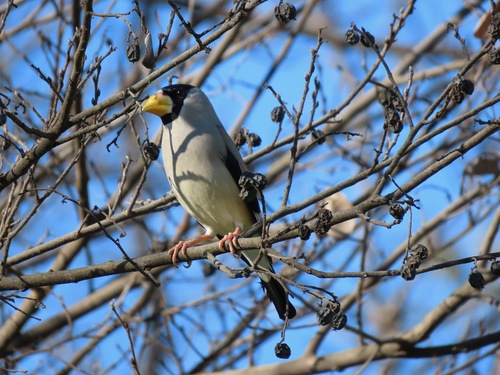
The 16.5–18 cm long hawfinch is a bulky bull-headed bird, which appears very short-tailed in flight. Its head is orange-brown with a black eyestripe and bib, and a massive bill, which is black in summer but paler in winter. The upper parts are dark brown and the underparts orange.

The white wing bars and tail tip are striking in flight. The sexes are similar. The call is a hard chick. The song of this unobtrusive bird is quiet and mumbled. Wikipedia →

Sounds

Call0:21

Sweden · 2025

© Lars Edenius · XC983067 · CC BY-NC-SA 4.0

Alarm call0:05

France · 2025

© FREDERIC Lionel · XC979193 · CC BY-NC-SA 4.0

Wingbeats0:18

Estonia · 2022

© Uku Paal · XC700501 · CC BY-NC-SA 4.0

Global Distribution

Parks Where Found

# Park Country Daily sighting probability
1 Białowieża National Park 🇵🇱 Poland
~50%
2 Biebrza National Park 🇵🇱 Poland
~30%
3 Gauja National Park 🇱🇻 Latvia
~30%
4 Plitvice Lakes National Park 🇭🇷 Croatia
~30%
5 Monfragüe National Park 🇪🇸 Spain
~20%
6 Bavarian Forest National Park 🇩🇪 Germany
~10%
7 Sierra Nevada National Park 🇪🇸 Spain
~10%
8 Kiskunság National Park 🇭🇺 Hungary
~10%
9 Gobi Gurvansaikhan National Park 🇲🇳 Mongolia
~10%
10 Triglav National Park 🇸🇮 Slovenia
~10%
11 Fertő-Hanság National Park 🇭🇺 Hungary
~10%
12 Tatra National Park 🇸🇰 Slovakia
<5%
13 Nikko National Park 🇯🇵 Japan
<5%
14 Sierra de Guadarrama National Park 🇪🇸 Spain
<5%
15 Aigüestortes National Park 🇪🇸 Spain
<5%
16 Cévennes National Park 🇫🇷 France
<5%
17 Hortobágy National Park 🇭🇺 Hungary
<5%
18 Pyrénées National Park 🇫🇷 France
<5%
19 Wadden Sea National Park 🇩🇪 Germany
<5%
20 Doñana National Park 🇪🇸 Spain
<5%
21 Snowdonia National Park 🇬🇧 United Kingdom
<5%

Cities Where Found

# City Country Daily sighting probability
1 Kharkiv 🇺🇦 Ukraine
~40%
2 Sendai 🇯🇵 Japan
~40%
3 Dushanbe 🇹🇯 Tajikistan
~30%
4 Budapest 🇭🇺 Hungary
~20%
5 Sofia 🇧🇬 Bulgaria
~20%
6 Minsk 🇧🇾 Belarus
~20%
7 Shenyang 🇨🇳 China
~20%
8 Beijing 🇨🇳 China
~20%
9 Prague 🇨🇿 Czechia
~20%
10 Berlin 🇩🇪 Germany
~10%

Zoos & Centres Where Found

# Zoo / Centre Country
1 Zoo Pilsen 🇨🇿 Czechia In captivity
2 Kaliningrad Zoo 🇷🇺 Russia In captivity
3 Beijing Wildlife Park 🇨🇳 China In captivity
4 Kharkiv Zoo 🇺🇦 Ukraine In captivity
5 Tierpark Hexentanzplatz 🇩🇪 Germany In captivity
6 Leningrad Zoo 🇷🇺 Russia In captivity
7 Zoopark Limpopo 🇷🇺 Russia In captivity
8 Kharkiv Dolphinarium 🇺🇦 Ukraine In captivity

Before you go

What are the chances of seeing a Hawfinch in Sendai?

Likely

About 40% of wildlife watchers report a Hawfinch sighting in Sendai on a given day, based on 211 verified sightings from GBIF citizen-science data. It is the 25th most-seen of the 107 birds we can rate there. Over three days the chance rises to about 80%, and over a week to over 90%, if each day is a fresh chance.

When is the best time to see a Hawfinch in Sendai?

January and March

In those months about 60% of wildlife watchers report a Hawfinch in Sendai on a given day, against about 10% in June to September, the lowest months.

What time of day is best to see a Hawfinch?

Between 8 and 11 am

Across all the parks we cover, that three-hour window holds the most Hawfinch sightings with a recorded time, and about 8 in 10 of them come between 6 am and 6 pm: it is a daytime animal.

Is Sendai the best place to see a Hawfinch?

Among the best

Of the 62 cities where we can rate Hawfinch sightings, Sendai ranks 2nd at about 40%, level with the leaders once rounded. The best odds are in Kharkiv (Ukraine, about 40%).

Which relatives of the Hawfinch live in Sendai?

Same family: Fringillidae

The closest relatives of the Hawfinch that you can see in Sendai (family Fringillidae, Finches, Euphonias, and Allies) are Oriental Greenfinch (about 70%), Long-tailed Rosefinch (about 20%) and Eurasian Siskin (about 10%), with each one's daily chance of a sighting.

Where does the Hawfinch sighting chance come from?

GBIF citizen-science records

It is estimated from how often the Hawfinch is recorded against all the birds logged in Sendai (211 verified sightings), calibrated against known sighting rates. Figures are rounded to the nearest 10% because citizen-science data supports honest approximations, not decimals, and months with records from fewer than five people show "—". How it works.

← Back to Sendai