Eurasian Nuthatch

Eurasian Nuthatch

Sitta europaea

Silhouette: robin_24 · PhyloPic

LCLeast ConcernNTVUENCR
Daily sighting probability ~20% · Possible
at Seoul

In 3 days ~40% in a week ~70%

1,242 Verified sightings at Seoul
8,039 In all 28 parks From 2019 to 2026
October Best month
☀️ Diurnal When it's spotted

About the Eurasian Nuthatch

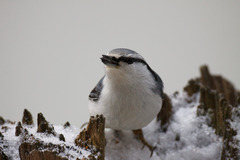
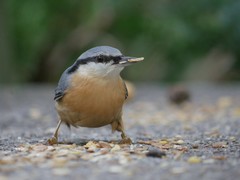
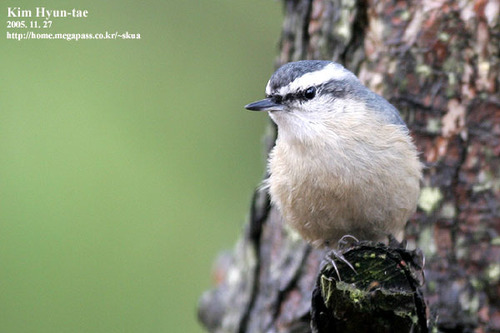
The Eurasian nuthatch, wood nuthatch (Sitta europaea), or simply nuthatch, is a small passerine bird found throughout the Palearctic and in Europe. Like other nuthatches, it is a short-tailed bird with a long bill, blue-gray upperparts and a black eye-stripe. It is a vocal bird with a repeated loud dwip call. There are more than 20 subspecies in three main groups; birds in the west of the range have orange-buff underparts and a white throat, those in Russia have whitish underparts, and those in the east have a similar appearance to European birds, but lack the white throat.

Its preferred habitat is mature deciduous or mixed woodland with large, old trees, preferably oak. Pairs hold permanent territories, and nest in tree holes, usually old woodpecker nests, but sometimes natural cavities. If the entrance to the hole is too large, the female plasters it with mud to reduce its size, and often coats the inside of the cavity too. The six to nine red-speckled white eggs are laid on a deep base of pine or other wood chips.

The Eurasian nuthatch eats mainly insects, particularly caterpillars and beetles, although in autumn and winter its diet is supplemented with nuts and seeds. The young are fed mainly on insects, with some seeds, food items mainly being found on tree trunks and large branches. The nuthatch can forage when descending trees head first, as well as when climbing. It readily visits bird tables, eating fatty man-made food items as well as seeds. It is an inveterate hoarder, storing food year-round. Its main natural predator is the Eurasian sparrowhawk.

Fragmentation of woodland can lead to local losses of breeding birds, but the species's range is still expanding. It has a large population and huge breeding area, and is therefore classified by the International Union for Conservation of Nature (IUCN) as being of least concern. Wikipedia →

Sounds

Song0:51

Sweden · 2026

© Lennart Jeppsson · XC1102572 · CC BY-NC-SA 4.0

Call0:51

Spain · 2026

© Jacobo Ramil Millarengo · XC1092574 · CC BY-NC-SA 4.0

Alarm call1:02

Sweden · 2024

© Ulf Elman · XC940526 · CC BY-NC-ND 4.0

Global Distribution

Parks Where Found

# Park Country Daily sighting probability
1 Plitvice Lakes National Park 🇭🇷 Croatia
~70%
2 Białowieża National Park 🇵🇱 Poland
~50%
3 Nikko National Park 🇯🇵 Japan
~50%
4 Triglav National Park 🇸🇮 Slovenia
~40%
5 Picos de Europa National Park 🇪🇸 Spain
~40%
6 Pyrénées National Park 🇫🇷 France
~40%
7 Sierra de Guadarrama National Park 🇪🇸 Spain
~30%
8 Bavarian Forest National Park 🇩🇪 Germany
~30%
9 Gauja National Park 🇱🇻 Latvia
~30%
10 Ordesa y Monte Perdido National Park 🇪🇸 Spain
~30%
11 Tatra National Park 🇸🇰 Slovakia
~20%
12 Aigüestortes National Park 🇪🇸 Spain
~20%
13 Taroko National Park 🇹🇼 Taiwan
~20%
14 Snowdonia National Park 🇬🇧 United Kingdom
~20%
15 Ecrins National Park 🇫🇷 France
~20%
16 Hohe Tauern National Park 🇦🇹 Austria
~20%
17 Biebrza National Park 🇵🇱 Poland
~20%
18 Sierra Nevada National Park 🇪🇸 Spain
~20%
19 Cévennes National Park 🇫🇷 France
~10%
20 Fertő-Hanság National Park 🇭🇺 Hungary
~10%
21 Monfragüe National Park 🇪🇸 Spain
~10%
22 Kiskunság National Park 🇭🇺 Hungary
~10%
23 Mercantour National Park 🇫🇷 France
~10%
24 Jiuzhaigou National Park 🇨🇳 China
~10%
25 Hortobágy National Park 🇭🇺 Hungary
<5%
26 Cairngorms National Park 🇬🇧 United Kingdom
<5%
27 Wadden Sea National Park 🇩🇪 Germany
<5%
28 Doñana National Park 🇪🇸 Spain
<5%

Cities Where Found

# City Country Daily sighting probability
1 Sapporo 🇯🇵 Japan
~60%
2 Yekaterinburg 🇷🇺 Russia
~60%
3 Vienna 🇦🇹 Austria
~50%
4 Prague 🇨🇿 Czechia
~50%
5 Munich 🇩🇪 Germany
~50%
6 Moscow 🇷🇺 Russia
~40%
7 Stockholm 🇸🇪 Sweden
~40%
8 Sofia 🇧🇬 Bulgaria
~40%
9 Manchester 🇬🇧 United Kingdom
~40%
10 Turin 🇮🇹 Italy
~30%

Zoos & Centres Where Found

# Zoo / Centre Country
1 Alpenzoo Innsbruck 🇦🇹 Austria In captivity

Before you go

What are the chances of seeing a Eurasian Nuthatch in Seoul?

Possible

About 20% of wildlife watchers report a Eurasian Nuthatch sighting in Seoul on a given day, based on 1,242 verified sightings from GBIF citizen-science data. It is the 37th most-seen of the 231 birds we can rate there. Over three days the chance rises to about 40%, and over a week to about 70%, if each day is a fresh chance.

When is the best time to see a Eurasian Nuthatch in Seoul?

March–April, July and September–December

In those months about 20% of wildlife watchers report a Eurasian Nuthatch in Seoul on a given day, against about 10% in January–February, May–June and August, the lowest months.

What time of day is best to see a Eurasian Nuthatch?

Between 9 am and noon

Across all the parks we cover, that three-hour window holds the most Eurasian Nuthatch sightings with a recorded time, and about 9 in 10 of them come between 6 am and 6 pm: it is a daytime animal.

Is Seoul the best place to see a Eurasian Nuthatch?

28th of 48

Of the 48 cities where we can rate Eurasian Nuthatch sightings, Seoul ranks 28th at about 20%. The best odds are in Sapporo (Japan, about 60%), Yekaterinburg (Russia, about 60%) and Vienna (Austria, about 50%).

Where does the Eurasian Nuthatch sighting chance come from?

GBIF citizen-science records

It is estimated from how often the Eurasian Nuthatch is recorded against all the birds logged in Seoul (1,242 verified sightings), calibrated against known sighting rates. Figures are rounded to the nearest 10% because citizen-science data supports honest approximations, not decimals, and months with records from fewer than five people show "—". How it works.

← Back to Seoul