Northern Beardless-Tyrannulet

Northern Beardless-Tyrannulet

Camptostoma imberbe

Silhouette: Emily Willoughby · PhyloPic

LCLeast ConcernNTVUENCR
Daily sighting probability <5% · Rare
at Cockscomb Basin Wildlife Sanctuary

In 3 days <5% in a week ~10%

12 Verified sightings at Cockscomb Basin Wildlife Sanctuary From 2019 to 2026
1,756 In all 23 parks
April Best month
☀️ Diurnal When it's spotted

About the Northern Beardless-Tyrannulet

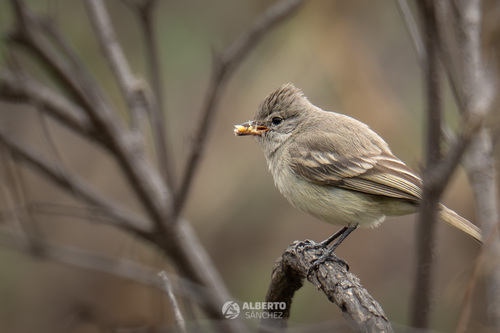
The northern beardless tyrannulet (Camptostoma imberbe) is a small passerine bird in the tyrant flycatcher family. It breeds from southeasternmost Arizona and Texas of the United States through Mexico and Central America to northwestern Costa Rica.

This species is found in light forests, cultivation and gardens with trees. The domed nest is made of plant fibre or leaves with a side entrance. The nest is placed by a tree fork. The typical clutch is two white eggs, which are marked with rufous and lilac mostly at the larger end. Incubation by the female is 14–15 days to hatching, with another 17 days to fledging.

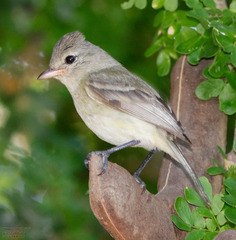
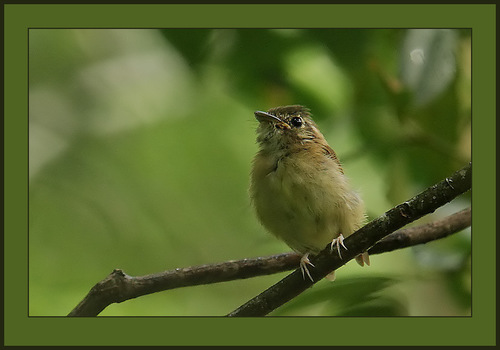
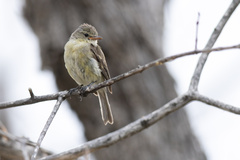
The northern beardless tyrannulet is 10.2 cm (4.0 in) long, and weighs 7.5 g (0.26 oz). The head is dark brown with an erectile crest and pale supercilium. The upperparts are grey-green becoming paler on the rump. The wings are brown with yellow feather-edging and two whitish wing bars. The tail is brown, the throat grey, the breast yellowish, and the abdomen yellow. The bill is pinkish.

Sexes are similar, and this species always appears not as bright, especially with regard to the wing bars, as the closely related southern beardless tyrannulet, C. obsoletum, with which it was once considered conspecific. However, the two forms overlap without interbreeding in Costa Rica.

Northern beardless tyrannulets are active birds, feeding in a vireo or warbler-like fashion on insects, spiders and berries. The call is a loud whistled Fleeeeeerrr, sometimes broken up as a fleeer-it, or a flee-flee-flee-flee. In courtship, or when alarmed, the crests are raised, the tail flicked, and an excited call is made. Wikipedia →
Sounds

Call0:10

Mexico · 2023

© Manuel Grosselet · XC807227 · CC BY-NC-SA 4.0

Recording0:08

Mexico · 2021

© Aziza Cooper · XC639864 · CC BY-NC-SA 4.0

Song0:23

Mexico · 2020

© Isain Contreras Rodríguez · XC572446 · CC BY-NC-SA 4.0

Global Distribution

Parks Where Found

# Park Country Daily sighting probability
1 El Triunfo 🇲🇽 Mexico
~20%
2 Calakmul Biosphere Reserve 🇲🇽 Mexico
~20%
3 Cañón del Sumidero National Park 🇲🇽 Mexico
~20%
4 Santa Rosa National Park 🇨🇷 Costa Rica
~10%
5 Arrecifes de Cozumel National Park 🇲🇽 Mexico
~10%
6 Celestún Biosphere Reserve 🇲🇽 Mexico
~10%
7 Tikal National Park 🇬🇹 Guatemala
~10%
8 Cumbres de Monterrey National Park 🇲🇽 Mexico
~10%
9 Rincón de la Vieja National Park 🇨🇷 Costa Rica
~10%
10 Las Baulas Marine National Park 🇨🇷 Costa Rica
~10%
11 Ostional Wildlife Refuge 🇨🇷 Costa Rica
~10%
12 Lago de Yojoa 🇭🇳 Honduras
<5%
13 Celaque National Park 🇭🇳 Honduras
<5%
14 Sian Ka'an Biosphere Reserve 🇲🇽 Mexico
<5%
15 Cabo Blanco Absolute Nature Reserve 🇨🇷 Costa Rica
<5%
16 Palo Verde National Park 🇨🇷 Costa Rica
<5%
17 Cerro Azul Meámbar National Park 🇭🇳 Honduras
<5%
18 Carara National Park 🇨🇷 Costa Rica
<5%
19 Ría Lagartos Biosphere Reserve 🇲🇽 Mexico
<5%
20 Cockscomb Basin Wildlife Sanctuary 🇧🇿 Belize
<5%
21 Saguaro National Park 🇺🇸 United States
<5%
22 Masaya Volcano National Park 🇳🇮 Nicaragua
<5%
23 Tenorio Volcano National Park 🇨🇷 Costa Rica
<5%

Cities Where Found

# City Country Daily sighting probability
1 Puebla 🇲🇽 México
~10%
2 Mexico City 🇲🇽 México
~10%
3 León 🇲🇽 México
~10%
4 Guadalajara 🇲🇽 México
~10%
5 San Pedro Sula 🇭🇳 Honduras
<5%
6 San José 🇨🇷 Costa Rica
<5%
7 Monterrey 🇲🇽 México
<5%
8 San Salvador 🇸🇻 El Salvador
<5%
9 Managua 🇳🇮 Nicaragua
<5%
10 Guatemala City 🇬🇹 Guatemala
<5%

Before you go

What are the chances of seeing a Northern Beardless-Tyrannulet in Cockscomb Basin Wildlife Sanctuary?

Rare

Under 5% of wildlife watchers report a Northern Beardless-Tyrannulet sighting in Cockscomb Basin Wildlife Sanctuary on a given day, based on 12 verified sightings from GBIF citizen-science data from 2019 to 2026. It is the 236th most-seen of the 277 birds we can rate there. Over three days the chance rises to under 5%, and over a week to about 10%, if each day is a fresh chance.

When is the best time to see a Northern Beardless-Tyrannulet in Cockscomb Basin Wildlife Sanctuary?

Any time of year

In every month with enough records, under 5% of wildlife watchers report a Northern Beardless-Tyrannulet in Cockscomb Basin Wildlife Sanctuary on a given day, so our monthly data shows no clear season.

What time of day is best to see a Northern Beardless-Tyrannulet?

Between 8 and 11 am

Across all the parks we cover, that three-hour window holds the most Northern Beardless-Tyrannulet sightings with a recorded time, and about 9 in 10 of them come between 6 am and 6 pm: it is a daytime animal.

Is Cockscomb Basin Wildlife Sanctuary the best place to see a Northern Beardless-Tyrannulet?

20th of 23

Of the 23 parks where we can rate Northern Beardless-Tyrannulet sightings, Cockscomb Basin Wildlife Sanctuary ranks 20th at under 5%. The best odds are in El Triunfo (Mexico, about 20%), Calakmul Biosphere Reserve (Mexico, about 20%) and Cañón del Sumidero National Park (Mexico, about 20%).

Which relatives of the Northern Beardless-Tyrannulet live in Cockscomb Basin Wildlife Sanctuary?

Same family: Tyrannidae

The closest relatives of the Northern Beardless-Tyrannulet that you can see in Cockscomb Basin Wildlife Sanctuary (family Tyrannidae, Tyrant Flycatchers) are Great Kiskadee (about 60%), Social Flycatcher (about 60%) and Yellow-bellied Flycatcher (about 40%), with each one's daily chance of a sighting.

Where does the Northern Beardless-Tyrannulet sighting chance come from?

GBIF citizen-science records

It is estimated from how often the Northern Beardless-Tyrannulet is recorded against all the birds logged in Cockscomb Basin Wildlife Sanctuary (12 verified sightings from 2019 to 2026), calibrated against known sighting rates. Figures are rounded to the nearest 10% because citizen-science data supports honest approximations, not decimals, and months with records from fewer than five people show "—". How it works.

← Back to Cockscomb Basin Wildlife Sanctuary