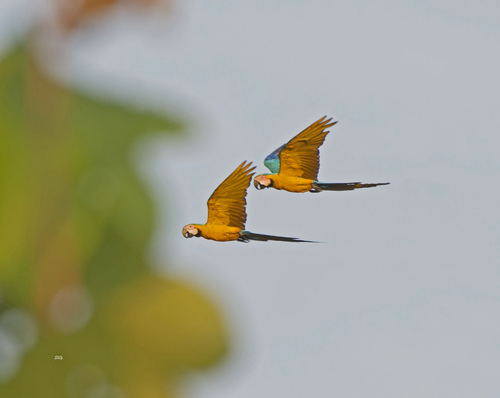
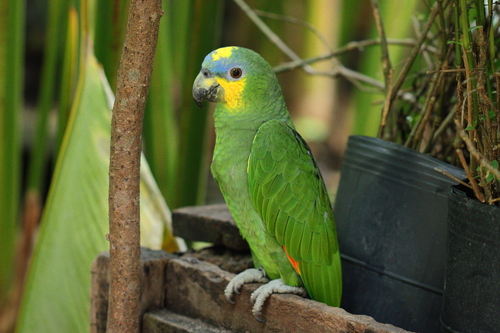
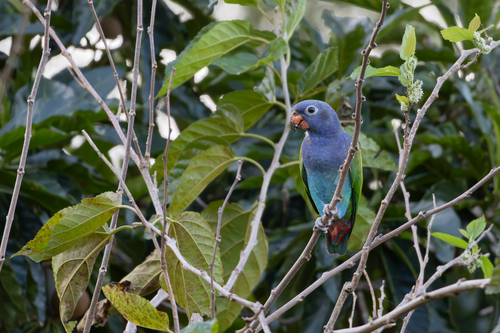
Red-and-green Macaw

Red-and-green Macaw

Ara chloropterus

Silhouette: Myriam_Ramirez · PhyloPic

LCLeast ConcernNTVUENCR
Daily sighting probability <5% · Rare
at Cuyabeno Wildlife Reserve

In 3 days ~10% in a week ~20%

16 Verified sightings at Cuyabeno Wildlife Reserve From 2019 to 2026
3,659 In all 10 parks
September Best month
☀️ Diurnal When it's spotted

About the Red-and-green Macaw

The red-and-green macaw (Ara chloropterus), also known as the green-winged macaw, is a large, mostly-red macaw of the genus Ara. It is popular in aviculture, and is the second most commonly kept macaw species after the blue-and-yellow macaw. However, they are not as common in captivity as the blue-and-yellow, and are much more expensive; prices are often double that of the blue-and-gold.

This is the largest of the genus Ara, widespread in the forests and woodlands of northern and central South America. However, in common with other macaws, in recent years there has been a marked decline in its numbers due to habitat loss and illegal capture for the parrot trade.

The green-winged macaw can be readily distinguished from the scarlet macaw. While the breast of both birds are bright red, the upper-wing covert feathers of the green-winged macaw is mostly green (as opposed to mostly yellow, or a strong mix of yellow and green in the scarlet macaw). In addition, the green-winged macaw has characteristic red lines around the eyes formed by rows of tiny feathers on the otherwise bare white skin patch; this is one of the biggest differences from a scarlet macaw to the casual... Wikipedia →

Sounds

Call0:30

Argentina · 2026

© Faustino Hollmann · XC1177181 · CC BY-NC-SA 4.0

Flight call0:50

Ecuador · 2026

© Manuel Sánchez-Nivicela · XC1074917 · CC BY-NC-ND 4.0

Uncertain0:04

Peru · 2019

© Jacob · XC664498 · CC BY-NC-SA 4.0

Global Distribution

Parks Where Found

# Park Country Daily sighting probability
1 Chapada dos Guimarães National Park 🇧🇷 Brazil
~50%
2 Tambopata National Reserve 🇵🇪 Peru
~40%
3 Darién National Park 🇵🇦 Panama
~30%
4 Manu National Park 🇵🇪 Peru
~20%
5 Iberá National Park 🇦🇷 Argentina
~10%
6 Yasuní National Park 🇪🇨 Ecuador
<5%
7 Anavilhanas National Park 🇧🇷 Brazil
<5%
8 Cuyabeno Wildlife Reserve 🇪🇨 Ecuador
<5%
9 Amacayacu National Natural Park 🇨🇴 Colombia
<5%
10 Iguazú National Park 🇦🇷 Argentina
<5%

Cities Where Found

# City Country Daily sighting probability
1 Asuncion 🇵🇾 Paraguay
~10%
2 Campo Grande 🇧🇷 Brazil
~10%
3 Belém 🇧🇷 Brazil
<5%
4 Caracas 🇻🇪 Venezuela
<5%
5 Manaus 🇧🇷 Brazil
<5%
6 Phnom Penh 🇰🇭 Cambodia
<5%
7 Medellín 🇨🇴 Colombia
<5%

Zoos & Centres Where Found

# Zoo / Centre Country
1 Disney's Animal Kingdom 🇺🇸 United States In captivity
2 Busch Gardens Tampa 🇺🇸 United States In captivity
3 SeaWorld San Diego 🇺🇸 United States In captivity
4 San Diego Zoo 🇺🇸 United States In captivity
5 National Zoological Park 🇺🇸 United States In captivity
6 Shedd Aquarium 🇺🇸 United States In captivity
7 ZooParc de Beauval 🇫🇷 France In captivity
8 Denver Zoo 🇺🇸 United States In captivity
9 California Academy of Sciences 🇺🇸 United States In captivity
10 Lisbon Oceanarium 🇵🇹 Portugal In captivity
11 Parque das Aves 🇧🇷 Brazil In captivity
12 Islamabad Zoo 🇵🇰 Pakistan In captivity
13 Australia Zoo 🇦🇺 Australia In captivity
14 Ostrava Zoo 🇨🇿 Czechia In captivity
15 Kolmården Wildlife Park 🇸🇪 Sweden In captivity
16 Tulsa Zoo 🇺🇸 United States In captivity
17 Parc Phœnix 🇫🇷 France In captivity
18 Taman Safari Bali (Bali Safari) 🇮🇩 Indonesia In captivity
19 Réserve africaine de Sigean 🇫🇷 France In captivity
20 Greensboro Science Center 🇺🇸 United States In captivity
21 Walsrode World Bird Park 🇩🇪 Germany In captivity
22 Zoologic park de Lille 🇫🇷 France In captivity
23 Parc des oiseaux 🇫🇷 France In captivity
24 Zoo de Doué 🇫🇷 France In captivity
25 Ecomuseum Zoo 🇨🇦 Canada In captivity
26 清远长隆动物大越野 🇨🇳 China In captivity
27 Parque Temático Hacienda Nápoles 🇨🇴 Colombia In captivity
28 Xinjiang Tianshan Safari Park 🇨🇳 China In captivity
29 Zoo Miami 🇺🇸 United States In captivity
30 Mohamed bin Zayed Nature Reserve 🇧🇭 Bahrain In captivity
31 Jardín Botánico y Zoológico de Asunción 🇵🇾 Paraguay In captivity
32 Lion Country Safari 🇺🇸 United States In captivity
33 Toronto Zoo 🇨🇦 Canada In captivity
34 Minnesota Zoo 🇺🇸 United States In captivity
35 Taipei Zoo 🇹🇼 Taiwan In captivity
36 Parque Zoológico 🇧🇷 Brazil In captivity
37 Safari West 🇺🇸 United States In captivity
38 Nehru Zoological Park 🇮🇳 India In captivity
39 Shanghai Wild Animal Park 🇨🇳 China In captivity
40 Grant's Farm 🇺🇸 United States In captivity
41 Bronx Zoo 🇺🇸 United States In captivity
42 Longleat Safari and Adventure Park 🇬🇧 United Kingdom In captivity
43 Kadoorie Farm and Botanic Garden 🇭🇰 Hong Kong SAR China In captivity
44 长沙生态动物园 🇨🇳 China In captivity
45 Zoological Garden of Belo Horizonte 🇧🇷 Brazil In captivity
46 Zoológico de Brasília 🇧🇷 Brazil In captivity
47 Parque Zoobotânico de Teresina 🇧🇷 Brazil In captivity
48 Badoca Safari Park 🇵🇹 Portugal In captivity
49 Brookfield Zoo 🇺🇸 United States In captivity
50 Baton Rouge Zoo 🇺🇸 United States In captivity

Before you go

What are the chances of seeing a Red-and-green Macaw in Cuyabeno Wildlife Reserve?

Rare

Under 5% of wildlife watchers report a Red-and-green Macaw sighting in Cuyabeno Wildlife Reserve on a given day, based on 16 verified sightings from GBIF citizen-science data from 2019 to 2026. It is the 212th most-seen of the 328 birds we can rate there. Over three days the chance rises to about 10%, and over a week to about 20%, if each day is a fresh chance.

When is the best time to see a Red-and-green Macaw in Cuyabeno Wildlife Reserve?

September

In that month about 20% of wildlife watchers report a Red-and-green Macaw in Cuyabeno Wildlife Reserve on a given day, against under 5% in October to August, the lowest months.

What time of day is best to see a Red-and-green Macaw?

Between 7 and 10 am

Across all the parks we cover, that three-hour window holds the most Red-and-green Macaw sightings with a recorded time, and about 8 in 10 of them come between 6 am and 6 pm: it is a daytime animal.

Which relatives of the Red-and-green Macaw live in Cuyabeno Wildlife Reserve?

Same genus: Ara

The closest relatives of the Red-and-green Macaw that you can see in Cuyabeno Wildlife Reserve (genus Ara) are Blue-and-yellow Macaw (about 70%), Chestnut-fronted Macaw (about 30%) and Scarlet Macaw (about 30%), with each one's daily chance of a sighting.

Where does the Red-and-green Macaw sighting chance come from?

GBIF citizen-science records

It is estimated from how often the Red-and-green Macaw is recorded against all the birds logged in Cuyabeno Wildlife Reserve (16 verified sightings from 2019 to 2026), calibrated against known sighting rates. Figures are rounded to the nearest 10% because citizen-science data supports honest approximations, not decimals, and months with records from fewer than five people show "—". How it works.

← Back to Cuyabeno Wildlife Reserve