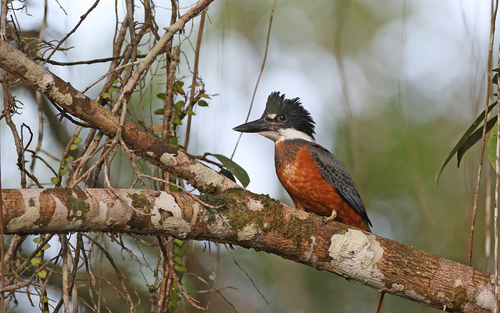
Rufous Motmot

Rufous Motmot

Baryphthengus martii

Silhouette: Sofía Terán Sánchez · PhyloPic

LCLeast ConcernNTVUENCR
Daily sighting probability <5% · Rare
at Farallones de Cali National Natural Park

In 3 days ~10% in a week ~20%

148 Verified sightings at Farallones de Cali National Natural Park From 2019 to 2026
9,795 In all 20 parks
June Best month
☀️ Diurnal When it's spotted

About the Rufous Motmot

The rufous motmot (Baryphthengus martii) is a near-passerine bird in the family Momotidae. It is found from northeastern Honduras south to western Ecuador, northern Bolivia, and western Brazil. The rufous motmot and rufous-capped motmot (Baryphtengus ruficapillus) are the only two species in their genus, and have sometimes been treated as conspecific and apparently form a superspecies. The rufous motmot has two recognized subspecies, the nominate Baryphthengus martii martii and B. m. semirufus. In the early 20th century, B. m. martii was classified in its own genus, Urospatha. The binomial commemorates the German botanist and explorer Carl Friedrich Philipp von Martius.

The rufous motmot is the second-largest member of its family. The male of the nominate subspecies is 42 to 47 cm (17 to 19 in) long and weighs 146 to 160 g (5.1 to 5.6 oz). The female weighs 153 to 173 g (5.4 to 6.1 oz). Male and female B. m. semirufus weigh 185 to 193 g (6.5 to 6.8 oz) and 170 to 208 g... Wikipedia →

Sounds

Call0:19

Brazil · 2026

© JAYRSON ARAUJO DE OLIVEIRA · XC1186091 · CC BY-NC-SA 4.0

Aberrant0:11

Ecuador · 2025

© Charlie Vogt · XC1053467 · CC BY-NC-SA 4.0

Song0:32

Ecuador · 2024

© Sue Riffe · XC929458 · CC BY-NC-SA 4.0

Global Distribution

Parks Where Found

# Park Country Daily sighting probability
1 Chagres National Park 🇵🇦 Panama
~30%
2 Soberanía National Park 🇵🇦 Panama
~30%
3 Arenal Volcano National Park 🇨🇷 Costa Rica
~20%
4 Braulio Carrillo National Park 🇨🇷 Costa Rica
~20%
5 San Lorenzo Protected Forest 🇵🇦 Panama
~20%
6 Darién National Park 🇵🇦 Panama
~10%
7 Tambopata National Reserve 🇵🇪 Peru
~10%
8 Utría National Natural Park 🇨🇴 Colombia
~10%
9 Tenorio Volcano National Park 🇨🇷 Costa Rica
~10%
10 Manu National Park 🇵🇪 Peru
~10%
11 Farallones de Cali National Natural Park 🇨🇴 Colombia
<5%
12 Yasuní National Park 🇪🇨 Ecuador
<5%
13 Bastimentos Island National Marine Park 🇵🇦 Panama
<5%
14 Cahuita National Park 🇨🇷 Costa Rica
<5%
15 La Amistad International Park (Panama) 🇵🇦 Panama
<5%
16 Amacayacu National Natural Park 🇨🇴 Colombia
<5%
17 Parque Natural Metropolitano 🇵🇦 Panama
<5%
18 Tapantí-Macizo de la Muerte National Park 🇨🇷 Costa Rica
<5%
19 Tortuguero National Park 🇨🇷 Costa Rica
<5%
20 Monteverde Cloud Forest Reserve 🇨🇷 Costa Rica
<5%

Before you go

What are the chances of seeing a Rufous Motmot in Farallones de Cali National Natural Park?

Rare

Under 5% of wildlife watchers report a Rufous Motmot sighting in Farallones de Cali National Natural Park on a given day, based on 148 verified sightings from GBIF citizen-science data from 2019 to 2026. It is the 220th most-seen of the 542 birds we can rate there. Over three days the chance rises to about 10%, and over a week to about 20%, if each day is a fresh chance.

When is the best time to see a Rufous Motmot in Farallones de Cali National Natural Park?

June

In that month about 20% of wildlife watchers report a Rufous Motmot in Farallones de Cali National Natural Park on a given day, against under 5% in August and October–May, the lowest months.

What time of day is best to see a Rufous Motmot?

Between 9 am and noon

Across all the parks we cover, that three-hour window holds the most Rufous Motmot sightings with a recorded time, and about 8 in 10 of them come between 6 am and 6 pm: it is a daytime animal.

Is Farallones de Cali National Natural Park the best place to see a Rufous Motmot?

11th of 20

Of the 20 parks where we can rate Rufous Motmot sightings, Farallones de Cali National Natural Park ranks 11th at under 5%. The best odds are in Chagres National Park (Panama, about 30%), Soberanía National Park (Panama, about 30%) and Arenal Volcano National Park (Costa Rica, about 20%).

Where does the Rufous Motmot sighting chance come from?

GBIF citizen-science records

It is estimated from how often the Rufous Motmot is recorded against all the birds logged in Farallones de Cali National Natural Park (148 verified sightings from 2019 to 2026), calibrated against known sighting rates. Figures are rounded to the nearest 10% because citizen-science data supports honest approximations, not decimals, and months with records from fewer than five people show "—". How it works.

← Back to Farallones de Cali National Natural Park