Water Pipit

Water Pipit

Anthus spinoletta

Silhouette: Susan Murphy (original photograph), T. Michael Keesey (vectorization) · PhyloPic

LCLeast ConcernNTVUENCR
Daily sighting probability ~20% · Possible
at Gobi Gurvansaikhan National Park

In 3 days ~50% in a week ~80%

55 Verified sightings at Gobi Gurvansaikhan National Park From 2019 to 2026
3,701 In all 22 parks
May Best month
☀️ Diurnal When it's spotted

About the Water Pipit

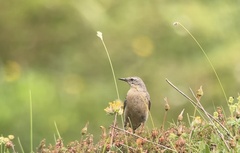
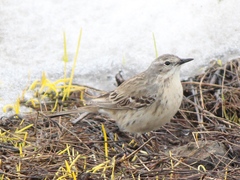
The water pipit (Anthus spinoletta) is a small passerine bird which breeds in the mountains of Southern Europe and the Palearctic eastwards to China. It is a short-distance migrant; many birds move to lower altitudes or wet open lowlands in winter.

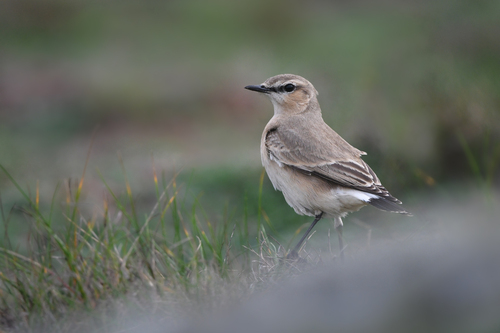
The water pipit in breeding plumage has greyish-brown upperparts, weakly streaked with darker brown, and pale pink-buff underparts fading to whitish on the lower belly. The head is grey with a broad white supercilium ("eyebrow"), and the outer tail feathers are white. In winter, the head is grey-brown, the supercilium is duller, the upperparts are more streaked, and the underparts are white, streaked lightly with brown on the breast and flanks. There are only minor differences among the three subspecies, the sexes are almost identical, and young birds resemble adults. The water pipit's song is delivered from a perch or in flight, and consists of four or five blocks, each consisting of about six repetitions of a different short note.

Water pipits construct a cup-like nest on the ground under vegetation or in cliff crevices and lay four to six speckled grey-ish white eggs, which hatch in about two weeks with a further 14–15 days to fledging. Although pipits occasionally catch insects in flight, they feed mainly on small invertebrates picked off the ground or vegetation, and also some plant material.

The water pipit may be hunted by birds of prey, infested by parasites such as fleas, or act as an involuntary host to the common cuckoo, but overall its population is large and stable, and it is therefore evaluated as a species of least concern by the International Union for Conservation of Nature (IUCN). Wikipedia →

Sounds

Flight call0:29

France · 2026

© Tony Rinaud · XC1101693 · CC BY-NC-SA 4.0

Call0:28

Spain · 2026

© Michael John O Mahony · XC1093972 · CC BY-NC-SA 4.0

Subsong0:21

Spain · 2026

© Sven Normant · XC1092248 · CC BY-NC-SA 4.0

Global Distribution

Parks Where Found

# Park Country Daily sighting probability
1 Vanoise National Park 🇫🇷 France
~50%
2 Picos de Europa National Park 🇪🇸 Spain
~40%
3 Hohe Tauern National Park 🇦🇹 Austria
~40%
4 Mercantour National Park 🇫🇷 France
~30%
5 Aigüestortes National Park 🇪🇸 Spain
~30%
6 Tatra National Park 🇸🇰 Slovakia
~30%
7 Pyrénées National Park 🇫🇷 France
~30%
8 Ordesa y Monte Perdido National Park 🇪🇸 Spain
~20%
9 Ecrins National Park 🇫🇷 France
~20%
10 Gobi Gurvansaikhan National Park 🇲🇳 Mongolia
~20%
11 Triglav National Park 🇸🇮 Slovenia
~10%
12 Kiskunság National Park 🇭🇺 Hungary
~10%
13 Sierra Nevada National Park 🇪🇸 Spain
~10%
14 Sierra de Guadarrama National Park 🇪🇸 Spain
~10%
15 Hortobágy National Park 🇭🇺 Hungary
~10%
16 Fertő-Hanság National Park 🇭🇺 Hungary
<5%
17 Camargue 🇫🇷 France
<5%
18 Monfragüe National Park 🇪🇸 Spain
<5%
19 Bavarian Forest National Park 🇩🇪 Germany
<5%
20 Wadden Sea National Park 🇩🇪 Germany
<5%
21 Doñana National Park 🇪🇸 Spain
<5%
22 Snowdonia National Park 🇬🇧 United Kingdom
<5%

Cities Where Found

# City Country Daily sighting probability
1 Lanzhou 🇨🇳 China
~20%
2 Beijing 🇨🇳 China
~10%
3 Shijiazhuang 🇨🇳 China
~10%
4 Jinan 🇨🇳 China
~10%
5 Cairo 🇪🇬 Egypt
<5%
6 Kuwait City 🇰🇼 Kuwait
<5%
7 Kathmandu 🇳🇵 Nepal
<5%
8 Turin 🇮🇹 Italy
<5%
9 Tel Aviv 🇮🇱 Israel
<5%
10 Tehran 🇮🇷 Iran
<5%

Before you go

What are the chances of seeing a Water Pipit in Gobi Gurvansaikhan National Park?

Possible

About 20% of wildlife watchers report a Water Pipit sighting in Gobi Gurvansaikhan National Park on a given day, based on 55 verified sightings from GBIF citizen-science data from 2019 to 2026. It is the 43rd most-seen of the 122 birds we can rate there. Over three days the chance rises to about 50%, and over a week to about 80%, if each day is a fresh chance.

When is the best time to see a Water Pipit in Gobi Gurvansaikhan National Park?

May

In that month about 30% of wildlife watchers report a Water Pipit in Gobi Gurvansaikhan National Park on a given day, against about 10% in July and December, the lowest months. January–April and October–November have too few records to rate.

What time of day is best to see a Water Pipit?

Between 9 am and noon

Across all the parks we cover, that three-hour window holds the most Water Pipit sightings with a recorded time, and about 9 in 10 of them come between 6 am and 6 pm: it is a daytime animal.

Which relatives of the Water Pipit live in Gobi Gurvansaikhan National Park?

Same genus: Anthus

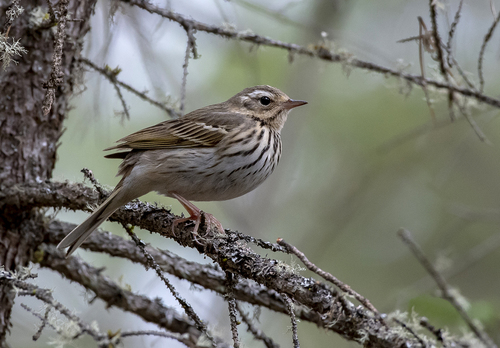
The closest relatives of the Water Pipit that you can see in Gobi Gurvansaikhan National Park (genus Anthus, Pipits) are Blyth's Pipit (about 10%), Richard's Pipit (about 10%) and Olive-backed Pipit (about 10%), with each one's daily chance of a sighting.

Where does the Water Pipit sighting chance come from?

GBIF citizen-science records

It is estimated from how often the Water Pipit is recorded against all the birds logged in Gobi Gurvansaikhan National Park (55 verified sightings from 2019 to 2026), calibrated against known sighting rates. Figures are rounded to the nearest 10% because citizen-science data supports honest approximations, not decimals, and months with records from fewer than five people show "—". How it works.

← Back to Gobi Gurvansaikhan National Park