Australian Hobby

Australian Hobby

Falco longipennis

Silhouette: Shyamal · PhyloPic

LCLeast ConcernNTVUENCR
Daily sighting probability <5% · Rare
at Great Otway National Park

In 3 days <5% in a week ~10%

37 Verified sightings at Great Otway National Park From 2019 to 2026
399 In all 13 parks
July Best month
☀️ Diurnal When it's spotted

About the Australian Hobby

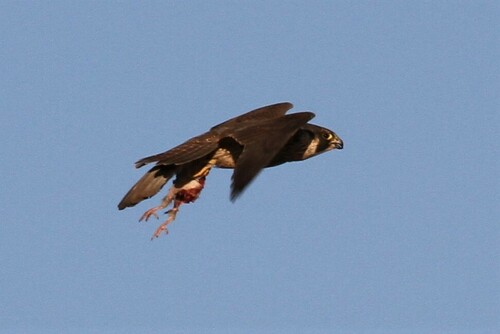
The Australian hobby (Falco longipennis), also known as the little falcon, is one of six Australian members of the family Falconidae. This predominantly diurnal bird of prey derives its name 'longipennis' from its long primary wing feathers. It occurs throughout Australia and other neighbouring countries with migrating individuals found on the islands of Indonesia and New Guinea.

The Australian hobby is a member of the family Falconidae and the order Falconiformes. Five major clades have been established in the genus Falco. These include kestrels, merlins, hobbies, hierofalcons and peregrines. Hobbies are somewhat removed from these groups but are still a component of a more inclusive clade.

Three subspecies of Australian hobby are usually recognised. These are: Falco longipennis longipennis, (Swainson, 1838) Falco longipennis murchisonianus (Mathews, 1912) is paler blue-grey above with a dull blackish head, and paler reddish-brown below with less distinct markings.

Of the hobbies in existence including the African hobby (Falco cuvierii) and the Oriental hobby... Wikipedia →

Sounds

Call0:20

Australia · 2024

© Nick Talbot · XC937063 · CC BY-NC-SA 4.0

Flight call0:04

Australia · 2016

© Marc Anderson · XC338741 · CC BY-NC-ND 4.0

Call0:07

Australia · 2022

© James Lambert · XC726090 · CC BY-NC-ND 4.0

Global Distribution

Parks Where Found

# Park Country Daily sighting probability
1 Wilsons Promontory National Park 🇦🇺 Australia
~10%
2 Ningaloo Marine Park 🇦🇺 Australia
~10%
3 Kosciuszko National Park 🇦🇺 Australia
~10%
4 Uluru-Kata Tjuta National Park 🇦🇺 Australia
~10%
5 Cape Range 🇦🇺 Australia
<5%
6 Booderee National Park 🇦🇺 Australia
<5%
7 Kakadu National Park 🇦🇺 Australia
<5%
8 Hattah-Kulkyne National Park 🇦🇺 Australia
<5%
9 Flinders Ranges National Park 🇦🇺 Australia
<5%
10 Great Otway National Park 🇦🇺 Australia
<5%
11 Blue Mountains National Park 🇦🇺 Australia
<5%
12 Royal National Park 🇦🇺 Australia
<5%
13 Lamington National Park 🇦🇺 Australia
<5%

Cities Where Found

# City Country Daily sighting probability
1 Perth 🇦🇺 Australia
~10%
2 Brisbane 🇦🇺 Australia
<5%
3 Melbourne 🇦🇺 Australia
<5%
4 Sydney 🇦🇺 Australia
<5%
5 Hobart 🇦🇺 Australia
<5%

Zoos & Centres Where Found

# Zoo / Centre Country
1 Alice Springs Desert Park 🇦🇺 Australia In captivity
2 Kangaroo Island Wildlife Park 🇦🇺 Australia In captivity
3 Raptor Refuge 🇦🇺 Australia In captivity

Before you go

What are the chances of seeing an Australian Hobby in Great Otway National Park?

Rare

Under 5% of wildlife watchers report an Australian Hobby sighting in Great Otway National Park on a given day, based on 37 verified sightings from GBIF citizen-science data from 2019 to 2026. It is the 136th most-seen of the 175 birds we can rate there. Over three days the chance rises to under 5%, and over a week to about 10%, if each day is a fresh chance.

When is the best time to see an Australian Hobby in Great Otway National Park?

Any time of year

In every month with enough records, under 5% of wildlife watchers report an Australian Hobby in Great Otway National Park on a given day, so our monthly data shows no clear season.

What time of day is best to see an Australian Hobby?

Between 2 and 5 pm

Across all the parks we cover, that three-hour window holds the most Australian Hobby sightings with a recorded time, and nearly all of them come between 6 am and 6 pm: it is a daytime animal.

Where does the Australian Hobby sighting chance come from?

GBIF citizen-science records

It is estimated from how often the Australian Hobby is recorded against all the birds logged in Great Otway National Park (37 verified sightings from 2019 to 2026), calibrated against known sighting rates. Figures are rounded to the nearest 10% because citizen-science data supports honest approximations, not decimals, and months with records from fewer than five people show "—". How it works.

← Back to Great Otway National Park