African Dusky Flycatcher

African Dusky Flycatcher

Muscicapa adusta

Silhouette: Ekytza · PhyloPic

LCLeast ConcernNTVUENCR
Daily sighting probability ~10% · With luck
at Hluhluwe-Imfolozi Park

In 3 days ~20% in a week ~30%

31 Verified sightings at Hluhluwe-Imfolozi Park From 2019 to 2026
7,599 In all 32 parks
April Best month
☀️ Diurnal When it's spotted

About the African Dusky Flycatcher

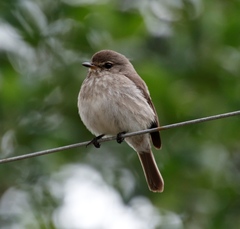
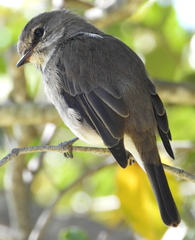
The African dusky flycatcher (Muscicapa adusta), also known as the dusky-brown flycatcher or dusky alseonax, is a small passerine bird of the Old World flycatcher family, Muscicapidae. It is a resident breeder in elevated areas of Sub-Saharan Africa (including the Bié and Western High plateaus). It is very common in its woodland habitat, which includes riverine forests, evergreen forest edges and clearings, especially near water bodies such as lakes, dams and streams, and well-wooded suburban gardens.

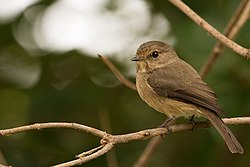
The African dusky flycatcher is 13 cm (5.1 in) long and weighs around 11 g (0.39 oz). Its upperparts are plain brown, with the only facial marking being an indistinct narrow eye-ring. The chin is plain pale grey, and the rest of the underparts are grey-brown with indistinct streaks. The short, straight, laterally flattened bill is black, the legs and feet are grey, and the eyes are brown. The sexes are similar, but the juvenile is spotted with buff above, and is whitish spotted with brown below.

This species is similar to the common migrant, the spotted flycatcher, Muscicapa striata, but is smaller and darker, especially on the underparts, than that species. Spotted flycatcher... Wikipedia →

Sounds

Call0:29

Kenya · 2024

© Peter Boesman · XC948282 · CC BY-NC-ND 4.0

Song0:22

Zambia · 2023

© Dries Van de Loock · XC854441 · CC BY-NC-ND 4.0

Song0:16

South Africa · 2021

© Lynette Rudman · XC664991 · CC BY-NC-SA 4.0

Global Distribution

Parks Where Found

# Park Country Daily sighting probability
1 Nyungwe National Park 🇷🇼 Rwanda
~60%
2 Arusha National Park 🇹🇿 Tanzania
~60%
3 Bwindi Impenetrable National Park 🇺🇬 Uganda
~50%
4 Volcanoes National Park 🇷🇼 Rwanda
~40%
5 Garden Route National Park 🇿🇦 South Africa
~40%
6 Aberdare National Park 🇰🇪 Kenya
~30%
7 Table Mountain National Park 🇿🇦 South Africa
~30%
8 Mkomazi National Park 🇹🇿 Tanzania
~20%
9 Kibale National Park 🇺🇬 Uganda
~20%
10 Virunga National Park 🇨🇩 Democratic Republic of the Congo
~20%
11 Bale Mountains National Park 🇪🇹 Ethiopia
~20%
12 Ngorongoro Conservation Area 🇹🇿 Tanzania
~10%
13 iSimangaliso Wetland Park 🇿🇦 South Africa
~10%
14 Nairobi National Park 🇰🇪 Kenya
~10%
15 uMkhuze Game Reserve 🇿🇦 South Africa
~10%
16 Hluhluwe-Imfolozi Park 🇿🇦 South Africa
~10%
17 Lake Nakuru National Park 🇰🇪 Kenya
<5%
18 Akagera National Park 🇷🇼 Rwanda
<5%
19 De Hoop Nature Reserve 🇿🇦 South Africa
<5%
20 Kruger National Park 🇿🇦 South Africa
<5%
21 Gorongosa National Park 🇲🇿 Mozambique
<5%
22 Semuliki National Park 🇺🇬 Uganda
<5%
23 Lake Manyara National Park 🇹🇿 Tanzania
<5%
24 Addo Elephant National Park 🇿🇦 South Africa
<5%
25 Queen Elizabeth National Park 🇺🇬 Uganda
<5%
26 Lake Mburo National Park 🇺🇬 Uganda
<5%
27 Masai Mara National Reserve 🇰🇪 Kenya
<5%
28 South Luangwa National Park 🇿🇲 Zambia
<5%
29 Murchison Falls National Park 🇺🇬 Uganda
<5%
30 Serengeti National Park 🇹🇿 Tanzania
<5%
31 Tarangire National Park 🇹🇿 Tanzania
<5%
32 West Coast National Park 🇿🇦 South Africa
<5%

Cities Where Found

# City Country Daily sighting probability
1 Addis Ababa 🇪🇹 Ethiopia
~30%
2 Durban 🇿🇦 South Africa
~20%
3 Nairobi 🇰🇪 Kenya
~20%
4 Cape Town 🇿🇦 South Africa
~10%
5 Kigali 🇷🇼 Rwanda
<5%
6 Kampala 🇺🇬 Uganda
<5%
7 Harare 🇿🇼 Zimbabwe
<5%

Before you go

What are the chances of seeing an African Dusky Flycatcher in Hluhluwe-Imfolozi Park?

With luck

About 10% of wildlife watchers report an African Dusky Flycatcher sighting in Hluhluwe-Imfolozi Park on a given day, based on 31 verified sightings from GBIF citizen-science data from 2019 to 2026. It is the 150th most-seen of the 220 birds we can rate there. Over three days the chance rises to about 20%, and over a week to about 30%, if each day is a fresh chance.

When is the best time to see an African Dusky Flycatcher in Hluhluwe-Imfolozi Park?

April

In that month about 20% of wildlife watchers report an African Dusky Flycatcher in Hluhluwe-Imfolozi Park on a given day, against under 5% in February–March, June and September–December, the lowest months.

What time of day is best to see an African Dusky Flycatcher?

Between 9 am and noon

Across all the parks we cover, that three-hour window holds the most African Dusky Flycatcher sightings with a recorded time, and nearly all of them come between 6 am and 6 pm: it is a daytime animal.

Which relatives of the African Dusky Flycatcher live in Hluhluwe-Imfolozi Park?

Same genus: Muscicapa

The closest relatives of the African Dusky Flycatcher that you can see in Hluhluwe-Imfolozi Park (genus Muscicapa, Muscicapa Flycatchers) are Ashy Alseonax (about 10%) and Spotted Flycatcher (about 10%), with each one's daily chance of a sighting.

Where does the African Dusky Flycatcher sighting chance come from?

GBIF citizen-science records

It is estimated from how often the African Dusky Flycatcher is recorded against all the birds logged in Hluhluwe-Imfolozi Park (31 verified sightings from 2019 to 2026), calibrated against known sighting rates. Figures are rounded to the nearest 10% because citizen-science data supports honest approximations, not decimals, and months with records from fewer than five people show "—". How it works.

← Back to Hluhluwe-Imfolozi Park