Common Rosefinch

Common Rosefinch

Carpodacus erythrinus

Silhouette: Sheatherius · PhyloPic

LCLeast ConcernNTVUENCR
Daily sighting probability ~10% · With luck
at Jim Corbett National Park

In 3 days ~20% in a week ~40%

122 Verified sightings at Jim Corbett National Park From 2019 to 2026
1,628 In all 23 parks
March Best month
☀️ Diurnal When it's spotted

About the Common Rosefinch

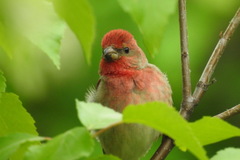
The common rosefinch (Carpodacus erythrinus) or scarlet rosefinch is the most widespread and common rosefinch of Asia and Europe. In a molecular phylogenetic study of the finch family published in 2012, Zuccon and colleagues found that the common rosefinch fell outside the core Carpodacus rosefinch clade and was a sister to the scarlet finch (at the time Haematospiza sipahi). They recommended that the common rosefinch should be moved to a new monotypic genus with the resurrected name of Erythrina. The British Ornithologists' Union accepted this proposal, but the International Ornithological Union chose instead to adopt a more inclusive Carpodacus that retained the common rosefinch in the rosefinch genus.

The genus name is from Ancient Greek karpos, "fruit" and dakno, "to bite", and the specific erythrinus is from Latin erythros, "red". The common rosefinch is 13–15 cm (5.1–5.9 in) in length. It has a stout and conical bill. The mature male has brilliant rosy-carmine head, breast and rump; heavy bill; dark brown wings with two indistinct bars, and a white belly. Females and young males are dull-colored with yellowish-brown above, brighter on the rump... Wikipedia →

Sounds

Song0:34

Sweden · 2026

© Louis-Marie Gourmelon · XC1142631 · CC BY-NC-SA 4.0

Call0:06

Sweden · 2025

© Lars Edenius · XC1022100 · CC BY-NC-SA 4.0

Flight call1:02

Poland · 2022

© Jarek Matusiak · XC785973 · CC BY-NC-ND 4.0

Global Distribution

Parks Where Found

# Park Country Daily sighting probability
1 Gobi Gurvansaikhan National Park 🇲🇳 Mongolia
~30%
2 Eravikulam National Park 🇮🇳 India
~20%
3 Hemis National Park 🇮🇳 India
~20%
4 Białowieża National Park 🇵🇱 Poland
~20%
5 Biebrza National Park 🇵🇱 Poland
~10%
6 Mudumalai National Park 🇮🇳 India
~10%
7 Doi Inthanon National Park 🇹🇭 Thailand
~10%
8 Jiuzhaigou National Park 🇨🇳 China
~10%
9 Jim Corbett National Park 🇮🇳 India
~10%
10 Chitwan National Park 🇳🇵 Nepal
<5%
11 Langtang National Park 🇳🇵 Nepal
<5%
12 Royal Manas National Park 🇧🇹 Bhutan
<5%
13 Gir National Park 🇮🇳 India
<5%
14 Ranthambore National Park 🇮🇳 India
<5%
15 Royal Bardia National Park 🇳🇵 Nepal
<5%
16 Bandhavgarh National Park 🇮🇳 India
<5%
17 Kanha National Park 🇮🇳 India
<5%
18 Gauja National Park 🇱🇻 Latvia
<5%
19 Manas National Park 🇮🇳 India
<5%
20 Periyar National Park 🇮🇳 India
<5%
21 Nagarhole National Park 🇮🇳 India
<5%
22 Keoladeo National Park 🇮🇳 India
<5%
23 Wadden Sea National Park 🇩🇪 Germany
<5%

Cities Where Found

# City Country Daily sighting probability
1 Ulaanbaatar 🇲🇳 Mongolia
~20%
2 Tashkent 🇺🇿 Uzbekistan
~20%
3 Novosibirsk 🇷🇺 Russia
~20%
4 Gwalior 🇮🇳 India
~20%
5 Tehran 🇮🇷 Iran
~10%
6 Helsinki 🇫🇮 Finland
~10%
7 Moscow 🇷🇺 Russia
~10%
8 Ürümqi 🇨🇳 China
~10%
9 Dushanbe 🇹🇯 Tajikistan
~10%
10 Dehradun 🇮🇳 India
~10%

Before you go

What are the chances of seeing a Common Rosefinch in Jim Corbett National Park?

With luck

About 10% of wildlife watchers report a Common Rosefinch sighting in Jim Corbett National Park on a given day, based on 122 verified sightings from GBIF citizen-science data from 2019 to 2026. It is the 174th most-seen of the 368 birds we can rate there. Over three days the chance rises to about 20%, and over a week to about 40%, if each day is a fresh chance.

When is the best time to see a Common Rosefinch in Jim Corbett National Park?

March–April and November–January

In those months about 10% of wildlife watchers report a Common Rosefinch in Jim Corbett National Park on a given day, against under 5% in February and May–October, the lowest months. Those are among Jim Corbett National Park's driest months, with about 25 mm of rain a month against 360 mm in July.

What time of day is best to see a Common Rosefinch?

Between 8 and 11 am

Across all the parks we cover, that three-hour window holds the most Common Rosefinch sightings with a recorded time, and about 9 in 10 of them come between 6 am and 6 pm: it is a daytime animal.

Where does the Common Rosefinch sighting chance come from?

GBIF citizen-science records

It is estimated from how often the Common Rosefinch is recorded against all the birds logged in Jim Corbett National Park (122 verified sightings from 2019 to 2026), calibrated against known sighting rates. Figures are rounded to the nearest 10% because citizen-science data supports honest approximations, not decimals, and months with records from fewer than five people show "—". How it works.

← Back to Jim Corbett National Park

