Weebill

Weebill

Smicrornis brevirostris

Silhouette: Sheatherius · PhyloPic

LCLeast ConcernNTVUENCR Endemic
Daily sighting probability ~10% · With luck
at Kakadu National Park

In 3 days ~40% in a week ~70%

237 Verified sightings at Kakadu National Park From 2019 to 2026
1,847 In all 9 parks
March Best month
☀️ Diurnal When it's spotted

About the Weebill

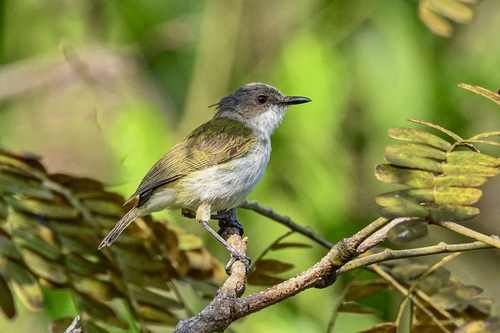
The weebill (Smicrornis brevirostris) is a species of bird in the family Acanthizidae. It is an insectivorous passerine that is found throughout mainland Australia. At 8 to 9 cm (3.1 to 3.5 in) long, it is Australia's smallest bird. It was originally described by John Gould in 1838, and four subspecies are recognised. The weebill's plumage is nondescript, with olive-grey upperparts and paler, more yellowish underparts. It grades from more brownish plumage in the southern regions of Australia to more yellow in tropical areas.

The weebill was described by John Gould in 1838 as Psilopus brevirostris. The species epithet is derived from the Latin words brevis 'short' and rostrum 'beak'. In 1843, Gould erected the genus Smicrornis for his new species Smicrornis flavescens, collected from Port Essington, noting it as distinct from Gerygone (which had replaced Psilopus as a name). The generic name Smicrornis derives from the Greek smicros 'small' and ornis 'bird'. It is the only member of genus Smicrornis; gene flow is strong and local variation follows Bergmann's and Gloger's rules.

Gould initially called it the short-billed smicrornis, but it did not gain acceptance. Other... Wikipedia →

Sounds

Call0:19

Australia · 2025

© Peter Boesman · XC1066970 · CC BY-NC-ND 4.0

Dawn song1:28

Australia · 2024

© Khristos Nizamis · XC917146 · CC BY-NC-ND 4.0

Song0:23

Australia · 2021

© James Lambert · XC671890 · CC BY-NC-ND 4.0

Global Distribution

Parks Where Found

# Park Country Daily sighting probability
1 Flinders Ranges National Park 🇦🇺 Australia
~60%
2 Hattah-Kulkyne National Park 🇦🇺 Australia
~60%
3 Nitmiluk National Park 🇦🇺 Australia
~30%
4 Grampians National Park 🇦🇺 Australia
~20%
5 Kakadu National Park 🇦🇺 Australia
~10%
6 Kosciuszko National Park 🇦🇺 Australia
~10%
7 Litchfield National Park 🇦🇺 Australia
~10%
8 Great Otway National Park 🇦🇺 Australia
<5%
9 Blue Mountains National Park 🇦🇺 Australia
<5%

Cities Where Found

# City Country Daily sighting probability
1 Perth 🇦🇺 Australia
~30%
2 Melbourne 🇦🇺 Australia
<5%

Before you go

What are the chances of seeing a Weebill in Kakadu National Park?

With luck

About 10% of wildlife watchers report a Weebill sighting in Kakadu National Park on a given day, based on 237 verified sightings from GBIF citizen-science data from 2019 to 2026. It is the 82nd most-seen of the 186 birds we can rate there. Over three days the chance rises to about 40%, and over a week to about 70%, if each day is a fresh chance.

When is the best time to see a Weebill in Kakadu National Park?

March

In that month about 30% of wildlife watchers report a Weebill in Kakadu National Park on a given day, against about 10% in May and August–January, the lowest months. That is one of Kakadu National Park's wettest months, with about 170 mm of rain against almost none in August. February has too few records to rate.

What time of day is best to see a Weebill?

Between 9 am and noon

Across all the parks we cover, that three-hour window holds the most Weebill sightings with a recorded time, and nearly all of them come between 6 am and 6 pm: it is a daytime animal.

Where does the Weebill sighting chance come from?

GBIF citizen-science records

It is estimated from how often the Weebill is recorded against all the birds logged in Kakadu National Park (237 verified sightings from 2019 to 2026), calibrated against known sighting rates. Figures are rounded to the nearest 10% because citizen-science data supports honest approximations, not decimals, and months with records from fewer than five people show "—". How it works.

← Back to Kakadu National Park