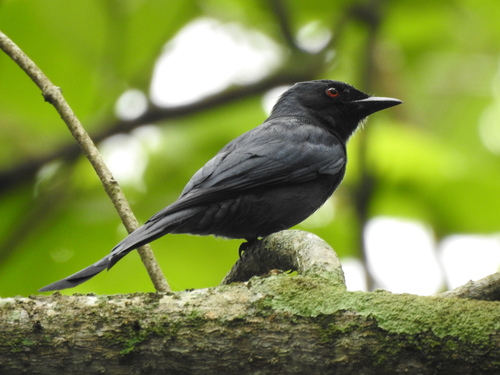
White-bellied Drongo

White-bellied Drongo

Dicrurus caerulescens

Silhouette: Ferran Sayol · PhyloPic

LCLeast ConcernNTVUENCR
Daily sighting probability ~30% · Possible
at Kanha National Park

In 3 days ~70% in a week ~90%

3,144 Verified sightings at Kanha National Park From 2019 to 2026
8,155 In all 18 parks
June Best month
🌅 Crepuscular When it's spotted

About the White-bellied Drongo

The white-bellied drongo (Dicrurus caerulescens) is a species of drongo found across the Indian Subcontinent. Like other members of the family Dicruridae, they are insectivorous and mainly black in colour, but with a white belly and vent. Young birds are, however, all black and may be confused with the black drongo, which is smaller and more compact in appearance. The subspecies found in Sri Lanka has white restricted to the vent.

In 1747 the English naturalist George Edwards included an illustration and a description of the white-bellied drongo in the second volume of his A Natural History of Uncommon Birds. He used the English name "The Fork- tail'd Indian Butcher-Bird". Edwards based his hand-coloured etching on a specimen that had been sent from Bengal to the silk-pattern designer Joseph Dandridge in London. When in 1758 the Swedish naturalist Carl Linnaeus updated his Systema Naturae for the tenth edition, he placed the white-bellied drongo with the shrikes in the genus Lanius. Linnaeus included a brief description, coined the binomial name Lanius caerulescens and cited Edwards' work. The specific epithet caerulescens is Latin meaning "bluish". The white-bellied... Wikipedia →

Sounds

Call0:27

Sri Lanka · 2021

© THILANKA EDIRISINGHE · XC650344 · CC BY-NC-SA 4.0

Song0:28

Sri Lanka · 2007

© Jelle Scharringa · XC630375 · CC BY-NC-SA 4.0

Uncertain0:27

Sri Lanka · 2018

© Blair Jollands · XC588846 · CC BY-NC-SA 4.0

Global Distribution

Parks Where Found

# Park Country Daily sighting probability
1 Sinharaja Forest Reserve 🇱🇰 Sri Lanka
~60%
2 Ranthambore National Park 🇮🇳 India
~50%
3 Royal Bardia National Park 🇳🇵 Nepal
~50%
4 Satpura National Park 🇮🇳 India
~40%
5 Bandhavgarh National Park 🇮🇳 India
~40%
6 Kanha National Park 🇮🇳 India
~30%
7 Mudumalai National Park 🇮🇳 India
~30%
8 Bandipur National Park 🇮🇳 India
~20%
9 Wilpattu National Park 🇱🇰 Sri Lanka
~20%
10 Nagarhole National Park 🇮🇳 India
~20%
11 Chitwan National Park 🇳🇵 Nepal
~20%
12 Minneriya National Park 🇱🇰 Sri Lanka
~20%
13 Udawalawe National Park 🇱🇰 Sri Lanka
~10%
14 Jim Corbett National Park 🇮🇳 India
~10%
15 Yala National Park 🇱🇰 Sri Lanka
~10%
16 Eravikulam National Park 🇮🇳 India
<5%
17 Horton Plains National Park 🇱🇰 Sri Lanka
<5%
18 Keoladeo National Park 🇮🇳 India
<5%

Cities Where Found

# City Country Daily sighting probability
1 Colombo [Sri Jayawardenepura Kotte] 🇱🇰 Sri Lanka
~50%
2 Jaipur 🇮🇳 India
~20%
3 Lucknow 🇮🇳 India
~10%
4 Jabalpur 🇮🇳 India
~10%
5 Bhopal 🇮🇳 India
<5%
6 Vadodara 🇮🇳 India
<5%
7 Prayagraj 🇮🇳 India
<5%
8 Mumbai 🇮🇳 India
<5%
9 Dehradun 🇮🇳 India
<5%
10 Nagpur 🇮🇳 India
<5%

Before you go

What are the chances of seeing a White-bellied Drongo in Kanha National Park?

Possible

About 30% of wildlife watchers report a White-bellied Drongo sighting in Kanha National Park on a given day, based on 3,144 verified sightings from GBIF citizen-science data from 2019 to 2026. It is the 36th most-seen of the 286 birds we can rate there. Over three days the chance rises to about 70%, and over a week to about 90%, if each day is a fresh chance.

When is the best time to see a White-bellied Drongo in Kanha National Park?

January–February, April and June

In those months about 40% of wildlife watchers report a White-bellied Drongo in Kanha National Park on a given day, against about 10% in July, the lowest month. Those are among Kanha National Park's driest months, with about 70 mm of rain a month against 430 mm in July.

What time of day is best to see a White-bellied Drongo?

Between 4 and 7 am

Across all the parks we cover, that three-hour window holds the most White-bellied Drongo sightings with a recorded time, and about 6 in 10 of them come between 6 am and 6 pm: it is most active around dawn and dusk.

Which relatives of the White-bellied Drongo live in Kanha National Park?

Same genus: Dicrurus

The closest relatives of the White-bellied Drongo that you can see in Kanha National Park (genus Dicrurus, Drongos) are Black Drongo (about 70%), Greater Racket-tailed Drongo (about 70%) and Ashy Drongo (about 20%), with each one's daily chance of a sighting.

Where does the White-bellied Drongo sighting chance come from?

GBIF citizen-science records

It is estimated from how often the White-bellied Drongo is recorded against all the birds logged in Kanha National Park (3,144 verified sightings from 2019 to 2026), calibrated against known sighting rates. Figures are rounded to the nearest 10% because citizen-science data supports honest approximations, not decimals, and months with records from fewer than five people show "—". How it works.
← Back to Kanha National Park