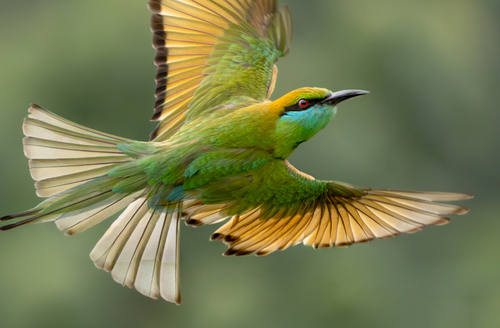
Blue-cheeked Bee-eater

Blue-cheeked Bee-eater

Merops persicus

Silhouette: Sheatherius · PhyloPic

LCLeast ConcernNTVUENCR
Daily sighting probability <5% · Rare
at Keoladeo National Park

In 3 days <5% in a week ~10%

25 Verified sightings at Keoladeo National Park From 2019 to 2026
2,556 In all 30 parks
October Best month
☀️ Diurnal When it's spotted

About the Blue-cheeked Bee-eater

The blue-cheeked bee-eater (Merops persicus) is a species of bee-eater that breeds in Northern Africa and the Middle East from eastern Turkey to Kazakhstan and India. It is generally strongly migratory, wintering in tropical Africa, although some populations are resident year-round in the Sahel. This species occurs as a rare vagrant north of its breeding range, with most vagrants occurring in Italy and Greece.

The genus name Merops is Ancient Greek for "bee-eater", and persicus is Latin for "Persian". Two subspecies of blue-cheeked bee-eater are accepted: Merops persicus persicus - Breeds in Asia, winters in East and Southern Africa.

Merops persicus chrysocercus - Breeds in North Africa, winters in West Africa. This species is closely related to the blue-tailed bee-eater, M. philippinus of East Asia, and the olive bee-eater of Africa, and has been treated as being the same species (conspecific).

This species, like other bee-eaters, is a richly coloured, slender bird. It is predominantly green; its face has blue sides with a black eye stripe, and a yellow and brown throat; the beak is black. It can reach a length of 31 cm (12 in), with... Wikipedia →

Sounds

Song0:20

South Africa · 2026

© JJSUN · XC1079403 · CC BY-NC-SA 4.0

Call0:18

Kuwait · 2025

© AUDEVARD Aurélien · XC1071542 · CC BY-NC-SA 4.0

Flight call0:09

Zambia · 2025

© Dries Van de Loock · XC958784 · CC BY-NC-ND 4.0

Global Distribution

Parks Where Found

# Park Country Daily sighting probability
1 iSimangaliso Wetland Park 🇿🇦 South Africa
~30%
2 Tarangire National Park 🇹🇿 Tanzania
~20%
3 uMkhuze Game Reserve 🇿🇦 South Africa
~20%
4 Liwonde National Park 🇲🇼 Malawi
~20%
5 Mkomazi National Park 🇹🇿 Tanzania
~20%
6 Akagera National Park 🇷🇼 Rwanda
~10%
7 Queen Elizabeth National Park 🇺🇬 Uganda
~10%
8 Chobe National Park 🇧🇼 Botswana
~10%
9 Semuliki National Park 🇺🇬 Uganda
~10%
10 Tsavo West National Park 🇰🇪 Kenya
~10%
11 Amboseli National Park 🇰🇪 Kenya
~10%
12 Meru National Park 🇰🇪 Kenya
~10%
13 Ruaha National Park 🇹🇿 Tanzania
~10%
14 Murchison Falls National Park 🇺🇬 Uganda
~10%
15 Virunga National Park 🇨🇩 Democratic Republic of the Congo
<5%
16 Gorongosa National Park 🇲🇿 Mozambique
<5%
17 Kafue National Park 🇿🇲 Zambia
<5%
18 Tsavo East National Park 🇰🇪 Kenya
<5%
19 Moremi Game Reserve 🇧🇼 Botswana
<5%
20 Mana Pools National Park 🇿🇼 Zimbabwe
<5%
21 Lake Mburo National Park 🇺🇬 Uganda
<5%
22 Arusha National Park 🇹🇿 Tanzania
<5%
23 Hwange National Park 🇿🇼 Zimbabwe
<5%
24 Lake Manyara National Park 🇹🇿 Tanzania
<5%
25 Kruger National Park 🇿🇦 South Africa
<5%
26 Keoladeo National Park 🇮🇳 India
<5%
27 Ranthambore National Park 🇮🇳 India
<5%
28 Bwindi Impenetrable National Park 🇺🇬 Uganda
<5%
29 Serengeti National Park 🇹🇿 Tanzania
<5%
30 Ngorongoro Conservation Area 🇹🇿 Tanzania
<5%

Cities Where Found

# City Country Daily sighting probability
1 Zanzibar City 🇹🇿 Tanzania
~40%
2 Serrekunda 🇬🇲 Gambia
~20%
3 Freetown 🇸🇱 Sierra Leone
~20%
4 Cairo 🇪🇬 Egypt
~10%
5 Vasai-Virar 🇮🇳 India
~10%
6 Dar es-Salaam 🇹🇿 Tanzania
~10%
7 Luxor 🇪🇬 Egypt
~10%
8 Riyadh 🇸🇦 Saudi Arabia
~10%
9 Kuwait City 🇰🇼 Kuwait
~10%
10 Monrovia 🇱🇷 Liberia
<5%

Before you go

What are the chances of seeing a Blue-cheeked Bee-eater in Keoladeo National Park?

Rare

Under 5% of wildlife watchers report a Blue-cheeked Bee-eater sighting in Keoladeo National Park on a given day, based on 25 verified sightings from GBIF citizen-science data from 2019 to 2026. It is the 211th most-seen of the 278 birds we can rate there. Over three days the chance rises to under 5%, and over a week to about 10%, if each day is a fresh chance.

When is the best time to see a Blue-cheeked Bee-eater in Keoladeo National Park?

May–June and October

In those months about 10% of wildlife watchers report a Blue-cheeked Bee-eater in Keoladeo National Park on a given day, against under 5% in July–September and November–April, the lowest months. Those are among Keoladeo National Park's driest months, with about 35 mm of rain a month against 240 mm in July.

What time of day is best to see a Blue-cheeked Bee-eater?

Between 7 and 10 am

Across all the parks we cover, that three-hour window holds the most Blue-cheeked Bee-eater sightings with a recorded time, and about 9 in 10 of them come between 6 am and 6 pm: it is a daytime animal.

Is Keoladeo National Park the best place to see a Blue-cheeked Bee-eater?

26th of 30

Of the 30 parks where we can rate Blue-cheeked Bee-eater sightings, Keoladeo National Park ranks 26th at under 5%. The best odds are in iSimangaliso Wetland Park (South Africa, about 30%), Tarangire National Park (Tanzania, about 20%) and uMkhuze Game Reserve (South Africa, about 20%).

Which relatives of the Blue-cheeked Bee-eater live in Keoladeo National Park?

Same genus: Merops

The closest relatives of the Blue-cheeked Bee-eater that you can see in Keoladeo National Park (genus Merops, Typical Bee-eaters) are Asian Green Bee-eater (about 30%) and Blue-tailed Bee-eater (about 10%), with each one's daily chance of a sighting.

Where does the Blue-cheeked Bee-eater sighting chance come from?

GBIF citizen-science records

It is estimated from how often the Blue-cheeked Bee-eater is recorded against all the birds logged in Keoladeo National Park (25 verified sightings from 2019 to 2026), calibrated against known sighting rates. Figures are rounded to the nearest 10% because citizen-science data supports honest approximations, not decimals, and months with records from fewer than five people show "—". How it works.

← Back to Keoladeo National Park