Greater Painted-Snipe

Greater Painted-Snipe

Rostratula benghalensis

Silhouette: Sheatherius · PhyloPic

LCLeast ConcernNTVUENCR
Daily sighting probability ~10% · With luck
at Keoladeo National Park

In 3 days ~20% in a week ~40%

179 Verified sightings at Keoladeo National Park From 2019 to 2026
1,629 In all 39 parks
May Best month
☀️ Diurnal When it's spotted

About the Greater Painted-Snipe

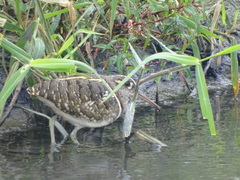
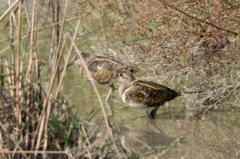
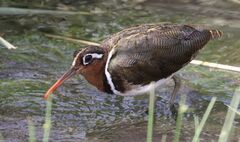
The greater painted-snipe (Rostratula benghalensis) is a species of wader in the small painted-snipe family Rostratulidae. It widely distributed across Africa and southern Asia and is found in a variety of wetland habitats, including swamps and the edges of larger water bodies such as lakes and rivers. This species is sexually dimorphic with the female being larger and more brightly coloured than the male. The female is normally polyandrous with the males incubating the eggs and caring for the young.

The greater painted-snipe was formally described in 1758 by the Swedish naturalist Carl Linnaeus in the tenth edition of his Systema Naturae. He placed it with the rails in the genus Rallus and coined the binomial name Rallus benghalenis. Linnaeus based his account on the "Bengall water rail" that had been described and illustrated in 1738 by the English naturalist Eleazar Albin in his A Natural History of Birds. Albin had examined a drawing that had been sent to the English silk-pattern designer Joseph Dandridge from Bengal. The greater painted-snipe is now placed with the Australian painted-snipe in the genus Rostratula that was introduced in 1816 by the French ornithologist... Wikipedia →

Sounds

Song0:23

Thailand · 2024

© Greg Irving · XC936883 · CC BY-NC-SA 4.0

Call0:07

China · 2024

© Vincent · XC919640 · CC BY-NC-SA 4.0

Recording0:18

Taiwan · 2013

© Sung Ming Chen · XC206311 · CC BY-NC-SA 4.0

Global Distribution

Parks Where Found

# Park Country Daily sighting probability
1 Amboseli National Park 🇰🇪 Kenya
~10%
2 Niokolo-Koba National Park 🇸🇳 Senegal
~10%
3 Ranthambore National Park 🇮🇳 India
~10%
4 Keoladeo National Park 🇮🇳 India
~10%
5 Gonarezhou National Park 🇿🇼 Zimbabwe
~10%
6 Tsavo East National Park 🇰🇪 Kenya
~10%
7 Mikumi National Park 🇹🇿 Tanzania
<5%
8 South Luangwa National Park 🇿🇲 Zambia
<5%
9 Nairobi National Park 🇰🇪 Kenya
<5%
10 Kruger National Park 🇿🇦 South Africa
<5%
11 Semuliki National Park 🇺🇬 Uganda
<5%
12 Lower Zambezi National Park 🇿🇲 Zambia
<5%
13 Moremi Game Reserve 🇧🇼 Botswana
<5%
14 Hwange National Park 🇿🇼 Zimbabwe
<5%
15 Kafue National Park 🇿🇲 Zambia
<5%
16 Chobe National Park 🇧🇼 Botswana
<5%
17 Manas National Park 🇮🇳 India
<5%
18 Ngorongoro Conservation Area 🇹🇿 Tanzania
<5%
19 Mana Pools National Park 🇿🇼 Zimbabwe
<5%
20 Murchison Falls National Park 🇺🇬 Uganda
<5%
21 Tarangire National Park 🇹🇿 Tanzania
<5%
22 Chitwan National Park 🇳🇵 Nepal
<5%
23 Wilpattu National Park 🇱🇰 Sri Lanka
<5%
24 Satpura National Park 🇮🇳 India
<5%
25 Kanha National Park 🇮🇳 India
<5%
26 Etosha National Park 🇳🇦 Namibia
<5%
27 Tsavo West National Park 🇰🇪 Kenya
<5%
28 Lake Mburo National Park 🇺🇬 Uganda
<5%
29 Arusha National Park 🇹🇿 Tanzania
<5%
30 Samburu National Reserve 🇰🇪 Kenya
<5%
31 Masai Mara National Reserve 🇰🇪 Kenya
<5%
32 Queen Elizabeth National Park 🇺🇬 Uganda
<5%
33 Lake Nakuru National Park 🇰🇪 Kenya
<5%
34 iSimangaliso Wetland Park 🇿🇦 South Africa
<5%
35 Bandhavgarh National Park 🇮🇳 India
<5%
36 Bandipur National Park 🇮🇳 India
<5%
37 Serengeti National Park 🇹🇿 Tanzania
<5%
38 Kaziranga National Park 🇮🇳 India
<5%
39 Jim Corbett National Park 🇮🇳 India
<5%

Cities Where Found

# City Country Daily sighting probability
1 Ouagadougou 🇧🇫 Burkina Faso
~30%
2 N'Djamena 🇹🇩 Chad
~20%
3 Quanzhou 🇨🇳 China
~10%
4 Kota 🇮🇳 India
~10%
5 Vasai-Virar 🇮🇳 India
~10%
6 Serrekunda 🇬🇲 Gambia
~10%
7 Coimbatore 🇮🇳 India
~10%
8 Thiruvananthapuram 🇮🇳 India
~10%
9 Taichung 🇹🇼 Taiwan
~10%
10 Kozhikode 🇮🇳 India
<5%

Before you go

What are the chances of seeing a Greater Painted-Snipe in Keoladeo National Park?

With luck

About 10% of wildlife watchers report a Greater Painted-Snipe sighting in Keoladeo National Park on a given day, based on 179 verified sightings from GBIF citizen-science data from 2019 to 2026. It is the 153rd most-seen of the 278 birds we can rate there. Over three days the chance rises to about 20%, and over a week to about 40%, if each day is a fresh chance.

When is the best time to see a Greater Painted-Snipe in Keoladeo National Park?

May

In that month about 50% of wildlife watchers report a Greater Painted-Snipe in Keoladeo National Park on a given day, against under 5% in July to December, the lowest months. That is one of Keoladeo National Park's driest months, with about 20 mm of rain against 240 mm in July.

What time of day is best to see a Greater Painted-Snipe?

Between 3 and 6 pm

Across all the parks we cover, that three-hour window holds the most Greater Painted-Snipe sightings with a recorded time, and about 9 in 10 of them come between 6 am and 6 pm: it is a daytime animal.

Is Keoladeo National Park the best place to see a Greater Painted-Snipe?

Among the best

Of the 39 parks where we can rate Greater Painted-Snipe sightings, Keoladeo National Park ranks 4th at about 10%, level with the leaders once rounded. The best odds are in Amboseli National Park (Kenya, about 10%), Niokolo-Koba National Park (Senegal, about 10%) and Ranthambore National Park (India, about 10%).

Which relatives of the Greater Painted-Snipe live in Keoladeo National Park?

Same order: Charadriiformes

The closest relatives of the Greater Painted-Snipe that you can see in Keoladeo National Park (order Charadriiformes, Shorebirds and Allies) are Red-wattled Lapwing (about 80%), Bronze-winged Jacana (about 70%) and Black-winged Stilt (about 60%), with each one's daily chance of a sighting.

Where does the Greater Painted-Snipe sighting chance come from?

GBIF citizen-science records

It is estimated from how often the Greater Painted-Snipe is recorded against all the birds logged in Keoladeo National Park (179 verified sightings from 2019 to 2026), calibrated against known sighting rates. Figures are rounded to the nearest 10% because citizen-science data supports honest approximations, not decimals, and months with records from fewer than five people show "—". How it works.

← Back to Keoladeo National Park