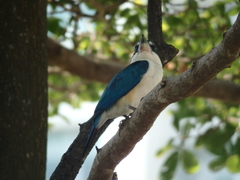
Collared Kingfisher

Collared Kingfisher

Todiramphus chloris

Silhouette: Steven Traver · PhyloPic

LCLeast ConcernNTVUENCR
Daily sighting probability ~20% · Possible
at Kerinci Seblat National Park

In 3 days ~40% in a week ~70%

113 Verified sightings at Kerinci Seblat National Park From 2019 to 2026
5,906 In all 15 parks
September Best month
🌅 Crepuscular When it's spotted

About the Collared Kingfisher

The collared kingfisher (Todiramphus chloris) is a medium-sized kingfisher belonging to the subfamily Halcyoninae, the tree kingfishers. It is also known as the white-collared kingfisher, black-masked kingfisher or mangrove kingfisher. It has a wide range extending from the Red Sea across southern Asia to Melanesia. A number of subspecies and subspecies groups have been split from this species including the Pacific kingfisher, the Islet kingfisher, the Torresian kingfisher, the Mariana kingfisher, and the Melanesian kingfisher.

The collared kingfisher was described by the French polymath Georges-Louis Leclerc, Comte de Buffon in his Histoire Naturelle des Oiseaux in 1780. The bird was also illustrated in a hand-coloured plate engraved by François-Nicolas Martinet in the Planches Enluminées D'Histoire Naturelle. This was produced under the supervision of Edme-Louis Daubenton to accompany Buffon's text. Neither the plate caption nor Buffon's description included a scientific name but in 1783 the Dutch naturalist Pieter Boddaert coined the binomial name Alcedo chloris in his catalogue of the Planches Enluminées. The type locality is the island of Buru within Indonesia... Wikipedia →

Sounds

Call0:19

Singapore · 2026

© Joan Theng · XC1166880 · CC BY-NC-SA 4.0

Song0:27

Indonesia · 2024

© Ding Li Yong · XC894014 · CC BY-NC-ND 4.0

Duet0:28

India · 2023

© amritography · XC805862 · CC BY-NC-SA 4.0

Global Distribution

Parks Where Found

# Park Country Daily sighting probability
1 Bali Barat National Park 🇮🇩 Indonesia
~80%
2 Sundarbans National Park 🇮🇳 India
~80%
3 Komodo National Park 🇮🇩 Indonesia
~70%
4 Way Kambas National Park 🇮🇩 Indonesia
~70%
5 Bako National Park 🇲🇾 Malaysia
~50%
6 Tangkoko Nature Reserve 🇮🇩 Indonesia
~40%
7 Kinabatangan Wildlife Sanctuary 🇲🇾 Malaysia
~20%
8 Kerinci Seblat National Park 🇮🇩 Indonesia
~20%
9 Sepilok 🇲🇾 Malaysia
~10%
10 Gunung Leuser National Park 🇮🇩 Indonesia
~10%
11 Raja Ampat 🇮🇩 Indonesia
<5%
12 Taman Negara National Park 🇲🇾 Malaysia
<5%
13 Danum Valley Conservation Area 🇲🇾 Malaysia
<5%
14 Kinabalu Park 🇲🇾 Malaysia
<5%
15 Kaeng Krachan National Park 🇹🇭 Thailand
<5%

Cities Where Found

# City Country Daily sighting probability
1 Cebu City 🇵🇭 Philippines
~90%
2 Davao City 🇵🇭 Philippines
~80%
3 Manila 🇵🇭 Philippines
~70%
4 Denpasar 🇮🇩 Indonesia
~60%
5 Kuching 🇲🇾 Malaysia
~40%
6 Singapore 🇸🇬 Singapore
~40%
7 Johor Bahru 🇲🇾 Malaysia
~40%
8 Bandar Lampung 🇮🇩 Indonesia
~40%
9 Jakarta 🇮🇩 Indonesia
~30%
10 Yogyakarta 🇮🇩 Indonesia
~30%

Zoos & Centres Where Found

# Zoo / Centre Country
1 ZooParc de Beauval 🇫🇷 France In captivity
2 Natura Artis Magistra 🇳🇱 Netherlands In captivity
3 Barcelona Zoo 🇪🇸 Spain In captivity
4 Walsrode World Bird Park 🇩🇪 Germany In captivity
5 Zoo Miami 🇺🇸 United States In captivity
6 Aquarama Barcelona 🇪🇸 Spain In captivity
7 Bali Bird Park 🇮🇩 Indonesia In captivity
8 Bioparc Fuengirola 🇪🇸 Spain In captivity
9 Snakeroom Serpentarium 🇪🇸 Spain In captivity

Before you go

What are the chances of seeing a Collared Kingfisher in Kerinci Seblat National Park?

Possible

About 20% of wildlife watchers report a Collared Kingfisher sighting in Kerinci Seblat National Park on a given day, based on 113 verified sightings from GBIF citizen-science data from 2019 to 2026. It is the 72nd most-seen of the 203 birds we can rate there. Over three days the chance rises to about 40%, and over a week to about 70%, if each day is a fresh chance.

When is the best time to see a Collared Kingfisher in Kerinci Seblat National Park?

September

In that month about 30% of wildlife watchers report a Collared Kingfisher in Kerinci Seblat National Park on a given day, against under 5% in March, the lowest month. January has too few records to rate.

What time of day is best to see a Collared Kingfisher?

Between 2 and 5 am

Across all the parks we cover, that three-hour window holds the most Collared Kingfisher sightings with a recorded time, and about half of them come between 6 pm and 6 am: it is most active around dawn and dusk.

Which relatives of the Collared Kingfisher live in Kerinci Seblat National Park?

Same family: Alcedinidae

The closest relatives of the Collared Kingfisher that you can see in Kerinci Seblat National Park (family Alcedinidae, Kingfishers) are White-throated Kingfisher (about 20%) and Banded Kingfisher (about 10%), with each one's daily chance of a sighting.

Where does the Collared Kingfisher sighting chance come from?

GBIF citizen-science records

It is estimated from how often the Collared Kingfisher is recorded against all the birds logged in Kerinci Seblat National Park (113 verified sightings from 2019 to 2026), calibrated against known sighting rates. Figures are rounded to the nearest 10% because citizen-science data supports honest approximations, not decimals, and months with records from fewer than five people show "—". How it works.

← Back to Kerinci Seblat National Park