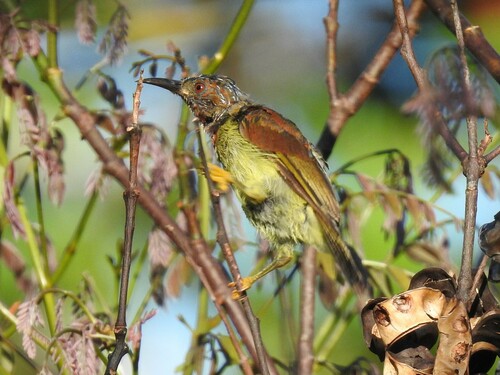
Little Spiderhunter

Little Spiderhunter

Arachnothera longirostra

Silhouette: Sheatherius · PhyloPic

LCLeast ConcernNTVUENCR
Daily sighting probability ~20% · Possible
at Kubah National Park

In 3 days ~50% in a week ~80%

17 Verified sightings at Kubah National Park From 2019 to 2026
5,192 In all 26 parks
March Best month
☀️ Diurnal When it's spotted

About the Little Spiderhunter

The little spiderhunter (Arachnothera longirostra) is a species of long-billed nectar-feeding bird in the family Nectariniidae found in the moist forests of South and Southeast Asia. Unlike typical sunbirds, males and females are very similar in plumage. They are usually seen in ones or twos and frequently make a tzeck call. They are most often found near flowering plants where they obtain nectar.

The distinctive long beak set it apart from other sunbirds. The sexes are similar, except that the female has a paler base on the lower mandible. Male has all black beak. They are found near their favourite nectar bearing trees, often species of wild Musaceae or flowers in gardens. They have a buzzy zick-zick call that is made regularly when disturbed or when foraging. Additionally, the song is series of rapid chipping notes and these can go on for long periods.

The genus name Arachnothera means "spider hunter" and the species epithet refers to the long beak. About thirteen geographic races are recognized. The nominate race longirostra (Latham, 1790) is found in southwestern India, central and northeastern India, foothills of the Himalayas and into Thailand...

Wikipedia →

Sounds

Call0:12

Singapore · 2026

© Joan Theng · XC1175104 · CC BY-NC-SA 4.0

Uncertain0:06

Vietnam · 2026

© Tim Dinh / Annambirding · XC1155913 · CC BY-NC-SA 4.0

Song0:16

Malaysia · 2022

© Amar-Singh HSS · XC721637 · CC BY-NC-SA 4.0

Global Distribution

Parks Where Found

# Park Country Daily sighting probability
1 Danum Valley Conservation Area 🇲🇾 Malaysia
~60%
2 Khao Luang National Park 🇹🇭 Thailand
~50%
3 Khao Sok National Park 🇹🇭 Thailand
~40%
4 Tanjung Puting National Park 🇮🇩 Indonesia
~40%
5 Sepilok 🇲🇾 Malaysia
~30%
6 Cat Tien National Park 🇻🇳 Vietnam
~30%
7 Kubah National Park 🇲🇾 Malaysia
~20%
8 Way Kambas National Park 🇮🇩 Indonesia
~20%
9 Doi Inthanon National Park 🇹🇭 Thailand
~10%
10 Periyar National Park 🇮🇳 India
~10%
11 Gunung Leuser National Park 🇮🇩 Indonesia
~10%
12 Khao Yai National Park 🇹🇭 Thailand
~10%
13 Kaeng Krachan National Park 🇹🇭 Thailand
~10%
14 Taman Negara National Park 🇲🇾 Malaysia
~10%
15 Bako National Park 🇲🇾 Malaysia
~10%
16 Namdapha National Park 🇮🇳 India
~10%
17 Kerinci Seblat National Park 🇮🇩 Indonesia
~10%
18 Kinabalu Park 🇲🇾 Malaysia
~10%
19 Kinabatangan Wildlife Sanctuary 🇲🇾 Malaysia
~10%
20 Bali Barat National Park 🇮🇩 Indonesia
~10%
21 Manas National Park 🇮🇳 India
<5%
22 Cuc Phuong National Park 🇻🇳 Vietnam
<5%
23 Nagarhole National Park 🇮🇳 India
<5%
24 Royal Manas National Park 🇧🇹 Bhutan
<5%
25 Kaziranga National Park 🇮🇳 India
<5%
26 Bandipur National Park 🇮🇳 India
<5%

Cities Where Found

# City Country Daily sighting probability
1 Kuala Lumpur 🇲🇾 Malaysia
~10%
2 Singapore 🇸🇬 Singapore
~10%
3 Guwahati 🇮🇳 India
<5%
4 Jakarta 🇮🇩 Indonesia
<5%
5 Denpasar 🇮🇩 Indonesia
<5%

Before you go

What are the chances of seeing a Little Spiderhunter in Kubah National Park?

Possible

About 20% of wildlife watchers report a Little Spiderhunter sighting in Kubah National Park on a given day, based on 17 verified sightings from GBIF citizen-science data from 2019 to 2026. It is the 38th most-seen of the 92 birds we can rate there. Over three days the chance rises to about 50%, and over a week to about 80%, if each day is a fresh chance.

When is the best time to see a Little Spiderhunter in Kubah National Park?

March

In that month about 40% of wildlife watchers report a Little Spiderhunter in Kubah National Park on a given day, against about 10% in April, June and December, the lowest months. January–February, September and November have too few records to rate.

What time of day is best to see a Little Spiderhunter?

Between 9 am and noon

Across all the parks we cover, that three-hour window holds the most Little Spiderhunter sightings with a recorded time, and about 9 in 10 of them come between 6 am and 6 pm: it is a daytime animal.

Where does the Little Spiderhunter sighting chance come from?

GBIF citizen-science records

It is estimated from how often the Little Spiderhunter is recorded against all the birds logged in Kubah National Park (17 verified sightings from 2019 to 2026), calibrated against known sighting rates. Figures are rounded to the nearest 10% because citizen-science data supports honest approximations, not decimals, and months with records from fewer than five people show "—". How it works.

← Back to Kubah National Park