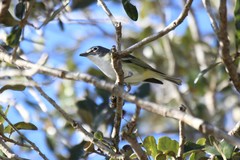
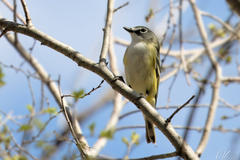
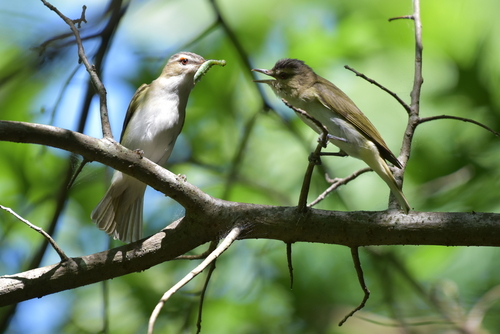
Blue-headed Vireo

Blue-headed Vireo

Vireo solitarius

Silhouette: Caleb Gordon · PhyloPic

LCLeast ConcernNTVUENCR
Daily sighting probability ~10% · With luck
at La Tigra National Park

In 3 days ~20% in a week ~40%

27 Verified sightings at La Tigra National Park From 2019 to 2026
13,742 In all 26 parks
February Best month
☀️ Diurnal When it's spotted

About the Blue-headed Vireo

The blue-headed vireo (Vireo solitarius) is a migratory songbird found in North and Central America. There are currently two recognized subspecies that belong to the blue-headed vireo. It has a range that extends across Canada and the eastern coast of the United States, Mexico, and some of Central America. It prefers large temperate forests with a mix of evergreen trees and deciduous under growth.

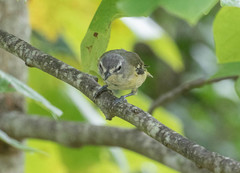
As the name suggests, the blue-headed vireo is characterized by its blue-grey head and bold yellow wing bars. Both sexes are very similar in plumage and size. Juveniles also have a similar plumage. Populations of the blue-headed vireo have been steadily increasing since the 1970s. Therefore, in 2004, the species was classified as a "Least Concern" species.

The blue-headed vireo has similar plumage year round and does not drastically change its appearance during the breeding season. It can be characterized by its olive green upper body, two bold yellow wing bars down the edge of its wing, and a deep blue-grey crown from which it gets its name. The juvenile plumage of immature blue-headed vireos is not distinct but very similar to the adult plumage. While this bird's appearance... Wikipedia →

Sounds

Song1:24

United States · 2026

© Scott Olmstead · XC1141320 · CC BY-NC-SA 4.0

Call0:34

Guatemala · 2024

© Peter Boesman · XC880375 · CC BY-NC-ND 4.0

Recording1:02

Canada · 2021

© Ray Cooke · XC653034 · CC BY-NC-SA 4.0

Global Distribution

Parks Where Found

# Park Country Daily sighting probability
1 Great Smoky Mountains National Park 🇺🇸 United States
~40%
2 Point Pelee National Park 🇨🇦 Canada
~30%
3 Cañón del Sumidero National Park 🇲🇽 Mexico
~30%
4 Gros Morne National Park 🇨🇦 Canada
~30%
5 Shenandoah National Park 🇺🇸 United States
~20%
6 El Triunfo 🇲🇽 Mexico
~20%
7 Cape Breton Highlands National Park 🇨🇦 Canada
~20%
8 Riding Mountain National Park 🇨🇦 Canada
~20%
9 Congaree National Park 🇺🇸 United States
~20%
10 Celaque National Park 🇭🇳 Honduras
~20%
11 Acadia National Park 🇺🇸 United States
~20%
12 Cumbres de Monterrey National Park 🇲🇽 Mexico
~10%
13 Voyageurs National Park 🇺🇸 United States
~10%
14 Isle Royale National Park 🇺🇸 United States
~10%
15 Big Cypress National Preserve 🇺🇸 United States
~10%
16 La Tigra National Park 🇭🇳 Honduras
~10%
17 Elk Island National Park 🇨🇦 Canada
~10%
18 Everglades National Park 🇺🇸 United States
<5%
19 Cerro Azul Meámbar National Park 🇭🇳 Honduras
<5%
20 Merritt Island National Wildlife Refuge 🇺🇸 United States
<5%
21 Lago de Yojoa 🇭🇳 Honduras
<5%
22 Monteverde Cloud Forest Reserve 🇨🇷 Costa Rica
<5%
23 Saguaro National Park 🇺🇸 United States
<5%
24 Tikal National Park 🇬🇹 Guatemala
<5%
25 Celestún Biosphere Reserve 🇲🇽 Mexico
<5%
26 Poás Volcano National Park 🇨🇷 Costa Rica
<5%

Cities Where Found

# City Country Daily sighting probability
1 Monterrey 🇲🇽 México
~10%
2 New York City 🇺🇸 United States
~10%
3 Guatemala City 🇬🇹 Guatemala
~10%
4 Miami 🇺🇸 United States
~10%
5 Austin 🇺🇸 United States
~10%
6 San Antonio 🇺🇸 United States
~10%
7 Boston 🇺🇸 United States
~10%
8 Houston 🇺🇸 United States
<5%
9 Orlando 🇺🇸 United States
<5%
10 Detroit 🇺🇸 United States
<5%

Before you go

What are the chances of seeing a Blue-headed Vireo in La Tigra National Park?

With luck

About 10% of wildlife watchers report a Blue-headed Vireo sighting in La Tigra National Park on a given day, based on 27 verified sightings from GBIF citizen-science data from 2019 to 2026. It is the 80th most-seen of the 176 birds we can rate there. Over three days the chance rises to about 20%, and over a week to about 40%, if each day is a fresh chance.

When is the best time to see a Blue-headed Vireo in La Tigra National Park?

February

In that month about 50% of wildlife watchers report a Blue-headed Vireo in La Tigra National Park on a given day, against under 5% in March to January, the lowest months. That is one of La Tigra National Park's driest months, with about 25 mm of rain against 260 mm in June.

What time of day is best to see a Blue-headed Vireo?

Between 9 am and noon

Across all the parks we cover, that three-hour window holds the most Blue-headed Vireo sightings with a recorded time, and nearly all of them come between 6 am and 6 pm: it is a daytime animal.

Where does the Blue-headed Vireo sighting chance come from?

GBIF citizen-science records

It is estimated from how often the Blue-headed Vireo is recorded against all the birds logged in La Tigra National Park (27 verified sightings from 2019 to 2026), calibrated against known sighting rates. Figures are rounded to the nearest 10% because citizen-science data supports honest approximations, not decimals, and months with records from fewer than five people show "—". How it works.

← Back to La Tigra National Park