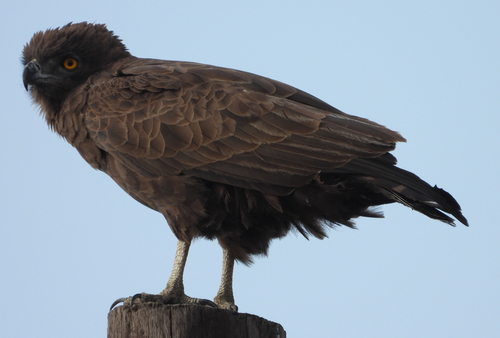
Tawny Eagle

Tawny Eagle

Aquila rapax

Silhouette: Shyamal · PhyloPic

LCNTVUVulnerableENCR
Daily sighting probability <5% · Rare
at Lake Manyara National Park

In 3 days ~10% in a week ~30%

19 Verified sightings at Lake Manyara National Park From 2019 to 2026
16,044 In all 42 parks
February Best month
☀️ Diurnal When it's spotted

About the Tawny Eagle

The tawny eagle (Aquila rapax) is a large bird of prey. Like all eagles, it belongs to the family Accipitridae. Its heavily feathered legs mark it as a member of the subfamily Aquilinae, also known as booted eagles. Tawny eagles have an extensive but discontinuous breeding range that constitutes much of the African continent as well as the Indian subcontinent, with rare residency in the southern Middle East. Throughout its range, it favours open dry habitats such as semideserts, deserts steppes, or savanna plains. Despite its preference for arid areas, the species seldom occurs in areas where trees are entirely absent. It is a resident breeder which lays one to three eggs in a stick nest most commonly in the crown of a tree. The tawny eagle is perhaps the most highly opportunistic of all Aquilinae, and often scavenges on carrion or engages in kleptoparasitism towards other carnivorous animals but is also a bold and active predator, often of relatively large and diverse prey. It is estimated that tawny eagles can reach the age of 16 years old. Nonetheless, precipitous declines have been detected throughout the tawny eagle's range. Numerous factors, particularly loss of nesting habitat due to logging and global warming, as well as persecution (largely via poisoning) and other anthropogenic mortality (largely through contact with various manmade objects) are driving the once numerous tawny eagle perhaps to the brink of extinction.

It is also the national animal of Ghana. Wikipedia →

Sounds

Call0:12

Tanzania · 2023

© isaac kilusu · XC836900 · CC BY-NC-SA 4.0

Begging call0:38

South Africa · 2018

© Raphaël Nussbaumer · XC459459 · CC BY-NC-SA 4.0

Global Distribution

Parks Where Found

# Park Country Daily sighting probability
1 Tarangire National Park 🇹🇿 Tanzania
~60%
2 Kgalagadi Transfrontier Park 🇿🇦 South Africa
~60%
3 Serengeti National Park 🇹🇿 Tanzania
~60%
4 Samburu National Reserve 🇰🇪 Kenya
~50%
5 Ruaha National Park 🇹🇿 Tanzania
~50%
6 Tsavo East National Park 🇰🇪 Kenya
~40%
7 Etosha National Park 🇳🇦 Namibia
~40%
8 Hwange National Park 🇿🇼 Zimbabwe
~40%
9 Ngorongoro Conservation Area 🇹🇿 Tanzania
~40%
10 Masai Mara National Reserve 🇰🇪 Kenya
~40%
11 Amboseli National Park 🇰🇪 Kenya
~40%
12 Tsavo West National Park 🇰🇪 Kenya
~30%
13 Kruger National Park 🇿🇦 South Africa
~30%
14 Gonarezhou National Park 🇿🇼 Zimbabwe
~30%
15 Meru National Park 🇰🇪 Kenya
~30%
16 Bale Mountains National Park 🇪🇹 Ethiopia
~30%
17 Chobe National Park 🇧🇼 Botswana
~30%
18 Moremi Game Reserve 🇧🇼 Botswana
~20%
19 Awash National Park 🇪🇹 Ethiopia
~20%
20 Lake Nakuru National Park 🇰🇪 Kenya
~20%
21 Mkomazi National Park 🇹🇿 Tanzania
~20%
22 Kidepo Valley National Park 🇺🇬 Uganda
~20%
23 uMkhuze Game Reserve 🇿🇦 South Africa
~20%
24 Mana Pools National Park 🇿🇼 Zimbabwe
~20%
25 Murchison Falls National Park 🇺🇬 Uganda
~20%
26 Hluhluwe-Imfolozi Park 🇿🇦 South Africa
~20%
27 Lower Zambezi National Park 🇿🇲 Zambia
~10%
28 Nairobi National Park 🇰🇪 Kenya
~10%
29 Lake Mburo National Park 🇺🇬 Uganda
~10%
30 South Luangwa National Park 🇿🇲 Zambia
~10%
31 Kafue National Park 🇿🇲 Zambia
~10%
32 Akagera National Park 🇷🇼 Rwanda
~10%
33 Arusha National Park 🇹🇿 Tanzania
~10%
34 Mikumi National Park 🇹🇿 Tanzania
~10%
35 Queen Elizabeth National Park 🇺🇬 Uganda
~10%
36 Niokolo-Koba National Park 🇸🇳 Senegal
~10%
37 Waterberg Plateau Park 🇳🇦 Namibia
~10%
38 Lake Manyara National Park 🇹🇿 Tanzania
<5%
39 Keoladeo National Park 🇮🇳 India
<5%
40 Mudumalai National Park 🇮🇳 India
<5%
41 Bandipur National Park 🇮🇳 India
<5%
42 iSimangaliso Wetland Park 🇿🇦 South Africa
<5%

Cities Where Found

# City Country Daily sighting probability
1 Addis Ababa 🇪🇹 Ethiopia
~10%
2 Prayagraj 🇮🇳 India
<5%
3 Kigali 🇷🇼 Rwanda
<5%
4 Kampala 🇺🇬 Uganda
<5%
5 Mysuru 🇮🇳 India
<5%
6 Bengaluru 🇮🇳 India
<5%

Zoos & Centres Where Found

# Zoo / Centre Country
1 Le rocher des aigles 🇫🇷 France In captivity
2 Mysore Zoo 🇮🇳 India In captivity
3 Lahore Zoo 🇵🇰 Pakistan In captivity
4 Dullstroom Bird Of Prey & Rehabilitation Centre 🇿🇦 South Africa In captivity
5 Leningrad Zoo 🇷🇺 Russia In captivity
6 Volerie des aigles 🇫🇷 France In captivity
7 Donjon des aigles 🇫🇷 France In captivity

Before you go

What are the chances of seeing a Tawny Eagle in Lake Manyara National Park?

Rare

Under 5% of wildlife watchers report a Tawny Eagle sighting in Lake Manyara National Park on a given day, based on 19 verified sightings from GBIF citizen-science data from 2019 to 2026. It is the 189th most-seen of the 307 birds we can rate there. Over three days the chance rises to about 10%, and over a week to about 30%, if each day is a fresh chance.

When is the best time to see a Tawny Eagle in Lake Manyara National Park?

August and December–March

In those months about 10% of wildlife watchers report a Tawny Eagle in Lake Manyara National Park on a given day, against under 5% in April–July and September–November, the lowest months.

What time of day is best to see a Tawny Eagle?

Between 7 and 10 am

Across all the parks we cover, that three-hour window holds the most Tawny Eagle sightings with a recorded time, and about 9 in 10 of them come between 6 am and 6 pm: it is a daytime animal.

Where does the Tawny Eagle sighting chance come from?

GBIF citizen-science records

It is estimated from how often the Tawny Eagle is recorded against all the birds logged in Lake Manyara National Park (19 verified sightings from 2019 to 2026), calibrated against known sighting rates. Figures are rounded to the nearest 10% because citizen-science data supports honest approximations, not decimals, and months with records from fewer than five people show "—". How it works.

← Back to Lake Manyara National Park