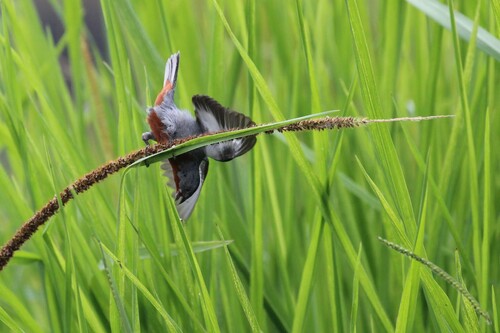
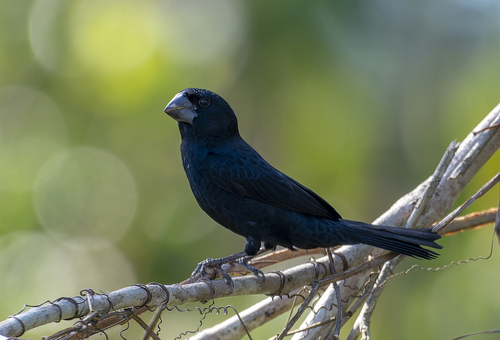
Double-collared Seedeater

Double-collared Seedeater

Sporophila caerulescens

Silhouette: Sheatherius · PhyloPic

LCLeast ConcernNTVUENCR
Daily sighting probability <5% · Rare
at Manu National Park

In 3 days <5% in a week ~10%

36 Verified sightings at Manu National Park From 2019 to 2026
3,304 In all 15 parks
May Best month
☀️ Diurnal When it's spotted

About the Double-collared Seedeater

The double-collared seedeater (Sporophila caerulescens) is a species of bird in the family Thraupidae. It is found in Argentina, Bolivia, Brazil, Paraguay, Peru, and Uruguay, as well as the southern border of Colombia on the Amazon River.

Its natural habitats are subtropical or tropical moist shrubland, pastureland, and heavily degraded former forest. It is a dimorphic species, with the male having a gray head and back, a black-collared throat, paired with a black band just below, across the upper whitish breast. It has gray legs, a medium length tail, and the stout bill for seed-eating. The female is less colorful.

The species ranges from central Argentina east of the Andes cordillera northwards through Bolivia and Paraguay, and northeastwards into south-central Brazil, and southeast coastal Brazil; the species retreats into Amazonia during the austral winter. The double-collared seedeater is only found in the southern Amazon Basin, limited by the Amazon River as its northern limit.

In the west Amazon Basin it is found in eastern regions of Peru, the Ucayali River areas, and mostly the eastern bank of the north-flowing river. In the southeast Basin... Wikipedia →

Sounds

Call0:11

Brazil · 2026

© JAYRSON ARAUJO DE OLIVEIRA · XC1150804 · CC BY-NC-SA 4.0

Begging call0:30

Brazil · 2026

© Marcelo J Feliti · XC1120000 · CC BY-NC-SA 4.0

Song0:06

Brazil · 2025

© Ricardo José Mitidieri · XC973024 · CC BY-NC-SA 4.0

Global Distribution

Parks Where Found

# Park Country Daily sighting probability
1 Itatiaia National Park 🇧🇷 Brazil
~40%
2 Chapada dos Guimarães National Park 🇧🇷 Brazil
~30%
3 Iberá National Park 🇦🇷 Argentina
~20%
4 Serra dos Órgãos National Park 🇧🇷 Brazil
~20%
5 Serra da Canastra National Park 🇧🇷 Brazil
~20%
6 Tijuca National Park 🇧🇷 Brazil
~20%
7 El Palmar National Park 🇦🇷 Argentina
~10%
8 Iguazú National Park 🇦🇷 Argentina
~10%
9 Iguaçu National Park 🇧🇷 Brazil
~10%
10 Emas National Park 🇧🇷 Brazil
~10%
11 El Impenetrable National Park 🇦🇷 Argentina
~10%
12 Parque Estadual Encontro das Águas 🇧🇷 Brazil
<5%
13 Amboró National Park 🇧🇴 Bolivia
<5%
14 Tambopata National Reserve 🇵🇪 Peru
<5%
15 Manu National Park 🇵🇪 Peru
<5%

Cities Where Found

# City Country Daily sighting probability
1 Asuncion 🇵🇾 Paraguay
~20%
2 Buenos Aires 🇦🇷 Argentina
~20%
3 Campinas 🇧🇷 Brazil
~10%
4 Rio de Janeiro 🇧🇷 Brazil
~10%
5 Rosario 🇦🇷 Argentina
~10%
6 Curitiba 🇧🇷 Brazil
~10%
7 Cordoba 🇦🇷 Argentina
~10%
8 Cochabamba 🇧🇴 Bolivia
<5%
9 São Paulo 🇧🇷 Brazil
<5%
10 Montevideo 🇺🇾 Uruguay
<5%

Before you go

What are the chances of seeing a Double-collared Seedeater in Manu National Park?

Rare

Under 5% of wildlife watchers report a Double-collared Seedeater sighting in Manu National Park on a given day, based on 36 verified sightings from GBIF citizen-science data from 2019 to 2026. It is the 483rd most-seen of the 641 birds we can rate there. Over three days the chance rises to under 5%, and over a week to about 10%, if each day is a fresh chance.

When is the best time to see a Double-collared Seedeater in Manu National Park?

Any time of year

In every month with enough records, under 5% of wildlife watchers report a Double-collared Seedeater in Manu National Park on a given day, so our monthly data shows no clear season.

What time of day is best to see a Double-collared Seedeater?

Between 9 am and noon

Across all the parks we cover, that three-hour window holds the most Double-collared Seedeater sightings with a recorded time, and about 9 in 10 of them come between 6 am and 6 pm: it is a daytime animal.

Which relatives of the Double-collared Seedeater live in Manu National Park?

Same genus: Sporophila

The closest relatives of the Double-collared Seedeater that you can see in Manu National Park (genus Sporophila, Typical Seedeaters and Seed-Finches) are Chestnut-bellied Seed-Finch (about 10%) and Chestnut-bellied Seedeater (about 10%), with each one's daily chance of a sighting.

Where does the Double-collared Seedeater sighting chance come from?

GBIF citizen-science records

It is estimated from how often the Double-collared Seedeater is recorded against all the birds logged in Manu National Park (36 verified sightings from 2019 to 2026), calibrated against known sighting rates. Figures are rounded to the nearest 10% because citizen-science data supports honest approximations, not decimals, and months with records from fewer than five people show "—". How it works.

← Back to Manu National Park