Mangrove Cuckoo

Mangrove Cuckoo

Coccyzus minor

Silhouette: Andy Wilson · PhyloPic

LCLeast ConcernNTVUENCR
Daily sighting probability <5% · Rare
at Manuel Antonio National Park

In 3 days ~10%

43 Verified sightings at Manuel Antonio National Park From 2019 to 2026
1,656 In all 23 parks
April Best month
☀️ Diurnal When it's spotted

About the Mangrove Cuckoo

The mangrove cuckoo (Coccyzus minor) is a species of cuckoo that is native to the Neotropics. The mangrove cuckoo was formally described in 1788 by the German naturalist Johann Friedrich Gmelin in his revised and expanded edition of Carl Linnaeus's Systema Naturae. He placed it with all the other cuckoos in the genus Cuculus and coined the binomial name Cuculus minor. Gmelin based his description on "Le petit vieillard" or "Coucou des palétuviers" from Cayenne that had been described and illustrated in 1779 by the French polymath Georges-Louis Leclerc, Comte de Buffon. The mangrove cuckoo is now placed with 12 other species in the genus Coccyzus that was introduced in 1816 by the French ornithologist Louis Pierre Vieillot. The genus name is from the Ancient Greek kokkuzō meaning "to cry cuckoo". The species is monotypic: no subspecies are recognised.

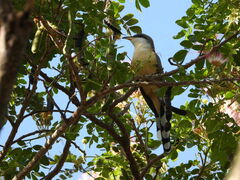
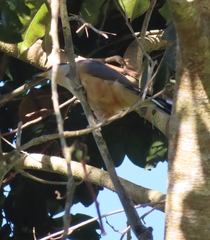
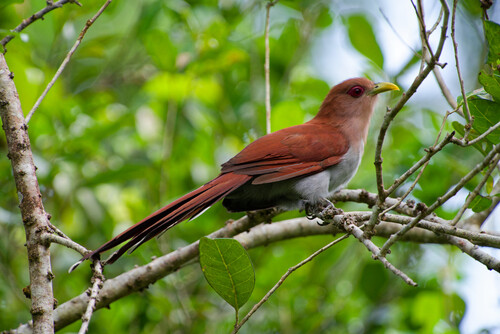
Adults have a long tail, brown above and black-and-white below, and a black curved bill with yellow on the lower mandible. The head and upper parts are brown. There is a yellow ring around the eye. This bird is best distinguished by its black facial mask and buffy underparts. Although the scientific name... Wikipedia →

Sounds

Call0:05

French Guiana · 2025

© Paul Lenrumé · XC1051844 · CC BY-NC-SA 4.0

Alarm call0:57

Mexico · 2020

© Manuel Grosselet · XC571034 · CC BY-NC-SA 4.0

Song0:30

Mexico · 2015

© Andrew Spencer · XC265338 · CC BY-NC-SA 4.0

Global Distribution

Parks Where Found

# Park Country Daily sighting probability
1 Los Haitises National Park 🇩🇴 Dominican Republic
~20%
2 Palo Verde National Park 🇨🇷 Costa Rica
~20%
3 Jaragua National Park 🇩🇴 Dominican Republic
~10%
4 Celestún Biosphere Reserve 🇲🇽 Mexico
~10%
5 Ría Lagartos Biosphere Reserve 🇲🇽 Mexico
~10%
6 Arrecifes de Cozumel National Park 🇲🇽 Mexico
~10%
7 Bastimentos Island National Marine Park 🇵🇦 Panama
~10%
8 Caroni Swamp 🇹🇹 Trinidad and Tobago
<5%
9 Santa Rosa National Park 🇨🇷 Costa Rica
<5%
10 Sian Ka'an Biosphere Reserve 🇲🇽 Mexico
<5%
11 Ostional Wildlife Refuge 🇨🇷 Costa Rica
<5%
12 Cañón del Sumidero National Park 🇲🇽 Mexico
<5%
13 Manuel Antonio National Park 🇨🇷 Costa Rica
<5%
14 La Amistad International Park (Panama) 🇵🇦 Panama
<5%
15 Carara National Park 🇨🇷 Costa Rica
<5%
16 Las Baulas Marine National Park 🇨🇷 Costa Rica
<5%
17 Everglades National Park 🇺🇸 United States
<5%
18 Marino Ballena National Park 🇨🇷 Costa Rica
<5%
19 Corcovado National Park 🇨🇷 Costa Rica
<5%
20 Tortuguero National Park 🇨🇷 Costa Rica
<5%
21 Piedras Blancas National Park 🇨🇷 Costa Rica
<5%
22 Big Cypress National Preserve 🇺🇸 United States
<5%
23 Soberanía National Park 🇵🇦 Panama
<5%

Cities Where Found

# City Country Daily sighting probability
1 Santo Domingo 🇩🇴 Dominican Republic
~10%
2 Mexico City 🇲🇽 México
<5%
3 Panama City 🇵🇦 Panama
<5%
4 San José 🇨🇷 Costa Rica
<5%
5 Miami 🇺🇸 United States
<5%

Before you go

What are the chances of seeing a Mangrove Cuckoo in Manuel Antonio National Park?

Rare

Under 5% of wildlife watchers report a Mangrove Cuckoo sighting in Manuel Antonio National Park on a given day, based on 43 verified sightings from GBIF citizen-science data from 2019 to 2026. It is the 179th most-seen of the 325 birds we can rate there. Over three days the chance rises to about 10%, if each day is a fresh chance.

When is the best time to see a Mangrove Cuckoo in Manuel Antonio National Park?

Any time of year

In every month with enough records, under 5% of wildlife watchers report a Mangrove Cuckoo in Manuel Antonio National Park on a given day, so our monthly data shows no clear season.

What time of day is best to see a Mangrove Cuckoo?

Between 8 and 11 am

Across all the parks we cover, that three-hour window holds the most Mangrove Cuckoo sightings with a recorded time, and about 9 in 10 of them come between 6 am and 6 pm: it is a daytime animal.

Is Manuel Antonio National Park the best place to see a Mangrove Cuckoo?

13th of 23

Of the 23 parks where we can rate Mangrove Cuckoo sightings, Manuel Antonio National Park ranks 13th at under 5%. The best odds are in Los Haitises National Park (Dominican Republic, about 20%), Palo Verde National Park (Costa Rica, about 20%) and Jaragua National Park (Dominican Republic, about 10%).

Which relatives of the Mangrove Cuckoo live in Manuel Antonio National Park?

Same family: Cuculidae

The closest relatives of the Mangrove Cuckoo that you can see in Manuel Antonio National Park (family Cuculidae, Cuckoos) are Groove-billed Ani (about 30%) and Smooth-billed Ani (about 10%), with each one's daily chance of a sighting.

Where does the Mangrove Cuckoo sighting chance come from?

GBIF citizen-science records

It is estimated from how often the Mangrove Cuckoo is recorded against all the birds logged in Manuel Antonio National Park (43 verified sightings from 2019 to 2026), calibrated against known sighting rates. Figures are rounded to the nearest 10% because citizen-science data supports honest approximations, not decimals, and months with records from fewer than five people show "—". How it works.

← Back to Manuel Antonio National Park