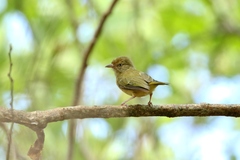
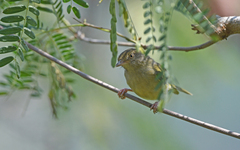

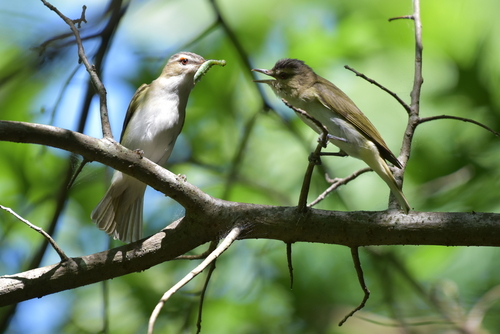
Scrub Greenlet

Scrub Greenlet

Hylophilus flavipes

Silhouette: Sheatherius · PhyloPic

LCLeast ConcernNTVUENCR
Daily sighting probability <5% · Rare
at Manuel Antonio National Park

In 3 days ~10% in a week ~20%

76 Verified sightings at Manuel Antonio National Park From 2019 to 2026
2,559 In all 13 parks
September Best month
☀️ Diurnal When it's spotted

About the Scrub Greenlet

The scrub greenlet (Hylophilus flavipes) is a small passerine bird in the family Vireonidae, the vireos, greenlets, and shrike-babblers. It is found in Colombia, Costa Rica, Panama, Tobago, and Venezuela. The scrub greenlet's taxonomy is unsettled. The IOC, the Clements taxonomy, AviList, and the independent South American Classification Committee assign it these seven subspecies:

Clements does recognize these taxa as distinctive within the full species, calling them the "scrub greenlet (yellow-green)", "scrub greenlet (Tobago)" and "scrub greenlet (scrub)". The North American Classification Committee of the American Ornithological Society... Wikipedia →

Sounds

Song0:17

Venezuela · 2023

© Francisco contreras · XC838721 · CC BY-NC-SA 4.0

Uncertain0:14

Colombia · 2021

© Mauricio Cuellar Ramirez (@Birding.travel) · XC632486 · CC BY-NC-SA 4.0

Call0:49

Panama · 2016

© Hans Matheve · XC361689 · CC BY-NC-ND 4.0

Global Distribution

Parks Where Found

# Park Country Daily sighting probability
1 Main Ridge Forest Reserve 🇹🇹 Trinidad and Tobago
~40%
2 Coiba National Park 🇵🇦 Panama
~40%
3 Piedras Blancas National Park 🇨🇷 Costa Rica
~10%
4 Soberanía National Park 🇵🇦 Panama
~10%
5 Tayrona National Natural Park 🇨🇴 Colombia
~10%
6 Henri Pittier National Park 🇻🇪 Venezuela
~10%
7 Parque Natural Metropolitano 🇵🇦 Panama
<5%
8 Manuel Antonio National Park 🇨🇷 Costa Rica
<5%
9 Corcovado National Park 🇨🇷 Costa Rica
<5%
10 Carara National Park 🇨🇷 Costa Rica
<5%
11 Marino Ballena National Park 🇨🇷 Costa Rica
<5%
12 Chagres National Park 🇵🇦 Panama
<5%
13 La Amistad International Park (Panama) 🇵🇦 Panama
<5%

Cities Where Found

# City Country Daily sighting probability
1 Panama City 🇵🇦 Panama
~10%
2 Valencia 🇻🇪 Venezuela
~10%
3 Caracas 🇻🇪 Venezuela
~10%
4 Medellín 🇨🇴 Colombia
<5%

Before you go

What are the chances of seeing a Scrub Greenlet in Manuel Antonio National Park?

Rare

Under 5% of wildlife watchers report a Scrub Greenlet sighting in Manuel Antonio National Park on a given day, based on 76 verified sightings from GBIF citizen-science data from 2019 to 2026. It is the 130th most-seen of the 325 birds we can rate there. Over three days the chance rises to about 10%, and over a week to about 20%, if each day is a fresh chance.

When is the best time to see a Scrub Greenlet in Manuel Antonio National Park?

September and October

In those months about 20% of wildlife watchers report a Scrub Greenlet in Manuel Antonio National Park on a given day, against under 5% in May–August and December–March, the lowest months. Those are among Manuel Antonio National Park's wettest months, with about 810 mm of rain a month against 35 mm in February.

What time of day is best to see a Scrub Greenlet?

Between 7 and 10 am

Across all the parks we cover, that three-hour window holds the most Scrub Greenlet sightings with a recorded time, and about 9 in 10 of them come between 6 am and 6 pm: it is a daytime animal.

Is Manuel Antonio National Park the best place to see a Scrub Greenlet?

8th of 13

Of the 13 parks where we can rate Scrub Greenlet sightings, Manuel Antonio National Park ranks 8th at under 5%. The best odds are in Main Ridge Forest Reserve (Trinidad and Tobago, about 40%), Coiba National Park (Panama, about 40%) and Piedras Blancas National Park (Costa Rica, about 10%).

Where does the Scrub Greenlet sighting chance come from?

GBIF citizen-science records

It is estimated from how often the Scrub Greenlet is recorded against all the birds logged in Manuel Antonio National Park (76 verified sightings from 2019 to 2026), calibrated against known sighting rates. Figures are rounded to the nearest 10% because citizen-science data supports honest approximations, not decimals, and months with records from fewer than five people show "—". How it works.

← Back to Manuel Antonio National Park