Narrow Stingless Bee

Narrow Stingless Bee

Tetragonisca angustula

Daily sighting probability ~10% · With luck
at Monteverde Cloud Forest Reserve

In 3 days ~20% in a week ~40%

16 Verified sightings at Monteverde Cloud Forest Reserve From 2019 to 2026
239 In all 15 parks
December Best month
☀️ Diurnal When it's spotted

About the Narrow Stingless Bee

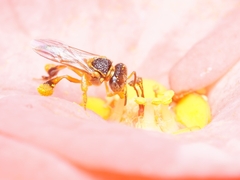
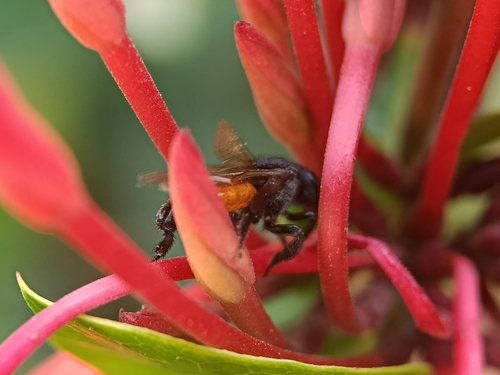
Tetragonisca angustula is a small eusocial stingless bee found in México, Central and South America. It is known by a variety of names in different regions (e.g., jataí, yatei, jaty, virginitas, angelitas inglesas, españolita, mariola, ramichi, chipisas, virgencitas, and mariolitas). A subspecies, Tetragonisca angustula fiebrigi, occupies different areas in South America and has a slightly different coloration.

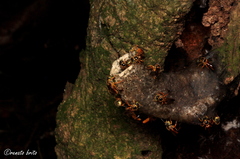
Tetragonisca angustula is a very small bee and builds unobtrusive nests, allowing it to thrive in urban areas. It also produces large amounts of honey, and is thus frequently kept in wooden hives by beekeepers. T. angustula hives are often overlooked, and since the bee lacks a stinger, it is not seen as a threat to humans.

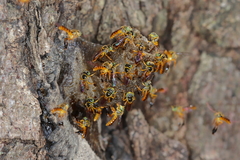
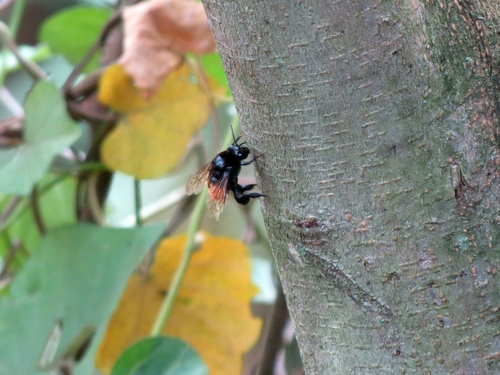
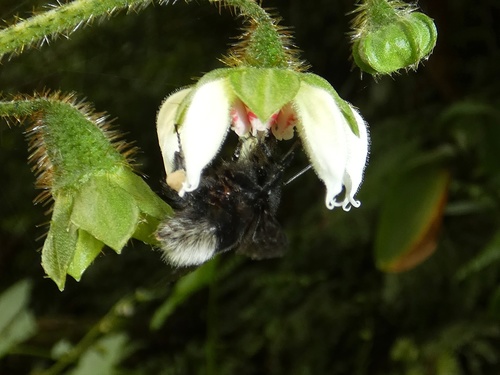
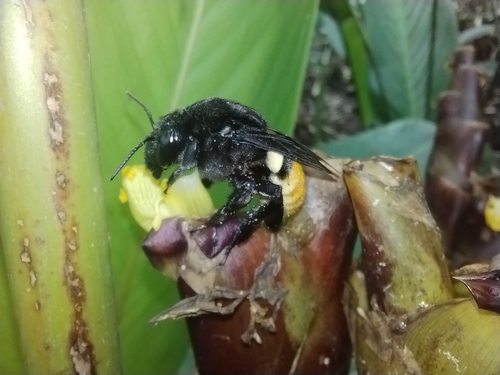
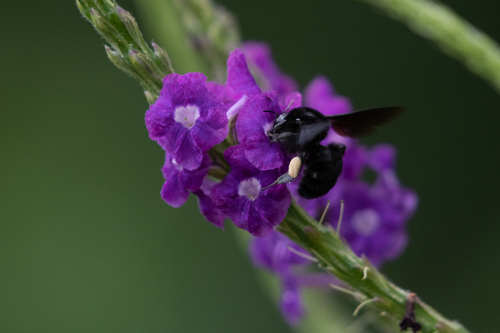
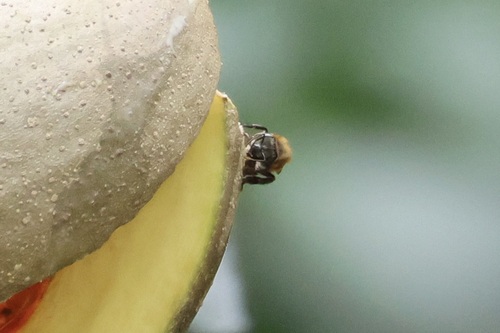
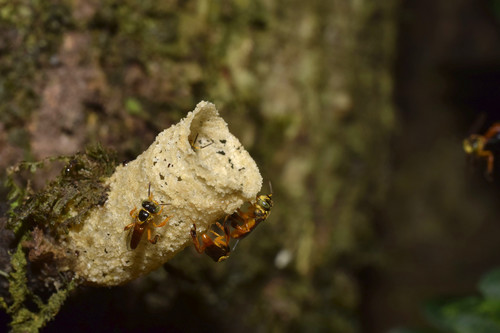
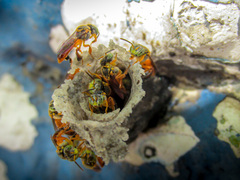
Many of their behaviors are concerned with colonizing a new nest and producing offspring, demonstrated by their swarming and nursing behaviors; however, a special caste of T. angustula are soldiers who are slightly larger than the workers. The soldiers in a T. angustula nest are very good at protecting the hive against intruders, making up for the lack of a stinger in their species. The accuracy of their recognition between nestmate and non-nestmate is some of the highest among bees. Some of these soldiers hover in mid air outside the nest, which is seen in the adjacent picture. Wikipedia →
Global Distribution

Parks Where Found

# Park Country Daily sighting probability
1 Cockscomb Basin Wildlife Sanctuary 🇧🇿 Belize
~20%
2 Tikal National Park 🇬🇹 Guatemala
~20%
3 Rincón de la Vieja National Park 🇨🇷 Costa Rica
~20%
4 Serra dos Órgãos National Park 🇧🇷 Brazil
~20%
5 Tijuca National Park 🇧🇷 Brazil
~20%
6 Arenal Volcano National Park 🇨🇷 Costa Rica
~20%
7 Braulio Carrillo National Park 🇨🇷 Costa Rica
~10%
8 Tortuguero National Park 🇨🇷 Costa Rica
~10%
9 Tenorio Volcano National Park 🇨🇷 Costa Rica
~10%
10 Soberanía National Park 🇵🇦 Panama
~10%
11 Carara National Park 🇨🇷 Costa Rica
~10%
12 Parque Natural Metropolitano 🇵🇦 Panama
~10%
13 Monteverde Cloud Forest Reserve 🇨🇷 Costa Rica
~10%
14 Manuel Antonio National Park 🇨🇷 Costa Rica
~10%
15 La Amistad International Park (Panama) 🇵🇦 Panama
<5%

Cities Where Found

# City Country Daily sighting probability
1 Salvador 🇧🇷 Brazil
~30%
2 Guatemala City 🇬🇹 Guatemala
~30%
3 Recife 🇧🇷 Brazil
~20%
4 Brasilia 🇧🇷 Brazil
~20%
5 São Paulo 🇧🇷 Brazil
~20%
6 Caracas 🇻🇪 Venezuela
~20%
7 Valencia 🇻🇪 Venezuela
~20%
8 Medellín 🇨🇴 Colombia
~20%
9 San Pedro Sula 🇭🇳 Honduras
~20%
10 Niterói 🇧🇷 Brazil
~20%

Before you go

What are the chances of seeing a Narrow Stingless Bee in Monteverde Cloud Forest Reserve?

With luck

About 10% of wildlife watchers report a Narrow Stingless Bee sighting in Monteverde Cloud Forest Reserve on a given day, based on 16 verified sightings from GBIF citizen-science data from 2019 to 2026. It is the 172nd most-seen of the 506 insects we can rate there. Over three days the chance rises to about 20%, and over a week to about 40%, if each day is a fresh chance.

When is the best time to see a Narrow Stingless Bee in Monteverde Cloud Forest Reserve?

December

In that month about 20% of wildlife watchers report a Narrow Stingless Bee in Monteverde Cloud Forest Reserve on a given day, against under 5% in June–July and September–October, the lowest months.

What time of day is best to see a Narrow Stingless Bee?

Between 9 am and noon

Across all the parks we cover, that three-hour window holds the most Narrow Stingless Bee sightings with a recorded time, and nearly all of them come between 6 am and 6 pm: it is a daytime animal.

Which relatives of the Narrow Stingless Bee live in Monteverde Cloud Forest Reserve?

Same family: Apidae

The closest relatives of the Narrow Stingless Bee that you can see in Monteverde Cloud Forest Reserve (family Apidae, Honey Bees, Bumble Bees, and Allies) are Red-Tailed Stingless Bee (about 30%), Eulaema polychroma (about 10%) and Bombus volucelloides (about 10%), with each one's daily chance of a sighting.

Where does the Narrow Stingless Bee sighting chance come from?

GBIF citizen-science records

It is estimated from how often the Narrow Stingless Bee is recorded against all the insects logged in Monteverde Cloud Forest Reserve (16 verified sightings from 2019 to 2026), calibrated against known sighting rates. Figures are rounded to the nearest 10% because citizen-science data supports honest approximations, not decimals, and months with records from fewer than five people show "—". How it works.

← Back to Monteverde Cloud Forest Reserve