Crested Treeswift

Crested Treeswift

Hemiprocne coronata

Silhouette: Sheatherius · PhyloPic

LCLeast ConcernNTVUENCR
Daily sighting probability ~30% · Possible
at Mudumalai National Park

In 3 days ~60% in a week ~90%

240 Verified sightings at Mudumalai National Park From 2019 to 2026
4,971 In all 21 parks
February Best month
🌅 Crepuscular When it's spotted

About the Crested Treeswift

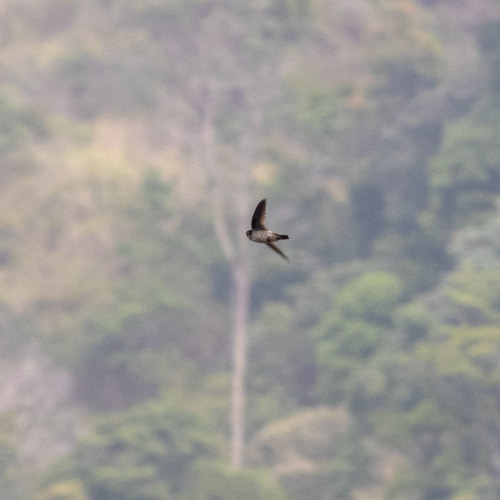
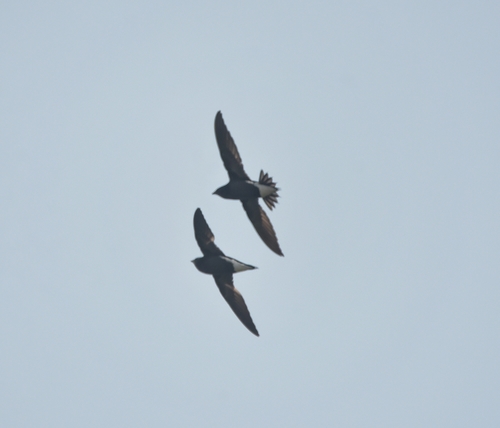
The crested treeswift (Hemiprocne coronata) is a species of tree swift. It was for some time considered the same species as its eastern relative, the gray-rumped treeswift (Hemiprocne longipennis), but they do not interbreed where their ranges overlap. It is distinct in flight, with long, bowed wings and a deeply forked tail that usually appears narrow and pointed.

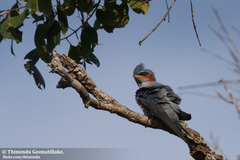
The crested treeswift is a large slender bird at 23 cm (9 in) length. This species is dove grey above and white below. The long swept-back wings are a darker grey above. This treeswift has a crest and a long, deeply forked tail. The adult male has orange cheeks and ear coverts with a narrow streak of white under the eye and a trace of a white supercilium. The female also has a thin white stripe below the eye running below the grey cheek and ear coverts. Young birds have a dark grey head and wings but the feathers are edged in white and the rest of the soft plumage is much streakier than that of the adults. They are found in small groups that fly in wide circles in open forest, occasionally perching atop a tall and leafless tree. When perched they appear to sit very upright.

The call of this species is a... Wikipedia →

Sounds

Uncertain0:38

Cambodia · 2026

© JJSUN · XC1103614 · CC BY-NC-SA 4.0

Call1:10

Laos · 2022

© Bram Piot · XC711520 · CC BY-NC-SA 4.0

Flight call0:15

India · 2017

© Mandar Bhagat · XC595245 · CC BY-NC-SA 4.0

Global Distribution

Parks Where Found

# Park Country Daily sighting probability
1 Yala National Park 🇱🇰 Sri Lanka
~50%
2 Wilpattu National Park 🇱🇰 Sri Lanka
~40%
3 Udawalawe National Park 🇱🇰 Sri Lanka
~30%
4 Mudumalai National Park 🇮🇳 India
~30%
5 Bandhavgarh National Park 🇮🇳 India
~20%
6 Bandipur National Park 🇮🇳 India
~20%
7 Minneriya National Park 🇱🇰 Sri Lanka
~20%
8 Kanha National Park 🇮🇳 India
~20%
9 Jim Corbett National Park 🇮🇳 India
~20%
10 Gir National Park 🇮🇳 India
~20%
11 Satpura National Park 🇮🇳 India
~20%
12 Sinharaja Forest Reserve 🇱🇰 Sri Lanka
~10%
13 Nagarhole National Park 🇮🇳 India
~10%
14 Chitwan National Park 🇳🇵 Nepal
~10%
15 Royal Bardia National Park 🇳🇵 Nepal
~10%
16 Doi Inthanon National Park 🇹🇭 Thailand
~10%
17 Periyar National Park 🇮🇳 India
~10%
18 Manas National Park 🇮🇳 India
~10%
19 Kaeng Krachan National Park 🇹🇭 Thailand
<5%
20 Khao Yai National Park 🇹🇭 Thailand
<5%
21 Cat Tien National Park 🇻🇳 Vietnam
<5%

Cities Where Found

# City Country Daily sighting probability
1 Thrissur 🇮🇳 India
<5%
2 Dehradun 🇮🇳 India
<5%

Before you go

What are the chances of seeing a Crested Treeswift in Mudumalai National Park?

Possible

About 30% of wildlife watchers report a Crested Treeswift sighting in Mudumalai National Park on a given day, based on 240 verified sightings from GBIF citizen-science data from 2019 to 2026. It is the 52nd most-seen of the 233 birds we can rate there. Over three days the chance rises to about 60%, and over a week to about 90%, if each day is a fresh chance.

When is the best time to see a Crested Treeswift in Mudumalai National Park?

May, August, October and December–February

In those months about 30% of wildlife watchers report a Crested Treeswift in Mudumalai National Park on a given day, against about 10% in June and September, the lowest months.

What time of day is best to see a Crested Treeswift?

Between 3 and 6 am

Across all the parks we cover, that three-hour window holds the most Crested Treeswift sightings with a recorded time, and about 6 in 10 of them come between 6 am and 6 pm: it is most active around dawn and dusk.

Which relatives of the Crested Treeswift live in Mudumalai National Park?

Same order: Apodiformes

The closest relatives of the Crested Treeswift that you can see in Mudumalai National Park (order Apodiformes, Swifts and Hummingbirds) are Indian Swiftlet (about 30%), Little Swift (about 20%) and Asian Palm-Swift (about 10%), with each one's daily chance of a sighting.

Where does the Crested Treeswift sighting chance come from?

GBIF citizen-science records

It is estimated from how often the Crested Treeswift is recorded against all the birds logged in Mudumalai National Park (240 verified sightings from 2019 to 2026), calibrated against known sighting rates. Figures are rounded to the nearest 10% because citizen-science data supports honest approximations, not decimals, and months with records from fewer than five people show "—". How it works.

← Back to Mudumalai National Park