Oriental Scops Owl

Oriental Scops Owl

Otus sunia

Silhouette: Armelle Ansart (photograph), Maxime Dahirel (digitisation) · PhyloPic

LCLeast ConcernNTVUENCR
Daily sighting probability <5% · Rare
at Nagarhole National Park

In 3 days ~10% in a week ~20%

57 Verified sightings at Nagarhole National Park From 2019 to 2026
1,567 In all 20 parks
February Best month
☀️🌙 Day & Night When it's spotted

About the Oriental Scops Owl

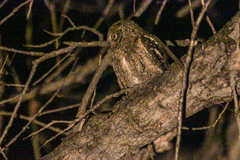
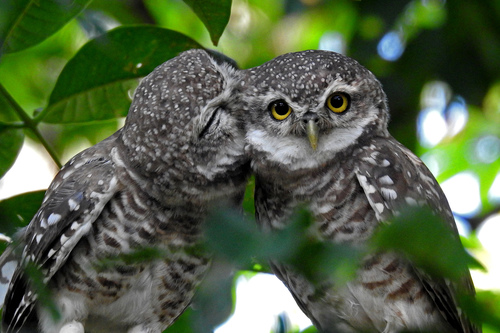
The oriental scops owl (Otus sunia) is a scops owl species native to South and Southeast Asia. The oriental scops owl is a small, variably plumaged, yellow-eyed owl with ear-tufts which are not always erect. It can be distinguished from the collared scops owl by its whitish scapular stripe, well-marked underparts, and lack of pale collar. There are two colour morphs, grey and rufous; intermediate forms also occur. Sexes are similar in appearance. Individuals may freeze with eyes half-closed when disturbed. The species has a repeated liquid call sounding like "tuk tok torok". Adults have higher-pitched calls than juveniles.

The oriental scops owl has an extremely wide distribution across eastern and southern Asia and inhabits dry deciduous forests from Russia to Thailand. The owl nests in holes in trees, especially Mahua trees, during February to April. Wikipedia →

Sounds

Song0:27

Japan · 2024

© Yuichi Yamaura · XC1001841 · CC BY-NC-SA 4.0

Call0:47

India · 2025

© Lim Ying Hien · XC991815 · CC BY-NC-ND 4.0

Song1:12

Vietnam · 2025

© Ding Li Yong · XC994882 · CC BY-NC-ND 4.0

Global Distribution

Parks Where Found

# Park Country Daily sighting probability
1 Periyar National Park 🇮🇳 India
~10%
2 Mudumalai National Park 🇮🇳 India
~10%
3 Kanha National Park 🇮🇳 India
~10%
4 Minneriya National Park 🇱🇰 Sri Lanka
~10%
5 Royal Bardia National Park 🇳🇵 Nepal
<5%
6 Manas National Park 🇮🇳 India
<5%
7 Nagarhole National Park 🇮🇳 India
<5%
8 Doi Inthanon National Park 🇹🇭 Thailand
<5%
9 Satpura National Park 🇮🇳 India
<5%
10 Bandipur National Park 🇮🇳 India
<5%
11 Namdapha National Park 🇮🇳 India
<5%
12 Sundarbans National Park 🇮🇳 India
<5%
13 Ranthambore National Park 🇮🇳 India
<5%
14 Chitwan National Park 🇳🇵 Nepal
<5%
15 Cat Tien National Park 🇻🇳 Vietnam
<5%
16 Kaeng Krachan National Park 🇹🇭 Thailand
<5%
17 Keoladeo National Park 🇮🇳 India
<5%
18 Khao Yai National Park 🇹🇭 Thailand
<5%
19 Bandhavgarh National Park 🇮🇳 India
<5%
20 Jim Corbett National Park 🇮🇳 India
<5%

Cities Where Found

# City Country Daily sighting probability
1 Qingdao 🇨🇳 China
~20%
2 Guangzhou 🇨🇳 China
~10%
3 Seoul 🇰🇷 South Korea
<5%
4 Jaipur 🇮🇳 India
<5%
5 Nanjing 🇨🇳 China
<5%
6 Guwahati 🇮🇳 India
<5%
7 Beijing 🇨🇳 China
<5%
8 Shanghai 🇨🇳 China
<5%
9 Bangkok 🇹🇭 Thailand
<5%

Before you go

What are the chances of seeing an Oriental Scops Owl in Nagarhole National Park?

Rare

Under 5% of wildlife watchers report an Oriental Scops Owl sighting in Nagarhole National Park on a given day, based on 57 verified sightings from GBIF citizen-science data from 2019 to 2026. It is the 184th most-seen of the 272 birds we can rate there. Over three days the chance rises to about 10%, and over a week to about 20%, if each day is a fresh chance.

When is the best time to see an Oriental Scops Owl in Nagarhole National Park?

February

In that month about 10% of wildlife watchers report an Oriental Scops Owl in Nagarhole National Park on a given day, against under 5% in March to January, the lowest months. That is one of Nagarhole National Park's driest months, with about 10 mm of rain against 270 mm in July.

What time of day is best to see an Oriental Scops Owl?

Between 3 and 6 pm

Across all the parks we cover, that three-hour window holds the most Oriental Scops Owl sightings with a recorded time, and about half of them come between 6 am and 6 pm: it is seen both by day and at night.

Is Nagarhole National Park the best place to see an Oriental Scops Owl?

7th of 20

Of the 20 parks where we can rate Oriental Scops Owl sightings, Nagarhole National Park ranks 7th at under 5%. The best odds are in Periyar National Park (India, about 10%), Mudumalai National Park (India, about 10%) and Kanha National Park (India, about 10%).

Where does the Oriental Scops Owl sighting chance come from?

GBIF citizen-science records

It is estimated from how often the Oriental Scops Owl is recorded against all the birds logged in Nagarhole National Park (57 verified sightings from 2019 to 2026), calibrated against known sighting rates. Figures are rounded to the nearest 10% because citizen-science data supports honest approximations, not decimals, and months with records from fewer than five people show "—". How it works.

← Back to Nagarhole National Park