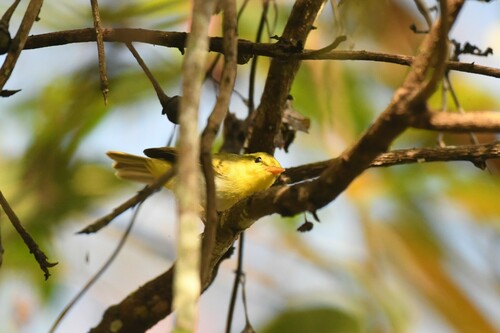
Dusky Warbler

Dusky Warbler

Phylloscopus fuscatus

Silhouette: Jiekun He · PhyloPic

LCLeast ConcernNTVUENCR
Daily sighting probability <5% · Rare
at Namdapha National Park

In 3 days <5% in a week ~10%

23 Verified sightings at Namdapha National Park From 2019 to 2026
1,006 In all 15 parks
October Best month
☀️ Diurnal When it's spotted

About the Dusky Warbler

The dusky warbler (Phylloscopus fuscatus) is a leaf warbler which breeds in the east Palearctic. The genus name Phylloscopus is from Ancient Greek phullon, "leaf", and skopos, "seeker" (from skopeo, "to watch"). The specific fuscatus is from Latin fuscus "dark".

This warbler is strongly migratory and winters in South Asia and South-east Asia. It sometimes occurs in North America in Alaska, and has also occurred in California. This is an abundant bird of taiga bogs and wet meadows. The nest is built low in a bush, and 5–6 eggs are laid. Like most Old World warblers, this small passerine is insectivorous.

The dusky warbler is prone to vagrancy as far as western Europe in October, despite a 3000 km distance from its breeding grounds. It has wintered in Great Britain. This is a warbler similar in size and shape to a chiffchaff. The adult has an unstreaked brown back and buff underparts. There is a prominent whitish supercilium, and the bill is fine and pointed. The sexes are identical, as with most warblers, but young birds are more olive-tinged above. Like most warblers, it is insectivorous, but will take other small food items, including berries.

The song is a monotonous whistle, and the call is a harsh check. The call is often the first clue that this typically skulking species is present, away from the breeding grounds. An individual of this locally rare species was detected in an urban park and later ringed in December 2025 in Porto, Portugal Wikipedia →

Sounds

Song0:18

China · 2025

© Bo Shunqi 薄顺奇 · XC1181333 · CC BY-NC-SA 4.0

Call0:23

China · 2026

© Peter Boesman · XC1147697 · CC BY-NC-ND 4.0

Subsong0:19

Mongolia · 2022

© Magnus Hellström · XC750804 · CC BY-NC-SA 4.0

Global Distribution

Parks Where Found

# Park Country Daily sighting probability
1 Gobi Gurvansaikhan National Park 🇲🇳 Mongolia
~20%
2 Kaziranga National Park 🇮🇳 India
~20%
3 Manas National Park 🇮🇳 India
~10%
4 Sundarbans National Park 🇮🇳 India
~10%
5 Cuc Phuong National Park 🇻🇳 Vietnam
<5%
6 Chitwan National Park 🇳🇵 Nepal
<5%
7 Royal Manas National Park 🇧🇹 Bhutan
<5%
8 Khao Yai National Park 🇹🇭 Thailand
<5%
9 Kaeng Krachan National Park 🇹🇭 Thailand
<5%
10 Cat Tien National Park 🇻🇳 Vietnam
<5%
11 Namdapha National Park 🇮🇳 India
<5%
12 Doi Inthanon National Park 🇹🇭 Thailand
<5%
13 Taroko National Park 🇹🇼 Taiwan
<5%
14 Keoladeo National Park 🇮🇳 India
<5%
15 Jim Corbett National Park 🇮🇳 India
<5%

Cities Where Found

# City Country Daily sighting probability
1 Xiuying District 🇨🇳 China
~40%
2 Quanzhou 🇨🇳 China
~30%
3 Tuen Mun 🇨🇳 China
~30%
4 Đà Nẵng 🇻🇳 Vietnam
~30%
5 Hanoi 🇻🇳 Vietnam
~30%
6 Jinan 🇨🇳 China
~20%
7 Nanchang 🇨🇳 China
~20%
8 Chattogram 🇧🇩 Bangladesh
~20%
9 Savar 🇧🇩 Bangladesh
~20%
10 Hong Kong 🇨🇳 China
~20%

Before you go

What are the chances of seeing a Dusky Warbler in Namdapha National Park?

Rare

Under 5% of wildlife watchers report a Dusky Warbler sighting in Namdapha National Park on a given day, based on 23 verified sightings from GBIF citizen-science data from 2019 to 2026. It is the 232nd most-seen of the 298 birds we can rate there. Over three days the chance rises to under 5%, and over a week to about 10%, if each day is a fresh chance.

When is the best time to see a Dusky Warbler in Namdapha National Park?

October

In that month about 20% of wildlife watchers report a Dusky Warbler in Namdapha National Park on a given day, against under 5% in November to May, the lowest months. June to September have too few records to rate.

What time of day is best to see a Dusky Warbler?

Between 10 am and 1 pm

Across all the parks we cover, that three-hour window holds the most Dusky Warbler sightings with a recorded time, and about 9 in 10 of them come between 6 am and 6 pm: it is a daytime animal.

Where does the Dusky Warbler sighting chance come from?

GBIF citizen-science records

It is estimated from how often the Dusky Warbler is recorded against all the birds logged in Namdapha National Park (23 verified sightings from 2019 to 2026), calibrated against known sighting rates. Figures are rounded to the nearest 10% because citizen-science data supports honest approximations, not decimals, and months with records from fewer than five people show "—". How it works.

← Back to Namdapha National Park