Levaillant's Cuckoo

Levaillant's Cuckoo

Clamator levaillantii

Silhouette: Nicolas Huet le Jeune and Jean-Gabriel Prêtre (vectorized by T. Michael Keesey) · PhyloPic

LCLeast ConcernNTVUENCR
Daily sighting probability <5% · Rare
at Niokolo-Koba National Park

In 3 days ~10% in a week ~20%

10 Verified sightings at Niokolo-Koba National Park From 2019 to 2026
2,185 In all 34 parks
September Best month
☀️ Diurnal When it's spotted

About the Levaillant's Cuckoo

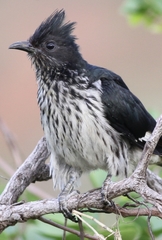
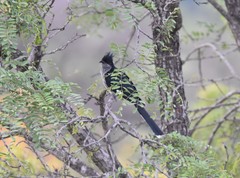
Levaillant's cuckoo (Clamator levaillantii) is a cuckoo which is a resident breeding species in Africa south of the Sahara. It is found in bushy habitats. It is a brood parasite, using the nests of bulbuls and babblers. It was named in honour of the French explorer, collector and ornithologist, François Le Vaillant.

The cuckoo is 37.5 cm (15 in) long, longer tailed than pied cuckoo, and with a more heavily streaked throat. There are two colour morphs. The light morph is black above, faintly glossed bluish or greenish. The throat streaking may extend on to the sides. The primaries and rectrix tips are white. The dark morph is black except for the white primary patch and white spots on the outer tail feathers (these are absent in dark pied cuckoo. The juvenile Levaillant's cuckoo is brown above, rufous on the wing-coverts and rectrix tips, with a buff forehead, face and underparts, and the throat more streaked. The call is a low ringing kuwu-weer, kuwu-weer... and an excited ku-wi-wi-wi.

Levaillant's cuckoo is a brood parasite and the female lays her eggs in the nest of another species of bird, typically the southern pied babbler (Turdoides bicolor... Wikipedia →

Sounds

Call0:22

Gambia · 2024

© Zsombor Károlyi · XC1163391 · CC BY-NC-SA 4.0

Song0:59

Burkina Faso · 2025

© Marc Languy · XC1010298 · CC BY-NC-SA 4.0

Call0:31

Gambia · 2018

© Peter Boesman · XC425558 · CC BY-NC-ND 4.0

Global Distribution

Parks Where Found

# Park Country Daily sighting probability
1 Lake Mburo National Park 🇺🇬 Uganda
~20%
2 Akagera National Park 🇷🇼 Rwanda
~10%
3 Mana Pools National Park 🇿🇼 Zimbabwe
~10%
4 Kruger National Park 🇿🇦 South Africa
~10%
5 Queen Elizabeth National Park 🇺🇬 Uganda
~10%
6 Virunga National Park 🇨🇩 Democratic Republic of the Congo
~10%
7 Ruaha National Park 🇹🇿 Tanzania
~10%
8 Bwindi Impenetrable National Park 🇺🇬 Uganda
~10%
9 Gonarezhou National Park 🇿🇼 Zimbabwe
~10%
10 Pilanesberg National Park 🇿🇦 South Africa
~10%
11 Hwange National Park 🇿🇼 Zimbabwe
~10%
12 Murchison Falls National Park 🇺🇬 Uganda
~10%
13 Moremi Game Reserve 🇧🇼 Botswana
~10%
14 Volcanoes National Park 🇷🇼 Rwanda
<5%
15 Kafue National Park 🇿🇲 Zambia
<5%
16 Tarangire National Park 🇹🇿 Tanzania
<5%
17 Chobe National Park 🇧🇼 Botswana
<5%
18 Liwonde National Park 🇲🇼 Malawi
<5%
19 Kibale National Park 🇺🇬 Uganda
<5%
20 Lake Manyara National Park 🇹🇿 Tanzania
<5%
21 Lower Zambezi National Park 🇿🇲 Zambia
<5%
22 South Luangwa National Park 🇿🇲 Zambia
<5%
23 Gorongosa National Park 🇲🇿 Mozambique
<5%
24 Kidepo Valley National Park 🇺🇬 Uganda
<5%
25 Niokolo-Koba National Park 🇸🇳 Senegal
<5%
26 Arusha National Park 🇹🇿 Tanzania
<5%
27 Ngorongoro Conservation Area 🇹🇿 Tanzania
<5%
28 Serengeti National Park 🇹🇿 Tanzania
<5%
29 Nairobi National Park 🇰🇪 Kenya
<5%
30 Tsavo West National Park 🇰🇪 Kenya
<5%
31 Nyungwe National Park 🇷🇼 Rwanda
<5%
32 Lake Nakuru National Park 🇰🇪 Kenya
<5%
33 Etosha National Park 🇳🇦 Namibia
<5%
34 Masai Mara National Reserve 🇰🇪 Kenya
<5%

Cities Where Found

# City Country Daily sighting probability
1 Ouagadougou 🇧🇫 Burkina Faso
~10%
2 Accra 🇬🇭 Ghana
~10%
3 Harare 🇿🇼 Zimbabwe
<5%
4 Maiduguri 🇳🇬 Nigeria
<5%
5 Kampala 🇺🇬 Uganda
<5%
6 Kigali 🇷🇼 Rwanda
<5%
7 Serrekunda 🇬🇲 Gambia
<5%

Before you go

What are the chances of seeing a Levaillant's Cuckoo in Niokolo-Koba National Park?

Rare

Under 5% of wildlife watchers report a Levaillant's Cuckoo sighting in Niokolo-Koba National Park on a given day, based on 10 verified sightings from GBIF citizen-science data from 2019 to 2026. It is the 194th most-seen of the 215 birds we can rate there. Over three days the chance rises to about 10%, and over a week to about 20%, if each day is a fresh chance.

When is the best time to see a Levaillant's Cuckoo in Niokolo-Koba National Park?

August and September

In those months about 20% of wildlife watchers report a Levaillant's Cuckoo in Niokolo-Koba National Park on a given day, against under 5% in January to April, the lowest months. Those are among Niokolo-Koba National Park's wettest months, with about 260 mm of rain a month against almost none in January. May–July and October have too few records to rate.

What time of day is best to see a Levaillant's Cuckoo?

Between 7 and 10 am

Across all the parks we cover, that three-hour window holds the most Levaillant's Cuckoo sightings with a recorded time, and about 9 in 10 of them come between 6 am and 6 pm: it is a daytime animal.

Is Niokolo-Koba National Park the best place to see a Levaillant's Cuckoo?

25th of 34

Of the 34 parks where we can rate Levaillant's Cuckoo sightings, Niokolo-Koba National Park ranks 25th at under 5%. The best odds are in Lake Mburo National Park (Uganda, about 20%), Akagera National Park (Rwanda, about 10%) and Mana Pools National Park (Zimbabwe, about 10%).

Which relatives of the Levaillant's Cuckoo live in Niokolo-Koba National Park?

Same family: Cuculidae

The closest relatives of the Levaillant's Cuckoo that you can see in Niokolo-Koba National Park (family Cuculidae, Cuckoos) are Senegal Coucal (about 70%) and Klaas's Cuckoo (about 20%), with each one's daily chance of a sighting.

Where does the Levaillant's Cuckoo sighting chance come from?

GBIF citizen-science records

It is estimated from how often the Levaillant's Cuckoo is recorded against all the birds logged in Niokolo-Koba National Park (10 verified sightings from 2019 to 2026), calibrated against known sighting rates. Figures are rounded to the nearest 10% because citizen-science data supports honest approximations, not decimals, and months with records from fewer than five people show "—". How it works.

← Back to Niokolo-Koba National Park