Greater Scaup

Greater Scaup

Aythya marila

Silhouette: Andy Wilson · PhyloPic

LCLeast ConcernNTVUENCR
Daily sighting probability <5% · Rare
at Olympic National Park

In 3 days ~10%

91 Verified sightings at Olympic National Park From 2019 to 2026
4,444 In all 31 parks
December Best month
☀️ Diurnal When it's spotted

About the Greater Scaup

The greater scaup (Aythya marila), just scaup in Europe or, colloquially, "bluebill" in North America, is a mid-sized diving duck, larger than the closely related lesser scaup and tufted duck. It spends the summer months breeding in Iceland, east across Scandinavia, northern Russia and Siberia, Alaska, and northern Canada. During the winter, it migrates south to the coasts of Europe, eastern Asia, and North America.

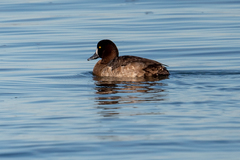
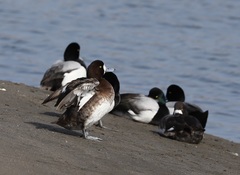
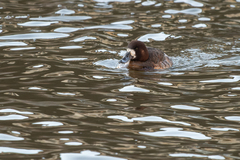
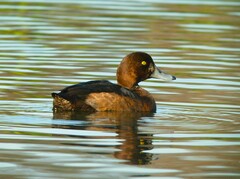
Male greater scaup average slightly larger than the females but with much overlap; they have a light blue-grey bill and yellow eyes. Their heads are dark, with a green to purple (depending on light angle) gloss; the breast is black, the belly white, the upperparts pale grey, and the wing shows a strong white stripe. The females are mostly brown, again with white on the wing. They have dull blue bills and a white patch on the face.

Greater scaup nest near water, typically on islands in northern lakes or on floating mats of vegetation. They begin breeding at age two, but start building nests in the first year. The drakes have a complex courtship, which takes place on the return migration to the summer breeding grounds and concludes with the formation of monogamous pairs. Females lay a clutch of six to nine olive-buff-coloured eggs. The eggs hatch in 24 to 28 days. The down-covered ducklings are able to follow their mother in her search for food immediately after hatching.

Greater scaup eat aquatic molluscs, plants, and insects, which they obtain by diving underwater to depths of 0.5–6 m, exceptionally 10 m. They form large groups, called "rafts", that can number in the thousands. Their main threat is human development, although they are also preyed upon by owls, skunks, raccoons, foxes, coyotes, and humans. Greater scaup populations have been declining since the 1980s; however, they are still listed as a species of least concern on the IUCN Red List. Wikipedia →

Sounds

Call0:11

United States · 2013

© Andrew Spencer · XC142583 · CC BY-NC-SA 3.0

Flight call0:10

Russian Federation · 2021

© Albert Lastukhin · XC674114 · CC BY-NC-ND 4.0

Alarm call1:28

Iceland · 2018

© Stanislas Wroza · XC487288 · CC BY-NC-SA 4.0

Global Distribution

Parks Where Found

# Park Country Daily sighting probability
1 Point Pelee National Park 🇨🇦 Canada
~10%
2 Wrangell-St. Elias National Park 🇺🇸 United States
~10%
3 Pacific Rim National Park Reserve 🇨🇦 Canada
~10%
4 Merritt Island National Wildlife Refuge 🇺🇸 United States
~10%
5 Great Bear Rainforest 🇨🇦 Canada
~10%
6 Kluane National Park 🇨🇦 Canada
~10%
7 Redwood National Park 🇺🇸 United States
~10%
8 Wadden Sea National Park 🇩🇪 Germany
<5%
9 Channel Islands National Park 🇺🇸 United States
<5%
10 Kenai Fjords National Park 🇺🇸 United States
<5%
11 Elk Island National Park 🇨🇦 Canada
<5%
12 Cape Breton Highlands National Park 🇨🇦 Canada
<5%
13 Katmai National Park 🇺🇸 United States
<5%
14 Denali National Park 🇺🇸 United States
<5%
15 Vatnajokull National Park 🇮🇸 Iceland
<5%
16 Nikko National Park 🇯🇵 Japan
<5%
17 Olympic National Park 🇺🇸 United States
<5%
18 Snowdonia National Park 🇬🇧 United Kingdom
<5%
19 Kiskunság National Park 🇭🇺 Hungary
<5%
20 Jasper National Park 🇨🇦 Canada
<5%
21 Padre Island National Seashore 🇺🇸 United States
<5%
22 Shenandoah National Park 🇺🇸 United States
<5%
23 El Vizcaíno Biosphere Reserve 🇲🇽 Mexico
<5%
24 Gros Morne National Park 🇨🇦 Canada
<5%
25 Acadia National Park 🇺🇸 United States
<5%
26 Camargue 🇫🇷 France
<5%
27 Yellowstone National Park 🇺🇸 United States
<5%
28 Grand Canyon National Park 🇺🇸 United States
<5%
29 Banff National Park 🇨🇦 Canada
<5%
30 Cairngorms National Park 🇬🇧 United Kingdom
<5%
31 Everglades National Park 🇺🇸 United States
<5%

Cities Where Found

# City Country Daily sighting probability
1 Anchorage 🇺🇸 United States
~50%
2 Ciudad Juárez 🇲🇽 México
~20%
3 Tokyo 🇯🇵 Japan
~10%
4 San Francisco 🇺🇸 United States
~10%
5 Toronto 🇨🇦 Canada
~10%
6 Nagoya 🇯🇵 Japan
~10%
7 Nizhny Novgorod 🇷🇺 Russia
~10%
8 Fukuoka 🇯🇵 Japan
<5%
9 Hiroshima 🇯🇵 Japan
<5%
10 Chicago 🇺🇸 United States
<5%

Zoos & Centres Where Found

# Zoo / Centre Country
1 Zoo Pilsen 🇨🇿 Czechia In captivity
2 Ecomuseum Zoo 🇨🇦 Canada In captivity
3 Columbus Zoo and Aquarium 🇺🇸 United States In captivity
4 Slimbridge Wetland Centre 🇬🇧 United Kingdom In captivity
5 Natur- und Tierpark Goldau 🇨🇭 Switzerland In captivity
6 Kunming Zoo 🇨🇳 China In captivity
7 Karlsruhe Zoo 🇩🇪 Germany In captivity
8 Cologne Zoological Garden 🇩🇪 Germany In captivity
9 Texas State Aquarium 🇺🇸 United States In captivity
10 Cologne Zoo Aquarium 🇩🇪 Germany In captivity
11 Les Oiseaux du Marais Poitevin 🇫🇷 France In captivity
12 Ogród zoologiczny w Lubinie 🇵🇱 Poland In captivity

Before you go

What are the chances of seeing a Greater Scaup in Olympic National Park?

Rare

Under 5% of wildlife watchers report a Greater Scaup sighting in Olympic National Park on a given day, based on 91 verified sightings from GBIF citizen-science data from 2019 to 2026. It is the 136th most-seen of the 216 birds we can rate there. Over three days the chance rises to about 10%, if each day is a fresh chance.

When is the best time to see a Greater Scaup in Olympic National Park?

March, October and December

In those months about 10% of wildlife watchers report a Greater Scaup in Olympic National Park on a given day, against under 5% in January–February, April–September and November, the lowest months.

What time of day is best to see a Greater Scaup?

Between noon and 3 pm

Across all the parks we cover, that three-hour window holds the most Greater Scaup sightings with a recorded time, and about 9 in 10 of them come between 6 am and 6 pm: it is a daytime animal.

Where does the Greater Scaup sighting chance come from?

GBIF citizen-science records

It is estimated from how often the Greater Scaup is recorded against all the birds logged in Olympic National Park (91 verified sightings from 2019 to 2026), calibrated against known sighting rates. Figures are rounded to the nearest 10% because citizen-science data supports honest approximations, not decimals, and months with records from fewer than five people show "—". How it works.

← Back to Olympic National Park