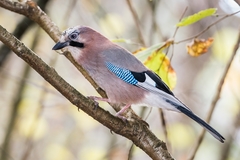
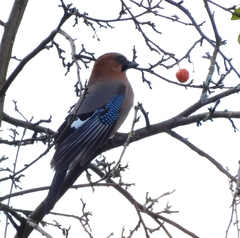
The Eurasian jay (Garrulus glandarius) is a species of passerine bird in the family Corvidae. It has pinkish brown plumage with a black stripe on each side of a whitish throat, a bright blue panel on the upper wing and a black tail. The Eurasian jay is a woodland bird that occurs over a vast region from western Europe and north-west Africa to the Indian subcontinent and farther to the eastern seaboard of Asia and down into south-east Asia. Across this vast range, several distinct racial forms have evolved which look different from each other, especially when comparing forms at the extremes of its range.
The Eurasian jay was formally described by the Swedish naturalist Carl Linnaeus in 1758 in the tenth edition of his Systema Naturae under the binomial name Corvus glandarius. Linnaeus specified the locality as "Europa" but this was restricted to Sweden by Ernst Hartert in 1903. The Eurasian jay is now one of three species placed in the genus Garrulus that was established in 1760 by the French zoologist Mathurin Jacques Brisson. The genus name Garrulus is a Latin word meaning "chattering", "babbling" or "noisy". The specific epithet glandarius is Latin meaning...