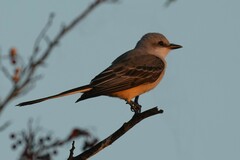

Scissor-tailed Flycatcher

Scissor-tailed Flycatcher

Tyrannus forficatus

Silhouette: PhyloPic

LCLeast ConcernNTVUENCR
Daily sighting probability <5% · Rare
at Padre Island National Seashore

In 3 days ~10%

27 Verified sightings at Padre Island National Seashore From 2019 to 2026
3,015 In all 19 parks
October Best month
☀️ Diurnal When it's spotted

About the Scissor-tailed Flycatcher

The scissor-tailed flycatcher (Tyrannus forficatus), known as swallow-tailed flycatcher or scissorstail, is a long-tailed insectivorous bird of the genus Tyrannus, whose members are collectively referred to as kingbirds. It is found in North and Central America, and is Oklahoma's State Bird.

The scissor-tailed flycatcher was formally described in 1789 by the German naturalist Johann Friedrich Gmelin in his revised and expanded edition of Carl Linnaeus's Systema Naturae. He placed it with the flycatchers in the genus Muscicapa and coined the binomial name Muscicapa forficata. The specific epithet is from Latin forfex, forficis meaning "a pair of scissors". Gmelin based his description on "Le moucherolle à queue fourchue du Mexique" (French: "the Mexican swallow-tailed flycatcher") that had been described in 1778 by the French polymath Comte de Buffon from a specimen from Mexico and illustrated with a hand-coloured engraving by François-Nicolas Martinet.

The scissor-tailed flycatcher is now one of 13 species placed in the kingbird genus Tyrannus that was introduced in 1799 by Bernard Germain de Lacépède. The species is monotypic: no subspecies are recognised. Within the... Wikipedia →

Sounds

Call0:19

Canada · 2024

© Sacha Balavoine · XC952633 · CC BY-NC-SA 4.0

Song1:16

United States · 2015

© Terry Davis · XC323788 · CC BY-NC-SA 4.0

Flight call0:09

United States · 2012

© Paul Marvin · XC161582 · CC BY-NC-SA 3.0

Global Distribution

Parks Where Found

# Park Country Daily sighting probability
1 Palo Verde National Park 🇨🇷 Costa Rica
~20%
2 Everglades National Park 🇺🇸 United States
~20%
3 Las Baulas Marine National Park 🇨🇷 Costa Rica
~10%
4 Point Pelee National Park 🇨🇦 Canada
~10%
5 Masaya Volcano National Park 🇳🇮 Nicaragua
~10%
6 Santa Rosa National Park 🇨🇷 Costa Rica
~10%
7 Ostional Wildlife Refuge 🇨🇷 Costa Rica
~10%
8 Rincón de la Vieja National Park 🇨🇷 Costa Rica
<5%
9 Cañón del Sumidero National Park 🇲🇽 Mexico
<5%
10 Cabo Blanco Absolute Nature Reserve 🇨🇷 Costa Rica
<5%
11 Carara National Park 🇨🇷 Costa Rica
<5%
12 Padre Island National Seashore 🇺🇸 United States
<5%
13 Manuel Antonio National Park 🇨🇷 Costa Rica
<5%
14 Big Cypress National Preserve 🇺🇸 United States
<5%
15 Celestún Biosphere Reserve 🇲🇽 Mexico
<5%
16 Big Bend National Park 🇺🇸 United States
<5%
17 Sian Ka'an Biosphere Reserve 🇲🇽 Mexico
<5%
18 Arenal Volcano National Park 🇨🇷 Costa Rica
<5%
19 Monteverde Cloud Forest Reserve 🇨🇷 Costa Rica
<5%

Cities Where Found

# City Country Daily sighting probability
1 San Antonio 🇺🇸 United States
~10%
2 Dallas 🇺🇸 United States
~10%
3 Managua 🇳🇮 Nicaragua
~10%
4 Austin 🇺🇸 United States
~10%
5 Montreal 🇨🇦 Canada
<5%
6 Houston 🇺🇸 United States
<5%
7 San Salvador 🇸🇻 El Salvador
<5%
8 San Pedro Sula 🇭🇳 Honduras
<5%
9 Monterrey 🇲🇽 México
<5%
10 Lima 🇵🇪 Peru
<5%

Zoos & Centres Where Found

# Zoo / Centre Country
1 National Aviary 🇺🇸 United States In captivity

Before you go

What are the chances of seeing a Scissor-tailed Flycatcher in Padre Island National Seashore?

Rare

Under 5% of wildlife watchers report a Scissor-tailed Flycatcher sighting in Padre Island National Seashore on a given day, based on 27 verified sightings from GBIF citizen-science data from 2019 to 2026. It is the 119th most-seen of the 171 birds we can rate there. Over three days the chance rises to about 10%, if each day is a fresh chance.

When is the best time to see a Scissor-tailed Flycatcher in Padre Island National Seashore?

October

In that month about 10% of wildlife watchers report a Scissor-tailed Flycatcher in Padre Island National Seashore on a given day, against under 5% in November to September, the lowest months.

What time of day is best to see a Scissor-tailed Flycatcher?

Between 8 and 11 am

Across all the parks we cover, that three-hour window holds the most Scissor-tailed Flycatcher sightings with a recorded time, and about 9 in 10 of them come between 6 am and 6 pm: it is a daytime animal.

Is Padre Island National Seashore the best place to see a Scissor-tailed Flycatcher?

12th of 19

Of the 19 parks where we can rate Scissor-tailed Flycatcher sightings, Padre Island National Seashore ranks 12th at under 5%. The best odds are in Palo Verde National Park (Costa Rica, about 20%), Everglades National Park (United States, about 20%) and Las Baulas Marine National Park (Costa Rica, about 10%).

Where does the Scissor-tailed Flycatcher sighting chance come from?

GBIF citizen-science records

It is estimated from how often the Scissor-tailed Flycatcher is recorded against all the birds logged in Padre Island National Seashore (27 verified sightings from 2019 to 2026), calibrated against known sighting rates. Figures are rounded to the nearest 10% because citizen-science data supports honest approximations, not decimals, and months with records from fewer than five people show "—". How it works.

← Back to Padre Island National Seashore