


Completed

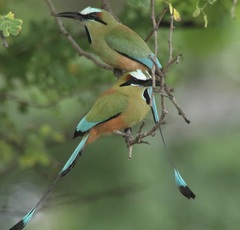

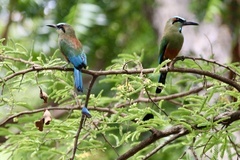


Turquoise-browed Motmot
Eumomota superciliosa
Silhouette: Sofía Terán Sánchez · PhyloPic
- KingdomAnimalia (Animals)
- PhylumChordata (Chordates)
- ClassAves (Birds)
- OrderCoraciiformes (Rollers, Kingfishers, and Allies)
- FamilyMomotidae (Motmots)
- GenusEumomota
- SpeciesEumomota superciliosa (Turquoise-browed Motmot)
In 3 days ~60% in a week ~90%
233 Verified sightings at Pico Bonito National Park From 2019 to 2026
10,128 In all 21 parks
October Best month
☀️ Diurnal When it's spotted
About the Turquoise-browed Motmot
The turquoise-browed motmot (Eumomota superciliosa) is a colourful, medium-sized bird of the motmot family, Momotidae. It is the only species in its genus Eumomota. It inhabits Central America from south-east Mexico (mostly the Yucatán Peninsula), to Costa Rica, where it is common and not considered threatened. It lives in fairly open habitats such as forest edge, gallery forest and scrubland. It has a preference for higher tree diversity and richness, alongside a low open canopy and dense understory. It also appears to prefer dry forest. This is in contrast to the other motmot known to inhabit the Yucatán, Lesson’s motmot, which prefers moist forest. As a result, their respective distributions allow ecologists to map the process of aridification induced by anthropogenic climate change. Some literature thus considers the turquoise-browed motmot to be a bioindicator.
The bird is 34 cm (13 in) long and weighs 65 g (2.3 oz). It has a mostly grey-blue body with a rufous back and belly. There is a bright blue strip above the eye and a blue-bordered black patch on the throat. The flight feathers and upperside of the tail are blue. The tips of the tail feathers are shaped like rackets and the bare feather shafts, also classified as wires, are longer than in other motmots. Although it is often said that motmots pluck the barbs off their tail to create the racketed shape, this is not true; the barbs are weakly attached and fall off due to abrasion with substrates and with routine preening.
To reproduce, they lay white eggs (3–6) in a long tunnel nest in an earth bank, or sometimes in a quarry or fresh-water well. However, if this is not available, they will transition to nesting in inaccessible limestone crevices in cenotes or caves. It excavates nesting sites in March to avoid the hotter temperatures. Females lay in 48 hour intervals with a lay time of 24-56 days and hatch time from 16-20 days depending on the bird's location. A shorter lay and hatch time is observed in more populated areas. Wikipedia →
Recent sightings of Turquoise-browed Motmot in Pico Bonito National Park
LIVEiNaturalistGlobal Distribution
Parks Where Found
| # | Park | Country | Daily sighting probability |
|---|---|---|---|
| 1 | Masaya Volcano National Park | 🇳🇮 Nicaragua | |
| 2 | Cerro Azul Meámbar National Park | 🇭🇳 Honduras | |
| 3 | Lago de Yojoa | 🇭🇳 Honduras | |
| 4 | Carara National Park | 🇨🇷 Costa Rica | |
| 5 | Ostional Wildlife Refuge | 🇨🇷 Costa Rica | |
| 6 | Rincón de la Vieja National Park | 🇨🇷 Costa Rica | |
| 7 | Cusuco National Park | 🇭🇳 Honduras | |
| 8 | Sian Ka'an Biosphere Reserve | 🇲🇽 Mexico | |
| 9 | El Triunfo | 🇲🇽 Mexico | |
| 10 | Pico Bonito National Park | 🇭🇳 Honduras | |
| 11 | Palo Verde National Park | 🇨🇷 Costa Rica | |
| 12 | Las Baulas Marine National Park | 🇨🇷 Costa Rica | |
| 13 | Santa Rosa National Park | 🇨🇷 Costa Rica | |
| 14 | Cabo Blanco Absolute Nature Reserve | 🇨🇷 Costa Rica | |
| 15 | Celestún Biosphere Reserve | 🇲🇽 Mexico | |
| 16 | Calakmul Biosphere Reserve | 🇲🇽 Mexico | |
| 17 | La Tigra National Park | 🇭🇳 Honduras | |
| 18 | Celaque National Park | 🇭🇳 Honduras | |
| 19 | Ría Lagartos Biosphere Reserve | 🇲🇽 Mexico | |
| 20 | Tenorio Volcano National Park | 🇨🇷 Costa Rica | |
| 21 | Monteverde Cloud Forest Reserve | 🇨🇷 Costa Rica |
Cities Where Found
| # | City | Country | Daily sighting probability |
|---|---|---|---|
| 1 | Tegucigalpa | 🇭🇳 Honduras | |
| 2 | San Salvador | 🇸🇻 El Salvador | |
| 3 | San Pedro Sula | 🇭🇳 Honduras | |
| 4 | Managua | 🇳🇮 Nicaragua | |
| 5 | Guatemala City | 🇬🇹 Guatemala | |
| 6 | San José | 🇨🇷 Costa Rica |
Zoos & Centres Where Found
| # | Zoo / Centre | Country | |
|---|---|---|---|
| 1 | Xcaret | 🇲🇽 Mexico |
Closest Relatives at Pico Bonito National Park


Before you go
What are the chances of seeing a Turquoise-browed Motmot in Pico Bonito National Park?
Possible
About 30% of wildlife watchers report a Turquoise-browed Motmot sighting in Pico Bonito National Park on a given day, based on 233 verified sightings from GBIF citizen-science data from 2019 to 2026. It is the 56th most-seen of the 271 birds we can rate there. Over three days the chance rises to about 60%, and over a week to about 90%, if each day is a fresh chance.
When is the best time to see a Turquoise-browed Motmot in Pico Bonito National Park?
September and October
In those months about 40% of wildlife watchers report a Turquoise-browed Motmot in Pico Bonito National Park on a given day, against about 20% in January–February and April–May, the lowest months.
What time of day is best to see a Turquoise-browed Motmot?
Between 7 and 10 am
Across all the parks we cover, that three-hour window holds the most Turquoise-browed Motmot sightings with a recorded time, and about 9 in 10 of them come between 6 am and 6 pm: it is a daytime animal.
Is Pico Bonito National Park the best place to see a Turquoise-browed Motmot?
10th of 21
Of the 21 parks where we can rate Turquoise-browed Motmot sightings, Pico Bonito National Park ranks 10th at about 30%. The best odds are in Masaya Volcano National Park (Nicaragua, about 60%), Cerro Azul Meámbar National Park (Honduras, about 40%) and Lago de Yojoa (Honduras, about 40%). All parks ranked.
Which relatives of the Turquoise-browed Motmot live in Pico Bonito National Park?
Same family: Momotidae
The closest relatives of the Turquoise-browed Motmot that you can see in Pico Bonito National Park (family Momotidae, Motmots) are Lesson's Motmot (about 50%), Keel-billed Motmot (about 10%) and Tody Motmot (about 10%), with each one's daily chance of a sighting.
Where does the Turquoise-browed Motmot sighting chance come from?
GBIF citizen-science records
It is estimated from how often the Turquoise-browed Motmot is recorded against all the birds logged in Pico Bonito National Park (233 verified sightings from 2019 to 2026), calibrated against known sighting rates. Figures are rounded to the nearest 10% because citizen-science data supports honest approximations, not decimals, and months with records from fewer than five people show "—". How it works.
