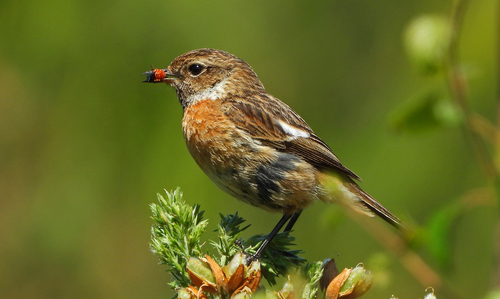
Rufous-tailed Rock-Thrush

Rufous-tailed Rock-Thrush

Monticola saxatilis

Silhouette: Martin Bulla, based on François Desbordes' illustration · PhyloPic

LCLeast ConcernNTVUENCR
Daily sighting probability ~10% · With luck
at Picos de Europa National Park

In 3 days ~40% in a week ~70%

154 Verified sightings at Picos de Europa National Park From 2019 to 2026
1,623 In all 26 parks
June Best month
☀️ Diurnal When it's spotted

About the Rufous-tailed Rock-Thrush

The common rock thrush (Monticola saxatilis), also known as the rufous-tailed rock thrush or simply rock thrush, is a species of chat that breeds in southern Europe across Central Asia to northern China. This species is strongly migratory, all populations wintering in Africa south of the Sahara. It is an uncommon visitor to northern Europe. Its range has contracted somewhat at the periphery in recent decades due to habitat destruction. For example, in the early 20th century it bred in the Jura Krakowsko-Częstochowska (Poland) where none occur today, but it is not considered globally endangered. Wikipedia →

Sounds

Song0:30

Mongolia · 2025

© Ding Li Yong · XC1002372 · CC BY-NC-ND 4.0

Call0:13

Spain · 2021

© Santiago Caballero Carrera · XC660711 · CC BY-NC-SA 4.0

Begging call0:27

Austria · 2020

© Leander Khil · XC579206 · CC BY-NC-SA 4.0

Global Distribution

Parks Where Found

# Park Country Daily sighting probability
1 Gobi Gurvansaikhan National Park 🇲🇳 Mongolia
~30%
2 Tsavo West National Park 🇰🇪 Kenya
~20%
3 Ordesa y Monte Perdido National Park 🇪🇸 Spain
~20%
4 Picos de Europa National Park 🇪🇸 Spain
~10%
5 Tsavo East National Park 🇰🇪 Kenya
~10%
6 Vanoise National Park 🇫🇷 France
~10%
7 Aigüestortes National Park 🇪🇸 Spain
~10%
8 Mercantour National Park 🇫🇷 France
~10%
9 Awash National Park 🇪🇹 Ethiopia
~10%
10 Mkomazi National Park 🇹🇿 Tanzania
~10%
11 Samburu National Reserve 🇰🇪 Kenya
~10%
12 Ecrins National Park 🇫🇷 France
~10%
13 Cévennes National Park 🇫🇷 France
~10%
14 Meru National Park 🇰🇪 Kenya
~10%
15 Pyrénées National Park 🇫🇷 France
<5%
16 Sierra de Guadarrama National Park 🇪🇸 Spain
<5%
17 Serengeti National Park 🇹🇿 Tanzania
<5%
18 Nairobi National Park 🇰🇪 Kenya
<5%
19 Sierra Nevada National Park 🇪🇸 Spain
<5%
20 Tarangire National Park 🇹🇿 Tanzania
<5%
21 Ngorongoro Conservation Area 🇹🇿 Tanzania
<5%
22 Lake Nakuru National Park 🇰🇪 Kenya
<5%
23 Amboseli National Park 🇰🇪 Kenya
<5%
24 Masai Mara National Reserve 🇰🇪 Kenya
<5%
25 Doñana National Park 🇪🇸 Spain
<5%
26 Wadden Sea National Park 🇩🇪 Germany
<5%

Cities Where Found

# City Country Daily sighting probability
1 Jodhpur 🇮🇳 India
<5%
2 Doha 🇶🇦 Qatar
<5%
3 Abu Dhabi 🇦🇪 United Arab Emirates
<5%
4 Tel Aviv 🇮🇱 Israel
<5%

Before you go

What are the chances of seeing a Rufous-tailed Rock-Thrush in Picos de Europa National Park?

With luck

About 10% of wildlife watchers report a Rufous-tailed Rock-Thrush sighting in Picos de Europa National Park on a given day, based on 154 verified sightings from GBIF citizen-science data from 2019 to 2026. It is the 48th most-seen of the 112 birds we can rate there. Over three days the chance rises to about 40%, and over a week to about 70%, if each day is a fresh chance.

When is the best time to see a Rufous-tailed Rock-Thrush in Picos de Europa National Park?

June–July and September

In those months about 20% of wildlife watchers report a Rufous-tailed Rock-Thrush in Picos de Europa National Park on a given day, against under 5% in March and October, the lowest months.

What time of day is best to see a Rufous-tailed Rock-Thrush?

Between 2 and 5 pm

Across all the parks we cover, that three-hour window holds the most Rufous-tailed Rock-Thrush sightings with a recorded time, and about 9 in 10 of them come between 6 am and 6 pm: it is a daytime animal.

Where does the Rufous-tailed Rock-Thrush sighting chance come from?

GBIF citizen-science records

It is estimated from how often the Rufous-tailed Rock-Thrush is recorded against all the birds logged in Picos de Europa National Park (154 verified sightings from 2019 to 2026), calibrated against known sighting rates. Figures are rounded to the nearest 10% because citizen-science data supports honest approximations, not decimals, and months with records from fewer than five people show "—". How it works.

← Back to Picos de Europa National Park