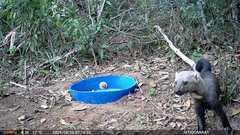
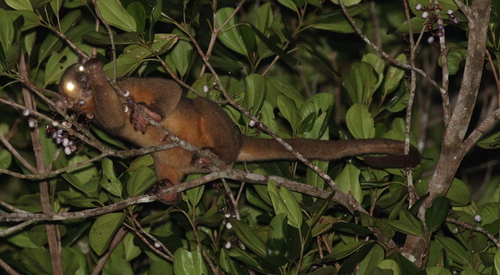
Tayra

Tayra

Eira barbara

Silhouette: Margot Michaud · PhyloPic

LCLeast ConcernNTVUENCR
Daily sighting probability ~20% · Possible
at Piedras Blancas National Park

In 3 days ~60% in a week ~90%

18 Verified sightings at Piedras Blancas National Park From 2019 to 2026
156 In all 15 parks
December Best month
☀️ Diurnal When it's spotted

About the Tayra

The tayra (Eira barbara) is an omnivorous animal from the mustelid family, native to the Americas. It is the only species in the genus Eira. Tayras are also known as the tolomuco or perico ligero in Central America, motete in Honduras, irara in Brazil, san hol or viejo de monte in the Yucatan Peninsula, and high-woods dog (or historically chien bois) in Trinidad. The genus name Eira is derived from the indigenous name of the animal in Bolivia and Peru, while barbara means "strange" or "foreign".

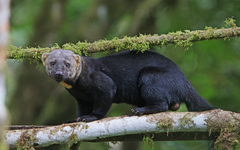
Tayras are long, agile mustelids, similar in appearance to a large fisher or marten, but slightly more reminiscent of a sleeker, smaller wolverine. They range from 56 to 71 cm (22 to 28 in) in length, not including their 37- to 46-cm-long (15 to 18 in) bushy tail, and weigh 2.7 to 7.0 kg (6.0 to 15.4 lb). Males are larger and slightly more muscular than females. They have short, dark brown to black fur, which is relatively uniform in length and color across the body, limbs, and tail—except for a yellowish or orange "heart"-shaped spot on the chest. Each tayra's chest patch is unique in color, shape and size, and thus may be used by biologists, rescuers and other specialists... Wikipedia →

Global Distribution

Parks Where Found

# Park Country Daily sighting probability
1 Itatiaia National Park 🇧🇷 Brazil
~30%
2 Piedras Blancas National Park 🇨🇷 Costa Rica
~20%
3 Calakmul Biosphere Reserve 🇲🇽 Mexico
~10%
4 Tenorio Volcano National Park 🇨🇷 Costa Rica
~10%
5 Braulio Carrillo National Park 🇨🇷 Costa Rica
~10%
6 Manu National Park 🇵🇪 Peru
~10%
7 Tambopata National Reserve 🇵🇪 Peru
~10%
8 Yasuní National Park 🇪🇨 Ecuador
~10%
9 Corcovado National Park 🇨🇷 Costa Rica
~10%
10 Arenal Volcano National Park 🇨🇷 Costa Rica
~10%
11 Carara National Park 🇨🇷 Costa Rica
~10%
12 Monteverde Cloud Forest Reserve 🇨🇷 Costa Rica
~10%
13 Soberanía National Park 🇵🇦 Panama
~10%
14 Iguazú National Park 🇦🇷 Argentina
~10%
15 Tapantí-Macizo de la Muerte National Park 🇨🇷 Costa Rica
~10%

Zoos & Centres Where Found

# Zoo / Centre Country
1 Prague Zoo 🇨🇿 Czechia In captivity
2 Parque das Aves 🇧🇷 Brazil In captivity
3 Ostrava Zoo 🇨🇿 Czechia In captivity
4 Auto Safari Chapin 🇬🇹 Guatemala In captivity
5 Parque Municipal Summit 🇵🇦 Panama In captivity
6 Parque Zoologico Guátika 🇨🇴 Colombia In captivity
7 Joya Grande 🇭🇳 Honduras In captivity
8 Ukumarí Biopark 🇨🇴 Colombia In captivity
9 Zoológico de Goiânia 🇧🇷 Brazil In captivity
10 Gramado Zoo 🇧🇷 Brazil In captivity
11 Parque Zoobotânico Getúlio Vargas 🇧🇷 Brazil In captivity
12 Parque Zoobotânico Arruda Câmara (BICA) 🇧🇷 Brazil In captivity
13 Bioparque Municipal Vesty Pakos 🇧🇴 Bolivia In captivity
14 Krakow Zoo 🇵🇱 Poland In captivity
15 Parque Ecológico de São Carlos 🇧🇷 Brazil In captivity
16 Bauru Zoo 🇧🇷 Brazil In captivity
17 Bioparque Los Ocarros 🇨🇴 Colombia In captivity
18 Pyrénées Animal Park 🇫🇷 France In captivity
19 Zoo. La Isla del Tapir 🇪🇨 Ecuador In captivity
20 Dierenpark Zie-ZOO 🇳🇱 Netherlands In captivity
21 Heritage Park Zoological Sanctuary 🇺🇸 United States In captivity
22 Papiliorama 🇨🇭 Switzerland In captivity
23 Buenaventura Zoo 🇵🇦 Panama In captivity
24 Ecozoológico San Martín 🇪🇨 Ecuador In captivity
25 Zoo El Pantanal 🇪🇨 Ecuador In captivity
26 Zoologico Mundo Andino - Tipon 🇵🇪 Peru In captivity
27 zoologico de barranquilla 🇨🇴 Colombia In captivity
28 Agroflori Parque de las Aves 🇧🇴 Bolivia In captivity
29 Rákosův pavilon 🇨🇿 Czechia In captivity
30 Velemlokárium 🇨🇿 Czechia In captivity
31 Amazon Rescue Center 🇵🇪 Peru In captivity
32 National Zoo of Nicaragua 🇳🇮 Nicaragua In captivity
33 Wiwa Quito 🇪🇨 Ecuador In captivity
34 Zoológico Miguél Álvarez del Toro 🇲🇽 Mexico In captivity

Before you go

What are the chances of seeing a Tayra in Piedras Blancas National Park?

Possible

About 20% of wildlife watchers report a Tayra sighting in Piedras Blancas National Park on a given day, based on 18 verified sightings from GBIF citizen-science data from 2019 to 2026. It is the 12th most-seen of the 21 mammals we can rate there. Over three days the chance rises to about 60%, and over a week to about 90%, if each day is a fresh chance.

When is the best time to see a Tayra in Piedras Blancas National Park?

July and December

In those months about 40% of wildlife watchers report a Tayra in Piedras Blancas National Park on a given day, against under 5% in January, May and September–October, the lowest months.

What time of day is best to see a Tayra?

Between 8 and 11 am

Across all the parks we cover, that three-hour window holds the most Tayra sightings with a recorded time, and about 9 in 10 of them come between 6 am and 6 pm: it is a daytime animal.

Is Piedras Blancas National Park the best place to see a Tayra?

2nd of 15

Of the 15 parks where we can rate Tayra sightings, Piedras Blancas National Park ranks 2nd at about 20%. The best odds are in Itatiaia National Park (Brazil, about 30%).

Which relatives of the Tayra live in Piedras Blancas National Park?

Same order: Carnivora

The closest relatives of the Tayra that you can see in Piedras Blancas National Park (order Carnivora, Carnivorans) are White-nosed Coati (about 50%), Common Raccoon (about 20%) and Kinkajou (about 20%), with each one's daily chance of a sighting.

Where does the Tayra sighting chance come from?

GBIF citizen-science records

It is estimated from how often the Tayra is recorded against all the mammals logged in Piedras Blancas National Park (18 verified sightings from 2019 to 2026), calibrated against known sighting rates. Figures are rounded to the nearest 10% because citizen-science data supports honest approximations, not decimals, and months with records from fewer than five people show "—". How it works.

← Back to Piedras Blancas National Park