Corn Bunting

Corn Bunting

Emberiza calandra

Silhouette: L. Shyamal · PhyloPic

LCLeast ConcernNTVUENCR
Daily sighting probability ~10% · With luck
at Plitvice Lakes National Park

In 3 days ~20% in a week ~30%

17 Verified sightings at Plitvice Lakes National Park From 2019 to 2026
5,812 In all 17 parks
June Best month
☀️ Diurnal When it's spotted

About the Corn Bunting

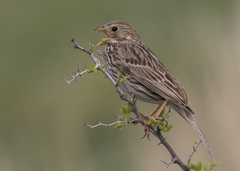
The corn bunting (Emberiza calandra) is a passerine bird in the bunting family Emberizidae, a group now separated by most modern authors from the finches, Fringillidae. This is a large bunting with heavily streaked buff-brown plumage. The sexes are similar but the male is slightly larger than the female. Its range extends from Western Europe and North Africa across to northwestern China.

The corn bunting was formally described by the Swedish naturalist Carl Linnaeus in 1758 in the tenth edition of his Systema Naturae and retains its original binomial name of Emberiza calandra. The type locality is Sweden. The genus name Emberiza is from Old German Embritz, a bunting. The specific calandra is from Ancient Greek kalandros, the calandra lark. The corn bunting has sometimes been placed in its own monotypic genus Miliaria.

Two subspecies are recognised: Wikipedia →

Sounds

Song0:36

Sweden · 2026

© Magnus Hellström · XC1141712 · CC BY-NC-SA 4.0

Call0:36

Italy · 2026

© Francesco Sottile · XC1092308 · CC BY-NC-SA 4.0

Aberrant0:18

Sweden · 2022

© Johan Willner · XC740155 · CC BY-NC-SA 4.0

Global Distribution

Parks Where Found

# Park Country Daily sighting probability
1 Monfragüe National Park 🇪🇸 Spain
~40%
2 Kiskunság National Park 🇭🇺 Hungary
~40%
3 Hortobágy National Park 🇭🇺 Hungary
~30%
4 Fertő-Hanság National Park 🇭🇺 Hungary
~30%
5 Camargue 🇫🇷 France
~20%
6 Doñana National Park 🇪🇸 Spain
~20%
7 Cévennes National Park 🇫🇷 France
~20%
8 Sierra Nevada National Park 🇪🇸 Spain
~20%
9 Białowieża National Park 🇵🇱 Poland
~10%
10 Biebrza National Park 🇵🇱 Poland
~10%
11 Plitvice Lakes National Park 🇭🇷 Croatia
~10%
12 Sierra de Guadarrama National Park 🇪🇸 Spain
~10%
13 Pyrénées National Park 🇫🇷 France
<5%
14 Aigüestortes National Park 🇪🇸 Spain
<5%
15 Wadden Sea National Park 🇩🇪 Germany
<5%
16 Picos de Europa National Park 🇪🇸 Spain
<5%
17 Bavarian Forest National Park 🇩🇪 Germany
<5%

Cities Where Found

# City Country Daily sighting probability
1 Sincan 🇹🇷 Turkey
~20%
2 Ramallah 🇵🇸 Palestine
~20%
3 Karaj 🇮🇷 Iran
~10%
4 Izmir 🇹🇷 Turkey
~10%
5 Berlin 🇩🇪 Germany
~10%
6 Almaty 🇰🇿 Kazakhstan
<5%
7 Jerusalem 🇮🇱 Israel
<5%
8 Rabat 🇲🇦 Morocco
<5%
9 Bucharest 🇷🇴 Romania
<5%
10 Madrid 🇪🇸 Spain
<5%

Zoos & Centres Where Found

# Zoo / Centre Country
1 Ogród Zoologiczny w Katowicach 🇵🇱 Poland In captivity

Before you go

What are the chances of seeing a Corn Bunting in Plitvice Lakes National Park?

With luck

About 10% of wildlife watchers report a Corn Bunting sighting in Plitvice Lakes National Park on a given day, based on 17 verified sightings from GBIF citizen-science data from 2019 to 2026. It is the 51st most-seen of the 76 birds we can rate there. Over three days the chance rises to about 20%, and over a week to about 30%, if each day is a fresh chance.

When is the best time to see a Corn Bunting in Plitvice Lakes National Park?

April to June

In those months about 10% of wildlife watchers report a Corn Bunting in Plitvice Lakes National Park on a given day, against under 5% in March and July–November, the lowest months. December to February have too few records to rate.

What time of day is best to see a Corn Bunting?

Between 7 and 10 am

Across all the parks we cover, that three-hour window holds the most Corn Bunting sightings with a recorded time, and about 7 in 10 of them come between 6 am and 6 pm: it is a daytime animal.

Where does the Corn Bunting sighting chance come from?

GBIF citizen-science records

It is estimated from how often the Corn Bunting is recorded against all the birds logged in Plitvice Lakes National Park (17 verified sightings from 2019 to 2026), calibrated against known sighting rates. Figures are rounded to the nearest 10% because citizen-science data supports honest approximations, not decimals, and months with records from fewer than five people show "—". How it works.

← Back to Plitvice Lakes National Park