Chaffinch

Chaffinch

Fringilla coelebs

Silhouette: Maxime Dahirel · PhyloPic

LCLeast ConcernNTVUENCR
Daily sighting probability ~90% · Very likely
at Plitvice Lakes National Park

In 3 days >90%

465 Verified sightings at Plitvice Lakes National Park From 2019 to 2026
35,518 In all 34 parks
September Best month
☀️ Diurnal When it's spotted

About the Chaffinch

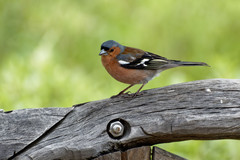
The Eurasian chaffinch, common chaffinch, or simply the chaffinch (Fringilla coelebs) is a common and widespread small passerine bird – in the finch family. The male is brightly coloured with a blue-grey cap and rust-red underparts. The female is more subdued in colouring, but both sexes have two contrasting white wing bars and white sides to the tail. The male bird has a strong voice and sings from exposed perches to attract a mate.

The chaffinch breeds in much of Europe, across the Palearctic to Siberia. The female builds a nest with a deep cup in the fork of a tree. The clutch is typically four or five eggs, which hatch in about 13 days. The chicks fledge in around 14 days, but are fed by both adults for several weeks after leaving the nest. Outside the breeding season, chaffinches form flocks in open countryside and forage for seeds on the ground. During the breeding season, they forage on trees for invertebrates, especially caterpillars, and feed these to their young. They are partial migrants; birds breeding in warmer regions are sedentary, while those breeding in the colder northern areas of their range winter further south.

The eggs and nestlings of the chaffinch are taken by a variety of mammalian and avian predators. Its large numbers and huge range mean that chaffinches are classed as of least concern by the International Union for Conservation of Nature. Wikipedia →

Sounds

Call0:18

Ukraine · 2026

© Taras Vykhovanets · XC1163567 · CC BY-NC-ND 4.0

Song1:17

France · 2026

© Olivier SWIFT · XC1151406 · CC BY-NC-SA 4.0

Imitation0:57

Italy · 2026

© Francesco Sottile · XC1145351 · CC BY-NC-SA 4.0

Global Distribution

Parks Where Found

# Park Country Daily sighting probability
1 Aoraki Mount Cook National Park 🇳🇿 New Zealand
~90%
2 Plitvice Lakes National Park 🇭🇷 Croatia
~90%
3 Arthur's Pass National Park 🇳🇿 New Zealand
~90%
4 Cairngorms National Park 🇬🇧 United Kingdom
~80%
5 Ecrins National Park 🇫🇷 France
~80%
6 Tatra National Park 🇸🇰 Slovakia
~80%
7 Białowieża National Park 🇵🇱 Poland
~80%
8 Triglav National Park 🇸🇮 Slovenia
~80%
9 Cévennes National Park 🇫🇷 France
~70%
10 Sierra Nevada National Park 🇪🇸 Spain
~70%
11 Fiordland National Park 🇳🇿 New Zealand
~70%
12 Mercantour National Park 🇫🇷 France
~70%
13 Aigüestortes National Park 🇪🇸 Spain
~70%
14 Sierra de Guadarrama National Park 🇪🇸 Spain
~70%
15 Ordesa y Monte Perdido National Park 🇪🇸 Spain
~70%
16 Pyrénées National Park 🇫🇷 France
~70%
17 Vanoise National Park 🇫🇷 France
~60%
18 Bavarian Forest National Park 🇩🇪 Germany
~60%
19 Picos de Europa National Park 🇪🇸 Spain
~60%
20 Monfragüe National Park 🇪🇸 Spain
~60%
21 Hohe Tauern National Park 🇦🇹 Austria
~60%
22 Biebrza National Park 🇵🇱 Poland
~60%
23 Abel Tasman National Park 🇳🇿 New Zealand
~60%
24 Snowdonia National Park 🇬🇧 United Kingdom
~50%
25 Gauja National Park 🇱🇻 Latvia
~40%
26 Fertő-Hanság National Park 🇭🇺 Hungary
~40%
27 Rakiura National Park 🇳🇿 New Zealand
~40%
28 Egmont National Park 🇳🇿 New Zealand
~40%
29 Kiskunság National Park 🇭🇺 Hungary
~30%
30 Wadden Sea National Park 🇩🇪 Germany
~30%
31 Doñana National Park 🇪🇸 Spain
~30%
32 Hortobágy National Park 🇭🇺 Hungary
~20%
33 Camargue 🇫🇷 France
~10%
34 Table Mountain National Park 🇿🇦 South Africa
~10%

Cities Where Found

# City Country Daily sighting probability
1 Mashhad 🇮🇷 Iran
~90%
2 Nizhny Novgorod 🇷🇺 Russia
~70%
3 Milan 🇮🇹 Italy
~60%
4 Moscow 🇷🇺 Russia
~60%
5 Turin 🇮🇹 Italy
~60%
6 Ankara 🇹🇷 Turkey
~60%
7 Vienna 🇦🇹 Austria
~60%
8 Istanbul 🇹🇷 Turkey
~60%
9 Paris 🇫🇷 France
~50%
10 Munich 🇩🇪 Germany
~50%

Zoos & Centres Where Found

# Zoo / Centre Country
1 Lusen National Park Centre 🇩🇪 Germany In captivity
2 Chișinău Zoo 🇲🇩 Moldova In captivity
3 Penza Zoo 🇷🇺 Russia In captivity
4 Stichting Dierenpark 🇳🇱 Netherlands In captivity
5 Zoo Hirschstetten 🇦🇹 Austria In captivity

Before you go

What are the chances of seeing a Chaffinch in Plitvice Lakes National Park?

Very likely

About 90% of wildlife watchers report a Chaffinch sighting in Plitvice Lakes National Park on a given day, based on 465 verified sightings from GBIF citizen-science data from 2019 to 2026. It is the most-seen of the 76 birds we can rate there. Over three days the chance rises to over 90%, if each day is a fresh chance.

When is the best time to see a Chaffinch in Plitvice Lakes National Park?

September

In that month over 90% of wildlife watchers report a Chaffinch in Plitvice Lakes National Park on a given day, against about 70% in November, the lowest month. December to February have too few records to rate.

What time of day is best to see a Chaffinch?

Between 3 and 6 pm

Across all the parks we cover, that three-hour window holds the most Chaffinch sightings with a recorded time, and about 9 in 10 of them come between 6 am and 6 pm: it is a daytime animal.

Is Plitvice Lakes National Park the best place to see a Chaffinch?

Among the best

Of the 34 parks where we can rate Chaffinch sightings, Plitvice Lakes National Park ranks 2nd at about 90%, level with the leaders once rounded. The best odds are in Aoraki Mount Cook National Park (New Zealand, about 90%). All parks ranked.

Which relatives of the Chaffinch live in Plitvice Lakes National Park?

Same family: Fringillidae

The closest relatives of the Chaffinch that you can see in Plitvice Lakes National Park (family Fringillidae, Finches, Euphonias, and Allies) are European Greenfinch (about 30%), Eurasian Goldfinch (about 30%) and Hawfinch (about 30%), with each one's daily chance of a sighting.

Where does the Chaffinch sighting chance come from?

GBIF citizen-science records

It is estimated from how often the Chaffinch is recorded against all the birds logged in Plitvice Lakes National Park (465 verified sightings from 2019 to 2026), calibrated against known sighting rates. Figures are rounded to the nearest 10% because citizen-science data supports honest approximations, not decimals, and months with records from fewer than five people show "—". How it works.

← Back to Plitvice Lakes National Park