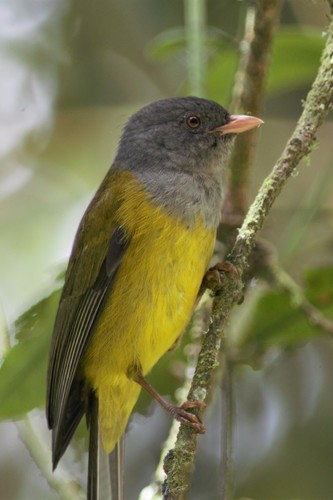
Magpie Tanager

Magpie Tanager

Cissopis leverianus

Silhouette: Sheatherius · PhyloPic

LCLeast ConcernNTVUENCR
Daily sighting probability <5% · Rare
at Podocarpus National Park

In 3 days <5% in a week ~10%

15 Verified sightings at Podocarpus National Park From 2019 to 2026
4,762 In all 12 parks
November Best month
☀️ Diurnal When it's spotted

About the Magpie Tanager

The magpie tanager (Cissopis leverianus) is a South American species of tanager. It is the only member of the monotypic genus Cissopis. As suggested by its common name, this blue-black and white species is superficially reminiscent of a European magpie. With a total length of 25–30 cm (9.8–11.8 in), a large percentage of which is tail, it is the longest species of tanager. It weighs 69–76 g (2.4–2.7 oz).

It is widespread in humid tropical and subtropical woodland, plantations, second growth, and parks in South America east of the Andes. It is absent from drier regions (such as the Caatinga) and most of north-eastern Brazil. In densely forested regions, it mainly occurs in relatively open sections (such as near major rivers). In such regions it is spreading with deforestation, which opens up the habitat. It is largely restricted to lowlands, but occurs up to an altitude of 2,000 m (6,600 ft) on the east Andean slopes. It is common throughout most of its range, but rarer in the Guianas.

It typically occurs in conspicuous, noisy pairs or groups of up to 10 individuals and commonly takes part in mixed-species flocks. It often moves its long tail up and down. It eats seeds, fruits, and insects. The cup-shaped nest is lined with grass, leaves, or other plant materials and is located low in trees near the ground or in shrubs in dense vegetation. The 2 eggs are reddish-brown with brown spots. The incubation time is 12–13 days in captivity. Wikipedia →

Sounds

Call1:10

Argentina · 2026

© Marcos E. Sosa · XC1142988 · CC BY-NC-SA 4.0

Song0:11

Brazil · 2024

© JAYRSON ARAUJO DE OLIVEIRA · XC944371 · CC BY-NC-SA 4.0

Flight call0:21

Ecuador · 1996

© John V. Moore · XC259760 · CC BY-NC-SA 4.0

Global Distribution

Parks Where Found

# Park Country Daily sighting probability
1 Iguazú National Park 🇦🇷 Argentina
~30%
2 Itatiaia National Park 🇧🇷 Brazil
~30%
3 Iguaçu National Park 🇧🇷 Brazil
~20%
4 Manu National Park 🇵🇪 Peru
~20%
5 Yasuní National Park 🇪🇨 Ecuador
~20%
6 Cuyabeno Wildlife Reserve 🇪🇨 Ecuador
~10%
7 Tambopata National Reserve 🇵🇪 Peru
~10%
8 Sierra de la Macarena National Park 🇨🇴 Colombia
<5%
9 Serra da Canastra National Park 🇧🇷 Brazil
<5%
10 Chingaza National Natural Park 🇨🇴 Colombia
<5%
11 Podocarpus National Park 🇪🇨 Ecuador
<5%
12 Chapada dos Guimarães National Park 🇧🇷 Brazil
<5%

Cities Where Found

# City Country Daily sighting probability
1 Bogota 🇨🇴 Colombia
<5%

Zoos & Centres Where Found

# Zoo / Centre Country
1 Aviario Nacional de Colombia 🇨🇴 Colombia In captivity

Before you go

What are the chances of seeing a Magpie Tanager in Podocarpus National Park?

Rare

Under 5% of wildlife watchers report a Magpie Tanager sighting in Podocarpus National Park on a given day, based on 15 verified sightings from GBIF citizen-science data from 2019 to 2026. It is the 341st most-seen of the 446 birds we can rate there. Over three days the chance rises to under 5%, and over a week to about 10%, if each day is a fresh chance.

When is the best time to see a Magpie Tanager in Podocarpus National Park?

Any time of year

In every month with enough records, under 5% of wildlife watchers report a Magpie Tanager in Podocarpus National Park on a given day, so our monthly data shows no clear season.

What time of day is best to see a Magpie Tanager?

Between 7 and 10 am

Across all the parks we cover, that three-hour window holds the most Magpie Tanager sightings with a recorded time, and about 9 in 10 of them come between 6 am and 6 pm: it is a daytime animal.

Is Podocarpus National Park the best place to see a Magpie Tanager?

11th of 12

Of the 12 parks where we can rate Magpie Tanager sightings, Podocarpus National Park ranks 11th at under 5%. The best odds are in Iguazú National Park (Argentina, about 30%), Itatiaia National Park (Brazil, about 30%) and Iguaçu National Park (Brazil, about 20%).

Which relatives of the Magpie Tanager live in Podocarpus National Park?

Same family: Thraupidae

The closest relatives of the Magpie Tanager that you can see in Podocarpus National Park (family Thraupidae, Tanagers and Allies) are Lacrimose Mountain-Tanager (about 40%), Masked Flowerpiercer (about 40%) and Blue-necked Tanager (about 30%), with each one's daily chance of a sighting.

Where does the Magpie Tanager sighting chance come from?

GBIF citizen-science records

It is estimated from how often the Magpie Tanager is recorded against all the birds logged in Podocarpus National Park (15 verified sightings from 2019 to 2026), calibrated against known sighting rates. Figures are rounded to the nearest 10% because citizen-science data supports honest approximations, not decimals, and months with records from fewer than five people show "—". How it works.

← Back to Podocarpus National Park